Reinforcement learning (RL) has become a standard post-training method for diffusion models, but most RL objectives roll out the current policy at every iteration, and with a many-step sampler these rollouts typically dominate the cost of training. Few-step models cut this cost, yet they model an average velocity over an interval, whereas existing RL objectives are built for an instantaneous velocity with a many-step sampler. We adapt RL objectives to few-step models systematically in three phases, namely a transformation, a decomposition and an adaptation. The transformation to $x$-space expresses each objective we consider through a common policy prediction, at the clean end by default and at an explicitly marked level for transition or flow-map objectives, so that objectives stated over densities, velocities or rewards become comparable. The decomposition writes the gradient of each of these objectives as the sum of a self-regression toward a reference and a reward augmentation, so that a method reduces, at the gradient level, to a choice of anchors and weights. The adaptation computes each anchor from a few-step model at the end of its transport or along its tangent, with the instantaneous velocity recovered from the network itself or from an auxiliary network. This yields few-step versions of FlowGRPO, AWM, DiffusionNFT, DiffusionOPSD and ReFL in one modular codebase. In our experiments, reward-gradient-based methods are the most effective when the reward is differentiable and its gradient is affordable; otherwise DiffusionNFT-style methods generally reach high rewards in relatively few iterations despite a sometimes higher per-iteration cost. Extra inference steps show no systematic aggregate benefit in our experiments, although selected outputs visibly improve with two to four times as many sampling steps as in training.

This paper investigates developing real-world perception for active agents, proposes Gibson Environment for this purpose, and showcases a set of perceptual tasks learned therein.
F. Xia, Amir Zamir, Zhi-Yang He et al.· 2018 IEEE/CVF Conference on...· 1,069 citations· ⚡112
This publication proposes a definition and a classification of agile software development approaches and analyses ten software development methods that can be characterized as being "agile" against the defined criterion.
P. Abrahamsson, O. Salo, Jussi Ronkainen et al.· arXiv.org· 727 citations· ⚡54
The study shows that agile practices improve both informal and formal communication, but indicates that, in larger development situations involving multiple external stakeholders, a mismatch of adequate communication mechanisms can sometimes even hinder the communication.
M. Pikkarainen, Jukka Haikara, O. Salo et al.· Empirical Software Engineeri...· 401 citations· ⚡48
The results indicate that software engineering work practices are chosen opportunistically, adapted and configured to provide value under the constrains imposed by the startup context.
Nicolò Paternoster, Carmine Giardino, M. Unterkalmsteiner et al.· Information and Software Tec...· 394 citations· ⚡54
The possibility of inferring high-dimensional data inference in a model that consists of a prior and an auxiliary differentiable constraint given some additional information is considered, thereby allowing a range of potential applications in adapting models to new domains and tasks.
Alexandros Graikos, Esmeralda S. Whitammer, N. Jojic et al.· Neural Information Processin...· 316 citations· ⚡15
Related blog posts
MIT News · Artificial Intelligence· news.mit.eduOct 28, 2026
Professor Paris Smaragdis develops computers with superhuman hearing for applications like speech recognition, music understanding, and environmental monitoring.
Exploring how generative AI could make machine vision more accessible to businesses. The post GenEye in a Box: Making Machine Vision Something You Can Just Ask For appeared first on GPT-Lab.
Microsoft Research Blog· microsoft.comAug 11, 2026
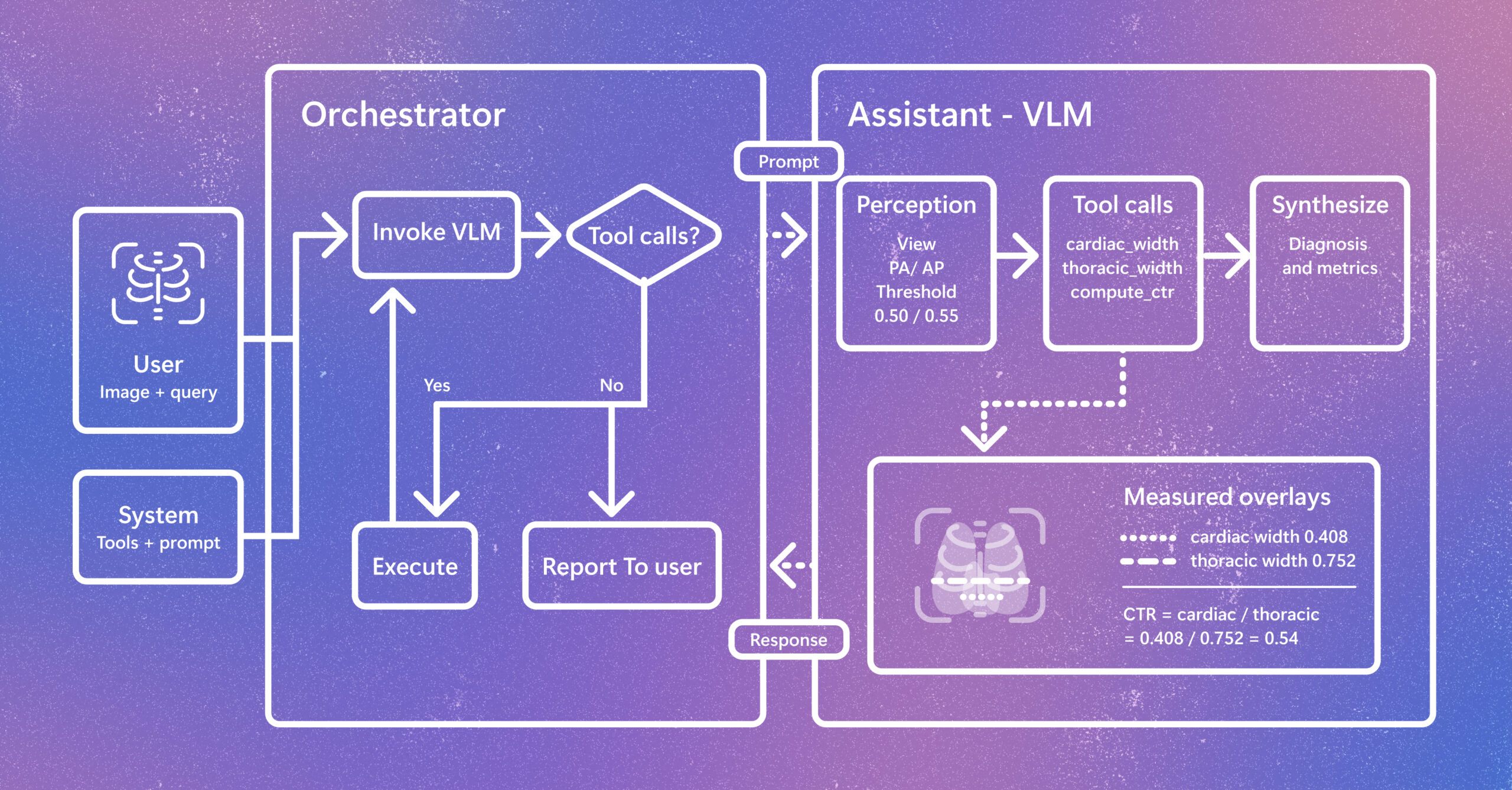
Radiology AI is evolving beyond report generation. CARE-X explores a unified approach that combines flexible reasoning, calibrated predictions, and measurement-based tools for chest X-ray interpretation. The post Introducing CARE-X: Towards Clinically Useful Radiology VLMs with Auxiliary Supervision, Reward-Aligned Learning, and Tool-Augmented Measurement appeared first on Microsoft Research.