We present TropicalCycloneNext (TC-Next), a multimodal deep learning model that forecasts tropical cyclone track and intensity at $6$-$24$ h leads by leveraging a foundation model's forecast fields of atmospheric kinematic and thermodynamic fields and GridSat infrared satellite imagery. Trained only on GraphCast forecasts over the Western Pacific (WP), yet reliant only on generic atmospheric variables, TC-Next on GraphCast lowers track error by $15$-$44\%$ and intensity error by a factor of $3$-$6$ relative to a conventional, rule-based tracker, TempestExtremes; applied without retraining to the forecast fields of Pangu-Weather and IFS HRES, it stays ahead of TempestExtremes on both. Applied zero-shot to the generic weather fields of WeatherNext Cyclones on the 2025 WP season, TC-Next attains lower intensity error at every lead time, and lower or comparable track error, compared to that model's specialized direct tracker in a deterministic comparison. Our ablation studies show that our multimodal model is able to utilize the additional modality to improve performance in tracking errors at every lead time and in intensity prediction at longer lead times.
Data-driven machine-learning weather models now rival, and in some respects surpass, operational numerical weather prediction (NWP), yet no single model dominates across variables, pressure levels, lead times, or regions, and the marginal returns from developing ever-larger individual models are diminishing. We present...
FlowsNet is presented, an observation-based multisensor fusion model that learns directly from radar/rain gauge-analyzed precipitation, surface variables from ground stations, geostationary satellite imagery, and satellite-derived precipitation context and outperforms a leading extrapolation-based method and state-of-t...
Very short-range forecasting of 850-hPa winds over tropical urban-coastal regions remains challenging due to complex land-sea circulation, topography, and rapidly changing atmospheric conditions. This study compares a CNN/U-Net baseline and an encoder-decoder Convolutional Long Short-Term Memory (ConvLSTM) model for gr...
Gatot Andriyanto, A. Susanto, A. A. Waskita· Jurnal Informatika, Teknolog...· 0 citations
Precipitation nowcasting plays a critical role in early hazard warning, especially for rapidly evolving convective systems. This study proposes a radar-based deep learning model that combines convolutional neural networks (CNN) for spatial feature extraction, a recurrent spatiotemporal module (ConvLSTM) for image seque...
Hoai Van Tran, Thinh Van Gia Nguyen, Le Dinh Quyet et al.· VNU Journal of Science Earth...· 0 citations
Accurate cloud-cover forecasts are important for temperature prediction, radiation forecasting, and solar-power operations. Short-range forecasting methods can preserve observed cloud placement during the first forecast hours, but their skill decreases when cloud fields evolve through formation, dissipation and deforma...
Mikko Partio, Leila Hieta, Ossi Laine· 0 citations
The results suggest that bidirectional Vision 15 Mamba is a strong backbone for neural weather prediction — achieving better accuracy and growing computational efficiency, consistent with a more suitable spatial inductive bias for atmospheric modeling.
Jiayou Chao, Guan-Chao Tong, Zhenhua Liu et al.· 0 citations
Exploring how generative AI could make machine vision more accessible to businesses. The post GenEye in a Box: Making Machine Vision Something You Can Just Ask For appeared first on GPT-Lab.
Microsoft Research Blog· microsoft.comAug 11, 2026
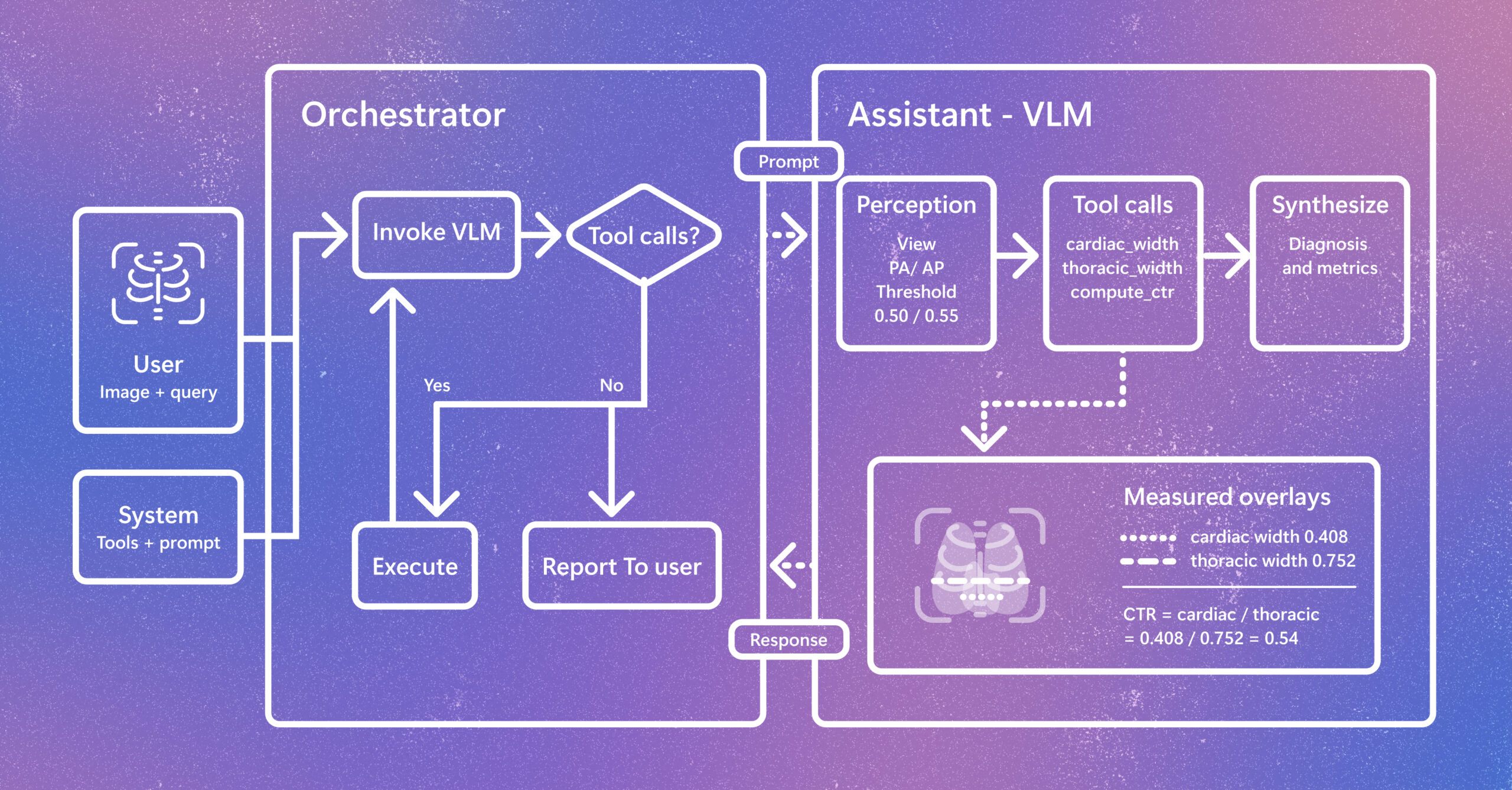
Radiology AI is evolving beyond report generation. CARE-X explores a unified approach that combines flexible reasoning, calibrated predictions, and measurement-based tools for chest X-ray interpretation. The post Introducing CARE-X: Towards Clinically Useful Radiology VLMs with Auxiliary Supervision, Reward-Aligned Learning, and Tool-Augmented Measurement appeared first on Microsoft Research.
Assistant Professor Benjamin Lindquist studies how engineers deliberately injected randomness into early AI, giving rise to deep-learning models that sometimes hallucinate.
We use cookies to run the site and, with your consent, for analytics and to show ads.
See our Cookie Policy.