A multi-source Masked Autoencoder (MAE) framework, named ProsMAE, for histopathology representation learning, which achieved a higher mean validation quadratic weighted kappa (QWK) than the vanilla MAE frozen linear-probe baseline under the evaluated disjoint PANDA split.
Abstract
Whole slide images (WSIs) provide rich diagnostic information for computational pathology, but their gigapixel scale, stain variation, scanner differences, tissue artifacts, and limited expert annotation make robust model training challenging. This paper presents a multi-source Masked Autoencoder (MAE) framework, named ProsMAE, for histopathology representation learning. Tiles from Prostate cANcer graDe Assessment (PANDA), CAncer MEtastases in LYmph nOdes challeNge 2017 (CAMELYON17), and BReAst Carcinoma Subtyping (BRACS) are used for ProsMAE pretraining to expose the encoder to diverse tissue morphology and acquisition conditions. The learned encoder is transferred for International Society of Urological Pathology (ISUP) grade classification through ProsCLS, using a frozen encoder and a linear classification head. ProsMAE achieved a higher mean validation quadratic weighted kappa (QWK) than the vanilla MAE frozen linear-probe baseline under the evaluated disjoint PANDA split. Repeated-split evaluation remains necessary to further establish robustness across split compositions.

Foundation models trained on large pathology image corpora now provide strong, transferable representations for computational pathology. Over the past few years a series of such models has been released, each trained on more slides than the last; on standard classification and segmentation benchmarks, the leading model...
Zhi Li, E. Amidi, Ya-Ting Cheng et al.· 0 citations
Background/Objectives: Cutaneous melanoma caused over 331,000 new cases and 58,000 deaths worldwide in 2022, with five-year survival falling from 99.4% in localised disease to 35.6% after distant metastasis. Most dermoscopic deep learning studies report headline accuracy without addressing data leakage, calibration, or...
Abdulvahap Pınar, F. H. Yagin, Cemil Çolak et al.· Journal of Clinical Medicine· 0 citations
Breast cancer diagnosis from histopathology images is accurate but labor-intensive and subject to interobserver variability. Deep learning has shown strong performance on digital pathology benchmarks; however, limited transparency, magnification variability, and patient-level data leakage can reduce clinical trust and...
Sittichat Mekwan, Buntueng Yana, Ratsada Praphasawat et al.· ECTI Transactions on Compute...· 0 citations
MagViT, an interpretable multi-magnification transformer framework with scale-gated fusion and patient-level model selection, is presented, an interpretable multi-magnification transformer framework with scale-gated fusion and patient-level model selection relative to prior ViT-centered BreakHis work.
Nabil Ashab, Soumitra Kundu, Saif Mahmud Parvez et al.· 0 citations
CRAFT (Coarse-to-fine Region-Adaptive Feature Tokenization), a DINO-based framework that learns image-dependent mixed-scale representations by using self-supervised attention to selectively refine informative regions while preserving coarse context, together with a symmetric cross-scale regularization objective that en...
Anabel Stammer, Valay Bundele, Mehran Hosseinzadeh et al.· 0 citations
BACKGROUND
Head and neck squamous cell carcinoma (HNSCC) is a common malignancy with increasing incidence. Histopathological assessment remains the diagnostic gold standard, but is labor-intensive and affected by a growing shortage of specialized pathologists. Limited availability of annotated data poses a major challe...
Till Nicke, Fleming Wolf-Eli Michelsen, J. Schäfer et al.· Journal of Oral Pathology &...· 0 citations
Exploring how generative AI could make machine vision more accessible to businesses. The post GenEye in a Box: Making Machine Vision Something You Can Just Ask For appeared first on GPT-Lab.
Microsoft Research Blog· microsoft.comAug 11, 2026
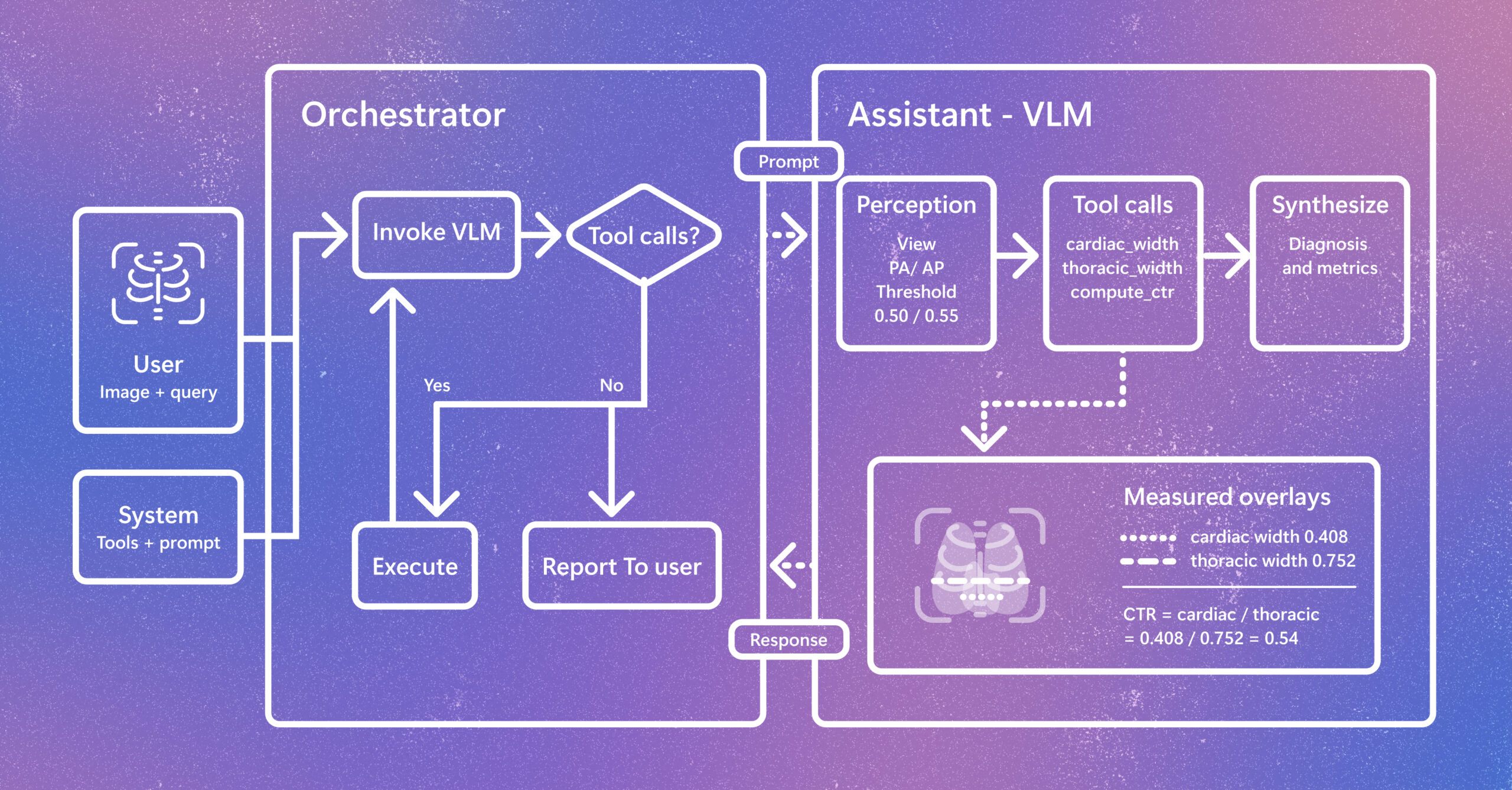
Radiology AI is evolving beyond report generation. CARE-X explores a unified approach that combines flexible reasoning, calibrated predictions, and measurement-based tools for chest X-ray interpretation. The post Introducing CARE-X: Towards Clinically Useful Radiology VLMs with Auxiliary Supervision, Reward-Aligned Learning, and Tool-Augmented Measurement appeared first on Microsoft Research.