Evidence-Gated Regularization (EGR) is proposed, a modality-agnostic training objective that introduces zero inference-time overhead and derives a per-frame and per-sensor task-relevance signal to gate two state-conditional consistency objectives: invariance on low-evidence sensors, and single-sensor sufficiency on high-evidence ones.
Abstract
Vision-Language-Action (VLA) policies fuse multimodal sensory inputs, but training on limited and homogeneous robot demonstrations encourages spurious inter-sensor correlations rather than task-relevant signal, a failure we term modality entanglement. Under real-world occlusions and distractors, this manifests as nuisance sensitivity to corruption of uninformative sensors and single-modality insufficiency when only one informative sensor remains intact. We propose Evidence-Gated Regularization (EGR), a modality-agnostic training objective that introduces zero inference-time overhead. EGR derives a per-frame and per-sensor task-relevance signal to gate two state-conditional consistency objectives: invariance on low-evidence sensors, and single-sensor sufficiency on high-evidence ones. We introduce a benchmark based on BEHAVIOR-1K, comprising a fast inference-only diagnostic suite and 47 rollout-based skills targeting modality entanglement. We validate EGR on this benchmark and on two real-robot setups with fundamentally different embodiments: a bi-manual setup with two Kinova arms and three RGB cameras, and a single-arm MELFA ASSISTA setup combining vision and GelSight tactile sensors. EGR improves simulation success rates (SR) from 12.5% to 16.4% under full modalities (+31%), from 9.4% to 16.5% under uninformative-sensor corruption (+75%), and from 2.8% to 6.1% under single-sensor fallback (+120%). Under physical-object distractors, EGR boosts SR from 30% to 85% on the bi-manual setup (+183%) and from 55% to 70% on the tactile setup (+27%).

Vision-Language-Action (VLA) models have achieved remarkable advances in robotic manipulation, yet their zero-shot generalization under out-of-distribution (OOD) conditions remains limited. These models often entangle task-relevant invariant structure with environment-specific non-invariant factors, causing policies to...
Ping-Rui Zhang, Yu Zhang, Peng-Yuan Wu et al.· 0 citations
Similar to humans, robots benefit from multiple sensing modalities when performing complex manipulation tasks. Current behavior cloning (BC) policies typically fuse learned observation embeddings from multimodal inputs before decoding them into actions. This approach suffers from two key limitations: 1) it requires all...
Vaibhav Saxena, Yun-Hao Luo, Yotto Koga et al.· IEEE Robotics and Automation...· 0 citations
The Modality Masking Mechanism (M3), an embarrassingly simple, training-only strategy that requires no architectural changes or large-scale robot pretraining, is introduced to improve robustness of query-based VLA policies for bimanual manipulation.
Dong-Zhou Cheng, Ziang Li, Yixiao Zhou et al.· 1 citation
ViTaR is introduced, which reframes tactile feedback from an action-generating perceptual input to an execution modulator that selects and scales bounded residual corrections atop a frozen VLA, preserving pretrained capabilities by construction.
Yi Wang, Ren-Jun Wu, Jin-Yan Liu et al.· 0 citations
Perturbot and GroundingFscore provide a training-and-evaluation framework for disentangling VLA decisions from shortcut priors while preserving responsiveness to task-relevant evidence.
Ming-Yu Liu, Chong-Hao Sima, Tianjian Feng et al.· 1 citation
Vision-language-action (VLA) models have driven rapid progress in robotic manipulation, demonstrating strong fine-grained control and promising performance on long-horizon tasks. However, many existing VLAs lack explicit access to interaction history, making them vulnerable to perceptual aliasing: similar current obser...
Ya-Xin Zhao, Dian-Ye Huang, Chen-Wei Wang et al.· 0 citations
Exploring how generative AI could make machine vision more accessible to businesses. The post GenEye in a Box: Making Machine Vision Something You Can Just Ask For appeared first on GPT-Lab.
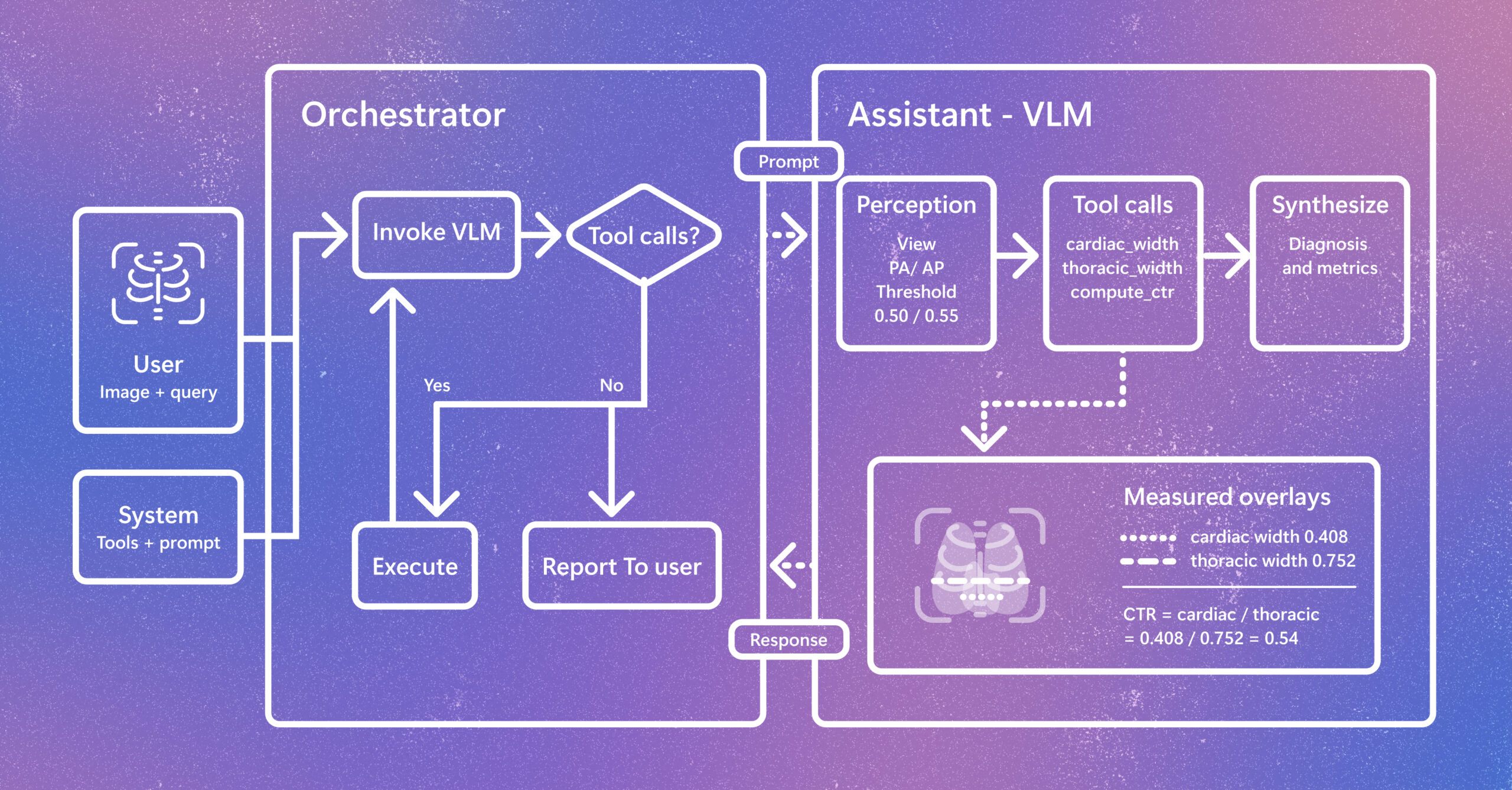
Radiology AI is evolving beyond report generation. CARE-X explores a unified approach that combines flexible reasoning, calibrated predictions, and measurement-based tools for chest X-ray interpretation. The post Introducing CARE-X: Towards Clinically Useful Radiology VLMs with Auxiliary Supervision, Reward-Aligned Learning, and Tool-Augmented Measurement appeared first on Microsoft Research.