CoverPruner is proposed, a training-free pruner that asks the complementary demand-side question: after a token is removed, which surviving original token represents it for the target VLM?
Abstract
Visual token pruning reduces the inference cost of vision-language models (VLMs), but most methods only ask which tokens to keep. This retained-token view can keep redundant high-scoring tokens while leaving discarded evidence without a close representative. We propose CoverPruner, a training-free pruner that asks the complementary demand-side question: after a token is removed, which surviving original token represents it for the target VLM? CoverPruner formulates pruning as Representational Coverage Maximization (RCM), covering the full projected visual-token set with query-weighted demand. It instantiates RCM with projector-space coverage and a lightweight first-layer attention probe. Across multiple VLM architectures and compression rates, CoverPruner achieves the best average accuracy among all compared methods, with the largest gains usually appearing under aggressive compression.
Experiments on FastVLM-1.5B across multiple vision-language benchmarks demonstrate that VPRune achieves a favorable accuracy--compression trade-off, with particularly pronounced advantages under aggressive compression, demonstrating its practicality for resource-constrained LVLM deployment.
QCPruner fuses two cross-modal cues into utility and applies it to both visual targets and candidate representatives within visual-affinity-based coverage, which achieves the highest average relative performance among evaluated complete-system pruning methods at every reported token budget.
Sheng-Li He, Yong-Chao Liang, Rou-Meng He et al.· 1 citation· ⚡1
S$^2$Prune is proposed, a training-free pruning method that preserves spatial coverage while adapting token density to local image structure and achieves the highest average accuracy among the evaluated training-free pruning methods.
StackTok is introduced, a training-free selector that treats query relevance as the objective and visual coverage as budget-calibrated support in vision-language models and ranks first among training-free selectors in every tested model--budget setting.
Zhen-Bin Wang, Lei Zhang, Li-Tuan Wang et al.· 0 citations
ProViP is proposed, a training-free progressive visual token pruning framework that removes redundant visual tokens based on the embedding similarity of input tokens before reasoning of the LLM backbone, and then prunes tokens during reasoning via head-aware pruning.
Chao-Fang Ma, Lin Jiang, Carol Jingyi Li et al.· 1 citation
Visual token pruning is an effective way to accelerate vision-language models and is especially useful for vision-language-action (VLA) inference, where many visual tokens must be processed before predicting robot actions. Existing pruning methods usually estimate which tokens can be pruned based on attention scores or...
Tian-Jun Shi, Hao-Tian Xiong, Zi-Yu Gong et al.· 0 citations
Exploring how generative AI could make machine vision more accessible to businesses. The post GenEye in a Box: Making Machine Vision Something You Can Just Ask For appeared first on GPT-Lab.
A new machine-learning framework aims to improve the success rate of computational protein design while moving away from results that reproduce sequences found in nature.
Microsoft Research Blog· microsoft.comAug 11, 2026
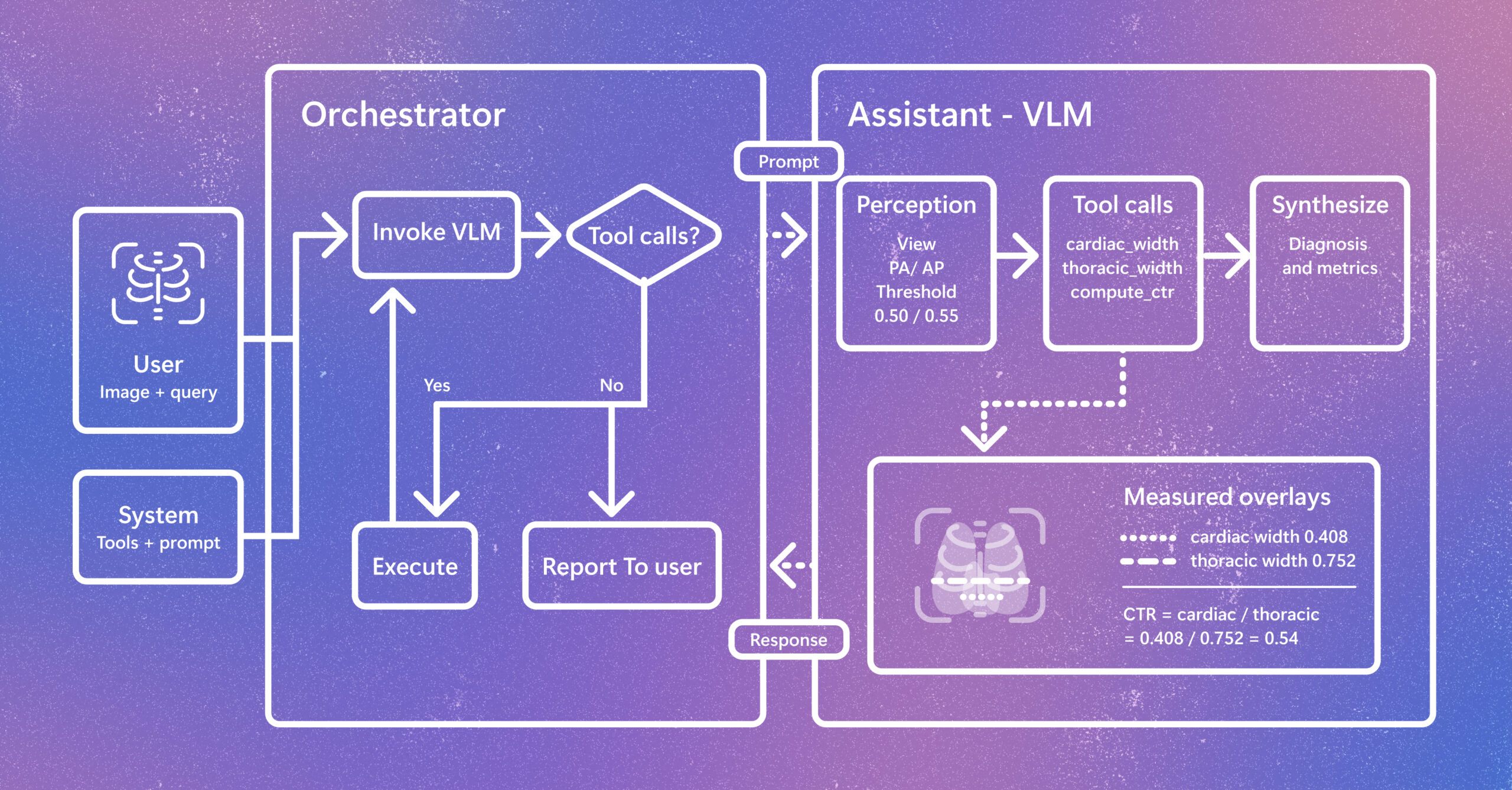
Radiology AI is evolving beyond report generation. CARE-X explores a unified approach that combines flexible reasoning, calibrated predictions, and measurement-based tools for chest X-ray interpretation. The post Introducing CARE-X: Towards Clinically Useful Radiology VLMs with Auxiliary Supervision, Reward-Aligned Learning, and Tool-Augmented Measurement appeared first on Microsoft Research.
We use cookies to run the site and, with your consent, for analytics and to show ads.
See our Cookie Policy.