This work introduces SPAR3S, a sparse voxel-aligned 3D latent generative model for conditional scene completion without requiring ground-truth 3D data for supervision, and trains a masked autoregressive transformer that jointly models voxel occupancy and latent token values, enabling efficient and spatially consistent generation of unseen regions.
Abstract
Generating complete 3D scenes from sparse, unconstrained views is a fundamental challenge in 3D vision which requires reasoning beyond observed content while remaining computationally tractable. Existing feed-forward reconstruction methods are inherently limited to content visible in the input images, while 3D generative modeling is hindered by the high computational cost of dense volumetric representations and the scarcity of large-scale 3D supervision. We introduce SPAR3S, a sparse voxel-aligned 3D latent generative model for conditional scene completion without requiring ground-truth 3D data for supervision. Our key insight is to formulate 3D scene generation in a structured, compact, voxel-aligned 3D latent space where only occupied voxels are represented. We learn this sparse latent space directly from multi-view images using photometric supervision via differentiable 3D Gaussian Splatting. Given a partial set of observed voxels encoded from sparse input views, scene completion reduces to predicting the missing latent tokens and their spatial support within the voxel grid. To this end, we train a masked autoregressive transformer that jointly models voxel occupancy and latent token values, enabling efficient and spatially consistent generation of unseen regions. We demonstrate the effectiveness of our method on synthetic indoor scenes, achieving higher novel-view quality than prior work. We further validate its generalization on RealEstate10k, highlighting its applicability to real-world data.

Partial-view 3D recognition – reconstructing 3D geometry and identifying object instances from a few sparse RGB images – is an exceptionally challenging yet practically essential task, particularly in cluttered, occluded real-world settings where full-view or reliable depth data are often unavailable. Existing methods,...
Young Hun Kim, Seungyeon Kim, Yonghyeon Lee et al.· IEEE Robotics and Automation...· 1 citation
A few-shot 3DGS framework that leverages scene-adapted generative priors gated by multi-view geometric consistency to enhance the reconstruction quality for both interpolated and extrapolated views given limited observing viewpoints is proposed.
Hao-Yu Zhang, Shuai-Feng Zhi, Zhen-Hua Du et al.· IEEE Transactions on Visuali...· 0 citations
USR-Drive is proposed, a unified conditional generative framework that, given only posed multi-view driving videos, jointly recovers dense dynamic geometry and instance-level object layouts within a shared scene representation and delivers state-of-the-art results for both dynamic reconstruction and 3D detection on the...
Li-Heng Chen, Haokai Pang, Cheng Su et al.· 0 citations
We introduce ReconSplat, a feed-forward model for 3D scene reconstruction that aims to address the longstanding trade-off between plausible view generation for unobserved regions and geometric consistency, providing both geometrically aligned novel views and sharp depth estimates. Our approach builds on 3D Gaussian spl...
Giuseppe Stracquadanio, Kevin Raj, Julia Grabinski et al.· 0 citations
SpatialCrafter is presented, a novel two-stage framework that addresses explorable image-to-scene generation issues by introducing a global 3D proxy for high-fidelity image-to-scene generation and appearance refinement and introduces Parallel Geometry Injection and Proxy-Aware Corruption training strategies.
Chuan Fang, Lingteng Qiu, Yixun Liang et al.· 3 citations
The results show that GS-Voxel provides structured latents for pre-optimized aerial 3DGS reconstructions, with latent capacity that grows with the number of occupied voxels, with latent capacity that grows with the number of occupied voxels.
Ming Qian, Zi-Jian Wang, Minchao Sun et al.· 1 citation
Exploring how generative AI could make machine vision more accessible to businesses. The post GenEye in a Box: Making Machine Vision Something You Can Just Ask For appeared first on GPT-Lab.
Microsoft Research Blog· microsoft.comAug 11, 2026
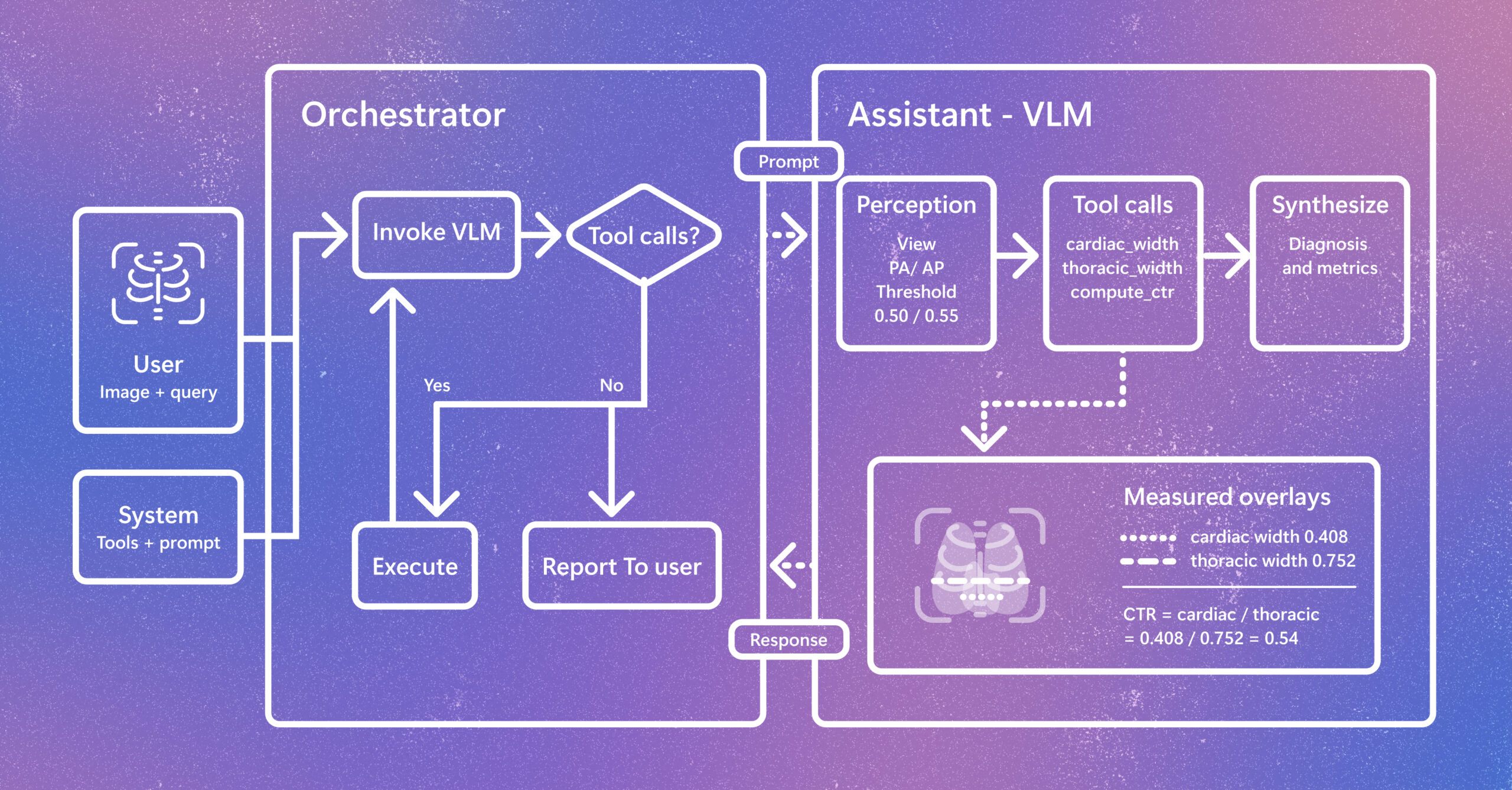
Radiology AI is evolving beyond report generation. CARE-X explores a unified approach that combines flexible reasoning, calibrated predictions, and measurement-based tools for chest X-ray interpretation. The post Introducing CARE-X: Towards Clinically Useful Radiology VLMs with Auxiliary Supervision, Reward-Aligned Learning, and Tool-Augmented Measurement appeared first on Microsoft Research.