Skip to content

Conditioned Initialization for Attention

Sep 2026 · 0 citations · 48 references
Computer Science

TL;DR

This paper proposes conditioned initialization, a principled scheme that initializes attention weights to improve the spectral properties of the attention layer and shows that conditioned initialization can potentially reduce the condition number of the attention Jacobian, leading to more stable optimization.

Abstract

Transformers are a dominant architecture in modern machine learning, powering applications across vision, language, and beyond. At the core of their success lies the attention layer, where the query, key, and value matrices determine how token dependencies are captured. While considerable work has focused on scaling and optimizing Transformers, comparatively little attention has been paid to how the weights of the queries, keys and values are initialized. Common practice relies on random initialization or alternatives such as mimetic initialization, which imitates weight patterns from converged models, and weight selection, which transfers weights from a teacher model. In this paper, we argue that initialization can introduce an optimization bias that fundamentally shapes training dynamics. We propose conditioned initialization, a principled scheme that initializes attention weights to improve the spectral properties of the attention layer. Theoretically, we show that conditioned initialization can potentially reduce the condition number of the attention Jacobian, leading to more stable optimization. Empirically, it accelerates convergence and improves generalization across diverse applications, highlighting conditioning as a critical yet underexplored area for advancing Transformer performance. Importantly, conditioned initialization is simple to apply and integrates seamlessly into a wide range of Transformer architectures.

View source

Similar papers

#artificial intelligence Preprint Sep 2026

From Attention Sensitivity to Layer Role: Revisiting Mixed-Precision Quantization of Transformers

This work defines one scalar loss over the joint Q, K, V weights of a block, evaluated against the block's real causally-masked attention output, and uses it twice: to fit the quantized weights, and to score the block for a multiple-choice knapsack allocation.

Nafiseh HosseinpourFardi, Negar Alihadi, Mahmoudreza Babaei et al. · 0 citations
#artificial intelligence Preprint Sep 2026

Switching Linear Attention

Designing expressive sequence layers with efficient inference remains a central challenge in modern machine learning. Standard softmax attention achieves excellent sequence modeling performance through rich nonlinear token interactions, but it requires a key-value cache that grows linearly with sequence length, limitin...

Hyun Dong Lee, X. Gonzalez, Nicolas Zucchet et al. · 0 citations
Preprint Aug 2026

Training-Free Universal Approximation by Prompting Random Transformers

How expressive is prompting a transformer? Answering this question is important for separating the roles of prompting, architecture, and pretraining in transformer models, and for determining whether task-specific behavior must be stored in model weights or can instead be induced at inference time through the prompt. W...

Alexander Hsu, Rong-Jie Lai · 1 citation
#machine learning Preprint Oct 2026

Universal interpolation for deep residual self-attention networks

Universal approximation is a necessary qualitative property of learning architectures to benefit from scaling laws. While it is generically verified on a variety of neural architectures and random feature models, it typically involves infinite width limits. In this work, we focus on deep self-attention models and consi...

Sibylle Marcotte, Joan Bruna · 0 citations
#natural language process... Preprint Sep 2026

MetaSteer: Context-Conditioned, nonlinear Steering via Attention-Projection Adaptation

Steering large language models typically relies on linear, context-independent interventions in activation space, an assumption that recent work has challenged and that can induce an information bottleneck when a fixed representation must encode many behavioral distinctions. We introduce MetaSteer, a method that learns...

Mehdi Jafari, Hao Xue, F. Salim · 0 citations
#artificial intelligence Preprint Sep 2026

Query Expansion and Key Specialization in Transformer Attention Geometry

Additional token-level checkpoint analyses show that the monotonic paired-contrast trend is not universal across pretrained families, but survives as an early-training regime that later decays over a full pretraining run, and the link between interaction-rank geometry and attention entropy remains visible in several mo...

Vidit Gupta, Siddhesh Nadkarni, Mihik Chaudhari et al. · 0 citations

Related blog posts

Microsoft Research Blog Aug 11, 2026

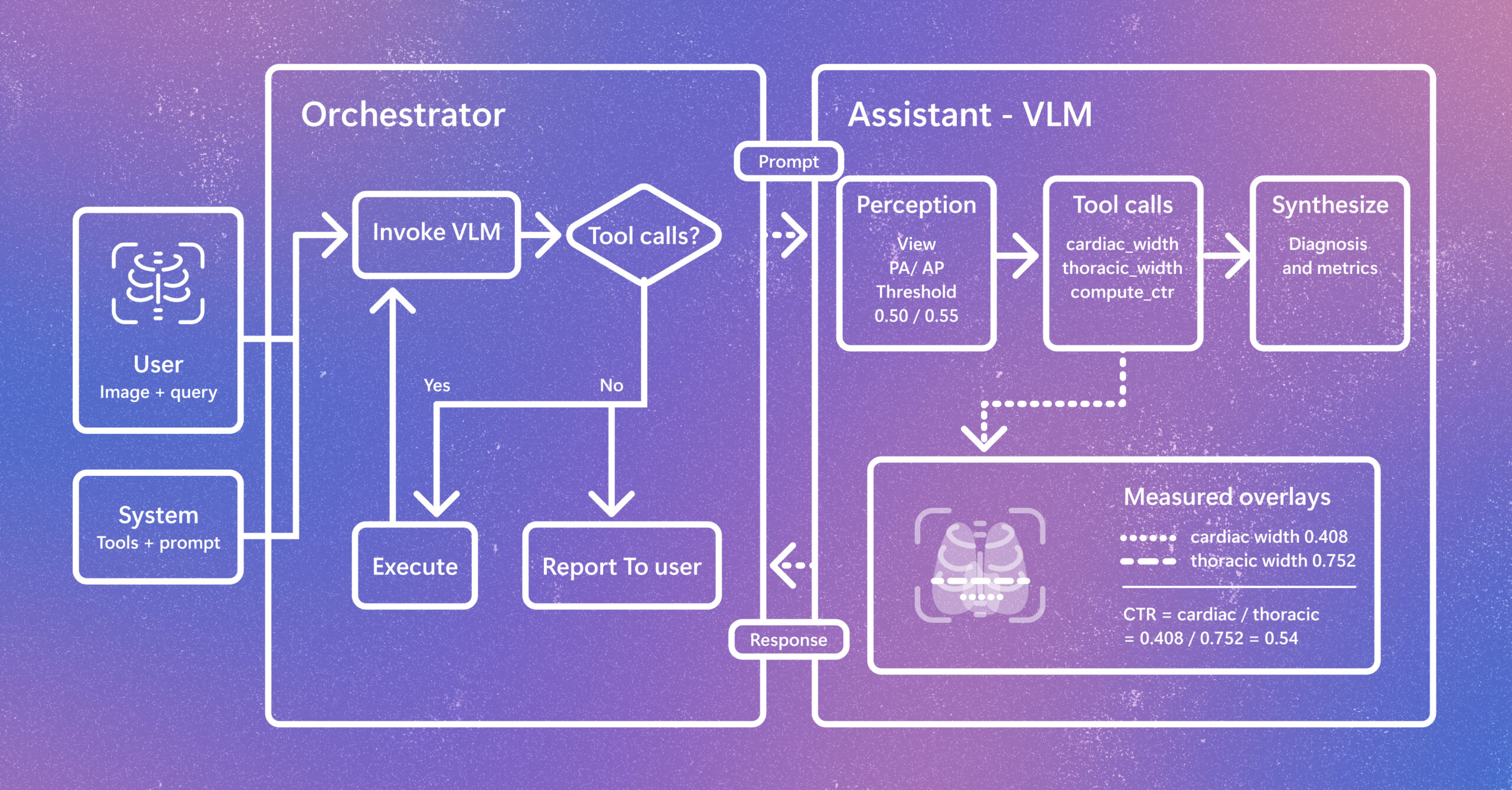
Introducing CARE-X: Towards Clinically Useful Radiology VLMs with Auxiliary Supervision, Reward-Aligned Learning, and Tool-Augmented Measurement

Radiology AI is evolving beyond report generation. CARE-X explores a unified approach that combines flexible reasoning, calibrated predictions, and measurement-based tools for chest X-ray interpretation. The post Introducing CARE-X: Towards Clinically Useful Radiology VLMs with Auxiliary Supervision, Reward-Aligned Learning, and Tool-Augmented Measurement appeared first on Microsoft Research.

We use cookies to run the site and, with your consent, for analytics and to show ads. See our Cookie Policy.