Skip to content

PlayTrain: An Efficient Reinforcement Learning Framework for LLM-Generated Adaptable JavaScript Games

Sep 2026 · 0 citations · 76 references
Computer Science

TL;DR

Through PlayTrain, an RL framework that combines the abilities of large language models to robustly generate JavaScript games from a minimal human prompt, and an efficient pipeline that can run any JS game in a standard'gym'environment, this work reimagine RL VGE development.

Abstract

While many video-game environments (VGEs) have played crucial roles in advancing reinforcement learning (RL), developing novel VGEs or modifying existing ones to support new features, has been a laborious process requiring extensive hand-coding. Here we present PlayTrain, an RL framework that combines the abilities of large language models (LLMs) to robustly generate JavaScript (JS) games from a minimal human prompt, and an efficient pipeline that can run any JS game in a standard'gym'environment. Not only are recent LLMs particularly good at writing JS code, but the JS format also allows users to easily play generated VGEs, while PlayTrain enables us to train RL agents on the exact same games. We demonstrate multiple use cases of PlayTrain, including cloning well-known Atari and ProcGen games in simple JS, where PlayTrain trains pixel-based agents end-to-end at over 1M agent-decisions per second on a single GPU node; and creating modified versions thereof (e.g., that support novel test sets, procedural generation logics, or game dynamics). Through PlayTrain, we reimagine RL VGE development: all we need is a single JS file, generated and modified through an LLM. We discuss promising future RL research directions that PlayTrain unlocks.

View source

Similar papers

#machine learning Preprint Aug 2026

LLM-Guided Reinforcement Learning for Adaptive NPC Behavior in Multi-Agent Combat Games

A runtime strategy-selection framework in which a large language model (LLM) guides a trained RL policy without modifying its underlying behavior is investigated, demonstrating both the potential and limitations of LLM-guided runtime strategy selection for adaptive multi-agent game AI.

H. D. Nair, Kayvan Karim · 0 citations
#machine learning Preprint Aug 2026

Learning Generalizable Behaviors for Terminal Agents

River, a simple training recipe that improves reward quality by filtering low-quality environments and augmenting outcome rewards with process-level behavior regularization is proposed, which achieves the best performance among evaluated open-source RL-trained 8B models across four terminal-agent benchmarks.

Yi-Fan Yao, Bo Pang, Xuan-Phi Nguyen et al. · 1 citation
Book Open access Aug 2026

Large Language Model (LLM) as an Excellent Reinforcement Learning Researcher in both Single-Agent and Multi-Agent Scenarios

A Self-Evolutional single-agent/multi-agent Reinforcement Learning (SE-RL) framework that utilizes a Large Language Model (LLM) to design various RL algorithm modules, such as agent model design, reward function, profiling, communication, and state imagination, by leveraging the LLM generating module output or code.

Vincent Fu, Xin-Xin Xu, Weichen Xu et al. · 0 citations
#artificial intelligence Preprint Sep 2026

UnifiedPlayers: Enhance Tool-Integrated Reasoning in Agentic Reinforcement Learning

UnifiedPlayers, a cooperative framework comprising a Planning Player that generates tasks, an Execution Player that produces multi-turn trajectories with Python tool calls, and an Evaluation Player that constructs executable verifiers, highlights cooperation among specialized players as a promising path toward self-enh...

Wen-Jie Liao, Liang Zhao, Ze-Hong Cao · 0 citations
Open access Aug 2026

Gaming with AI: A Hybrid Reinforcement Learning, Large Language Model, and Procedural Content Generation Framework for Enhancing Player Engagement and User Experience

Most existing game AI research examines individual mechanisms—Dynamic Difficulty Adjustment (DDA), large language model (LLM)-driven NPC dialogue, and Procedural Content Generation (PCG)—in isolation, leaving open the question of how these subsystems interact when evaluated together against a shared user-experience (UX...

Abhinav, Amandeep, Dharmender Kumar, Suraj, Keshav · 0 citations
#artificial intelligence Preprint Sep 2026

GlyphBench: A Playground for Language-Model Reinforcement Learning

We introduce GlyphBench, an environment suite for reinforcement learning (RL) post-training of language-model agents, with over 360 tasks spanning diverse games. GlyphBench renders spatial observations as two-dimensional Unicode grids and connects training, evaluation, and trajectory replay through a unified interface...

Roger Creus Castanyer, Marc-Alexandre Côté, Matthew J. Sargent et al. · 0 citations

Related blog posts

GPT-Lab Sep 3, 2026

Adaptive AI Agents in Construction Workflows

Adaptive AI agents can help make BIM data more machine-readable by navigating IFC models, interpreting inconsistent information, and mapping it to defined standards. In this blog, Alok Rawat shares findings from a real-world pilot in construction workflows. The post Adaptive AI Agents in Construction Workflows appeared first on GPT-Lab.

GPT-Lab Aug 28, 2026

We built an AI factory for HVAC control

What does it take to trust AI-driven HVAC optimization? Our AI Model Factory combines agents, machine learning, reinforcement learning and deterministic checks in a governed workflow designed for messy, real-world building data. The post We built an AI factory for HVAC control appeared first on GPT-Lab.

Microsoft Research Blog Jul 30, 2026

EvoLib: Turning experience into evolving knowledge

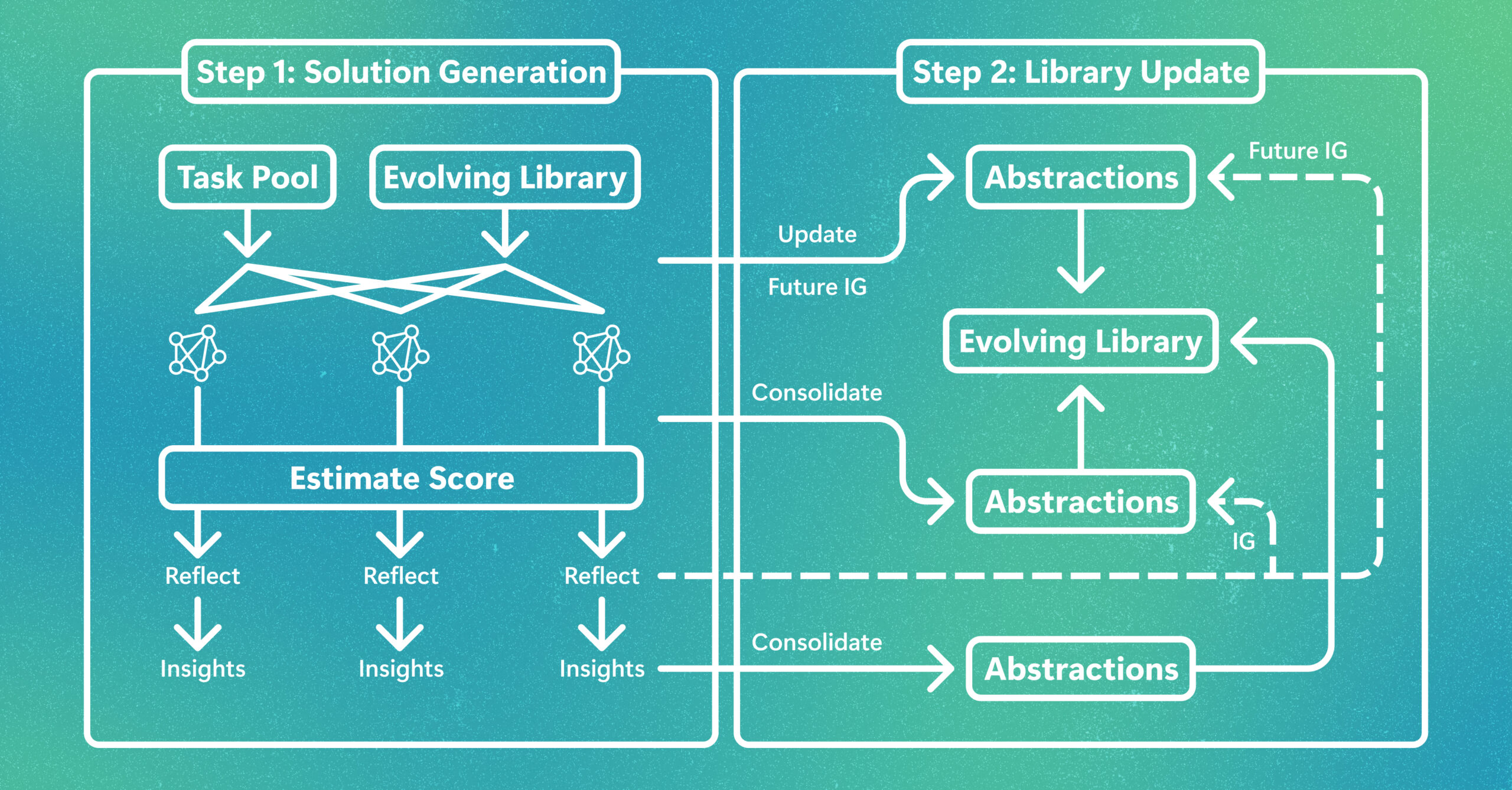
LLMs do not get smarter just by remembering more. EvoLib turns experience into evolving knowledge, taking reusable skills and insights that help models learn and adapt across tasks long after deployment. The post EvoLib: Turning experience into evolving knowledge appeared first on Microsoft Research.

We use cookies to run the site and, with your consent, for analytics and to show ads. See our Cookie Policy.