FlexMoGen generates high-quality motions that preserve semantic content while faithfully reflecting the target style, offering users greater control over the animation generation process, and demonstrates that FlexMoGen achieves the best balance between content fidelity and style reflection.
Abstract
We introduce FlexMoGen, a novel framework for flexible human motion synthesis conditioned on both natural language descriptions and motion style references. Text prompts are effective at defining semantic content, but they are often limited in capturing fine-grained style details such as timing, limb articulation, and expressive dynamics. A style example clip supplements the text by conveying these nuanced motion characteristics directly, enabling the model to preserve high-level intent while reproducing the desired stylistic traits. Given a text prompt and a style example clip, FlexMoGen generates high-quality motions that preserve semantic content while faithfully reflecting the target style, offering users greater control over the animation generation process. Unlike prior methods that rely on discrete style labels and do not generalize to long or multi-style generation, FlexMoGen learns a variational style encoder without style supervision and supports long, time-varying, multi-style synthesis. Our framework jointly pre-trains the style encoder and a text-to-motion latent diffusion model within a unified architecture, modulating motion style through a lightweight adaptation module. It integrates an efficient relative positional encoding scheme and is trained on both stylized and non-stylized datasets, enabling strong generalization to unseen text-style combinations. Experiments show that FlexMoGen achieves the best balance between content fidelity and style reflection.

Discrete text-to-motion generation models are powerful tools for synthesizing diverse human motions, yet endowing them with controllable, high-fidelity stylistic variations remains challenging. Direct retraining or fine-tuning these models often disrupts the fragile discrete token distributions learned by masked genera...
Shuai-Ying Hou, Hong-Yu Tao, Jun-Jie Gao et al.· IEEE Transactions on Visuali...· 0 citations
VISTA achieves the highest style recognition accuracy among video-conditioned methods while preserving competitive content alignment, and its decomposed 3-way classifier-free guidance provides independent, user-controllable calibration of the content-style balance at inference time.
Monseej Purkayastha, Anindita Ghosh, Philipp Slusallek· 0 citations
Existing human motion diffusion methods provide strong motion generation quality, and recent style transfer models can inject target style cues, but fine-grained continuous control of style intensity remains underexplored. In production, style intensity is subjective across artists and directors, so the practical requi...
Chen-Chieh Liao, Yi-Chen Peng, Yi-Yi Cai et al.· 0 citations
A novel self-supervised framework that enables granular control over image generation through a visual abstraction set that provides a richer, more flexible paradigm for creative design compared to state-of-the-art baselines across diverse styles and compositions is introduced.
Amir Hertz, Noah Snavely, Google DeepMind· 0 citations
Human motion may be viewed as a combination of action content, style, and body morphology. Existing motion style transfer methods transfer a reference style onto a content motion while assuming a canonical body, whereas shape-aware motion generators adapt motion to a target shape without explicit style control. This se...
Xinran Feng, E. D'Arnese, Mohan Sridharan· 0 citations
Text-driven motion editing modifies an existing motion sequence according to a text instruction while preserving the content of the source motion. Existing methods are typically built for a single, fixed skeletal topology, which limits their use in animation pipelines where characters differ in joint count and skeletal...
Qi-Chen Zheng, Si-Yuan Yang, Chong Wang et al.· 0 citations
Exploring how generative AI could make machine vision more accessible to businesses. The post GenEye in a Box: Making Machine Vision Something You Can Just Ask For appeared first on GPT-Lab.
Microsoft Research Blog· microsoft.comAug 11, 2026
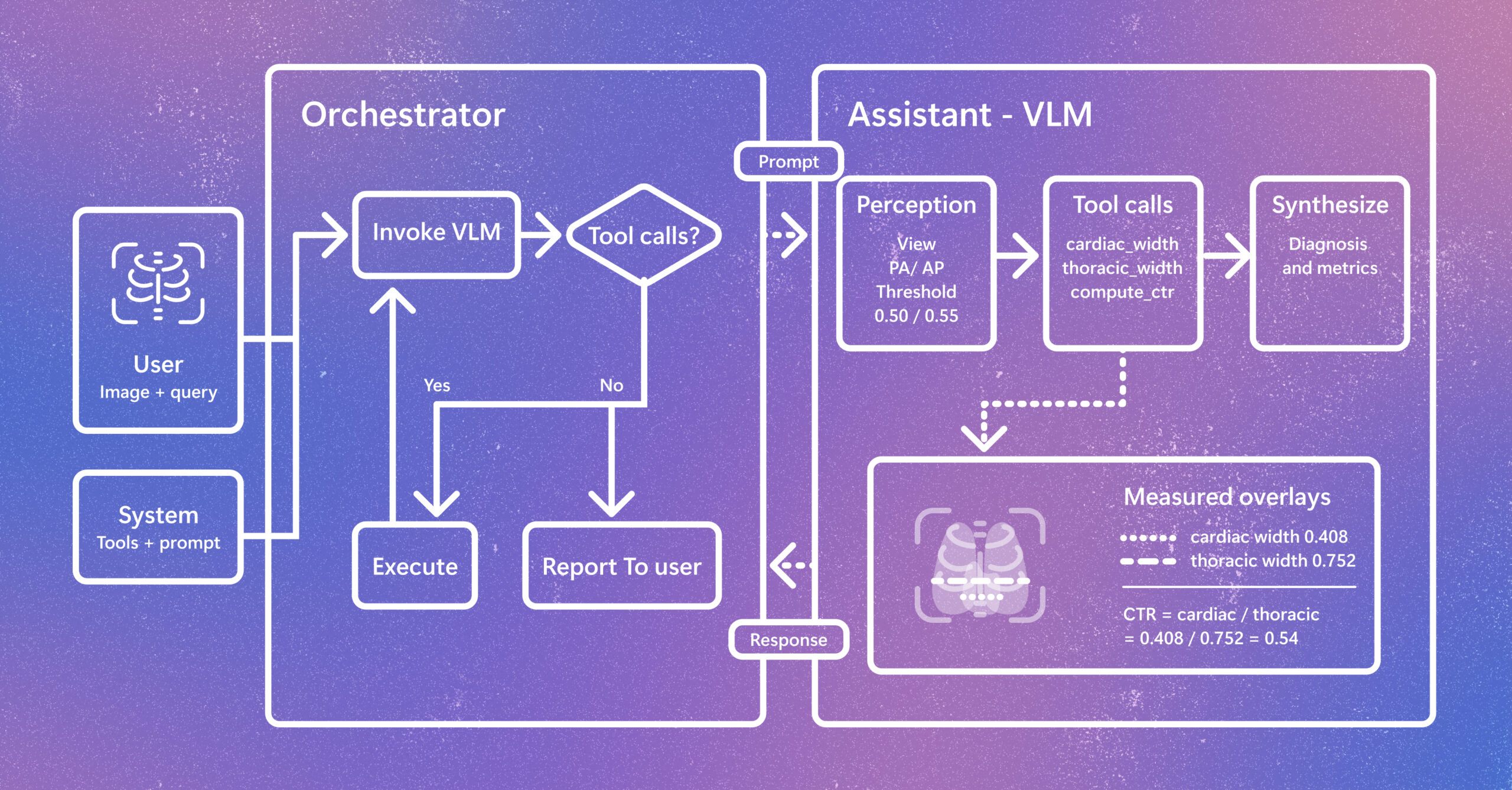
Radiology AI is evolving beyond report generation. CARE-X explores a unified approach that combines flexible reasoning, calibrated predictions, and measurement-based tools for chest X-ray interpretation. The post Introducing CARE-X: Towards Clinically Useful Radiology VLMs with Auxiliary Supervision, Reward-Aligned Learning, and Tool-Augmented Measurement appeared first on Microsoft Research.