MamMA, a Mamba-based pedestrian trajectory prediction algorithm considering occupancy maps and pedestrian awareness states is proposed, which achieves better average displacement error and final displacement error than the state-of-the-art algorithms.

Abstract
Many pedestrian trajectory prediction algorithms have been proposed to improve the safety of navigation for mobile robots working in human-robot coexistence environments. Some pedestrian trajectory prediction algorithms extract information about obstacles near pedestrians from top-down view images to improve the accuracy of trajectory prediction. However, mobile robots typically create local occupancy maps using LiDAR, rather than top-down view images. Meanwhile, the vision sensors on board robots provide egocentric view images, which contain fine-grained behavioral information about the pedestrians near the robot. To better use the information collected by LiDAR and on-board vision sensors, we propose MamMA, a Mamba-based pedestrian trajectory prediction algorithm considering occupancy maps and pedestrian awareness states. MamMA divides the occupancy map by patches and extracts obstacle features from each patch to create map features. Pedestrian awareness states are divided and considered, as some studies show that awareness states affect the perception and speed of pedestrians. Furthermore, a Mamba-based model is proposed to predict the future trajectories of pedestrians based on different types of features. Experiments on the STCrowd, SiT, JRDB, ETH, and UCY datasets show that MamMA achieves better average displacement error and final displacement error than the state-of-the-art algorithms.

Pedestrian-future-trajectory prediction is a critical task in intelligent driving, traffic-scene understanding, and active safety decision-making. In real-world road environments, pedestrians’ historical trajectories are frequently affected by occlusions from vehicles, other pedestrians, road infrastructure, and detect...
Si-Jie Yang, Zhao-Yu Li, Guo-Yu Lin et al.· Italian National Conference...· 0 citations
Obstacle trajectory prediction is a critical task for mobile robots to achieve dynamic obstacle avoidance, with the core challenge lying in enabling robots to accurately and promptly perceive and predict the trajectories of all obstacles within the same scene under varying obstacle motion states. To address this issue,...
Hong-Xia Wang· The International Conference...· 0 citations
Safe and proactive decision-making in autonomous driving systems depends on predicting the future locations of vehicles, pedestrians, and other dynamic actors in traffic with high precision. However, trajectory prediction is an extremely challenging problem due to the existence of multimodal possible futures, the rando...
Hatice Meltem Nergiz Sirin, O. Erkent· IEEE Access· 0 citations
For the problem of real-time navigation and obstacle avoidance of mobile robots in the scenario of a continuously moving pedestrian on a dynamic zebra crossing, this paper proposes a visual-based adaptive dynamic path planning framework. Firstly, the YOLO algorithm is used to detect dynamic pedestrians in the video str...
Jing-Yi Luo· The International Conference...· 0 citations
This paper presents a human-aware collision-free navigation system based on long-term motion prediction and a game against nature formulation for modelling uncertainty. The proposed approach explicitly takes into account mutual pedestrian interactions and introduces a method for estimating the confidence of predicted p...
K. Skrzypczyk· Advances in Science and Tech...· 0 citations
Accurate pedestrian localization is fundamental to urban monitoring systems such as crowd management and anomalous behavior detection. Multi-view systems combining CCTV and UAV imagery extend monitoring coverage, but pedestrian locations estimated from each domain must be consistent in a common world coordinate system...
Sunwoong Paik, Joonhee Youn, Phillip Kim et al.· The International Archives o...· 0 citations
Related blog posts
MIT News · Artificial Intelligence· news.mit.eduOct 28, 2026
Professor Paris Smaragdis develops computers with superhuman hearing for applications like speech recognition, music understanding, and environmental monitoring.
Exploring how generative AI could make machine vision more accessible to businesses. The post GenEye in a Box: Making Machine Vision Something You Can Just Ask For appeared first on GPT-Lab.
Microsoft Research Blog· microsoft.comAug 11, 2026
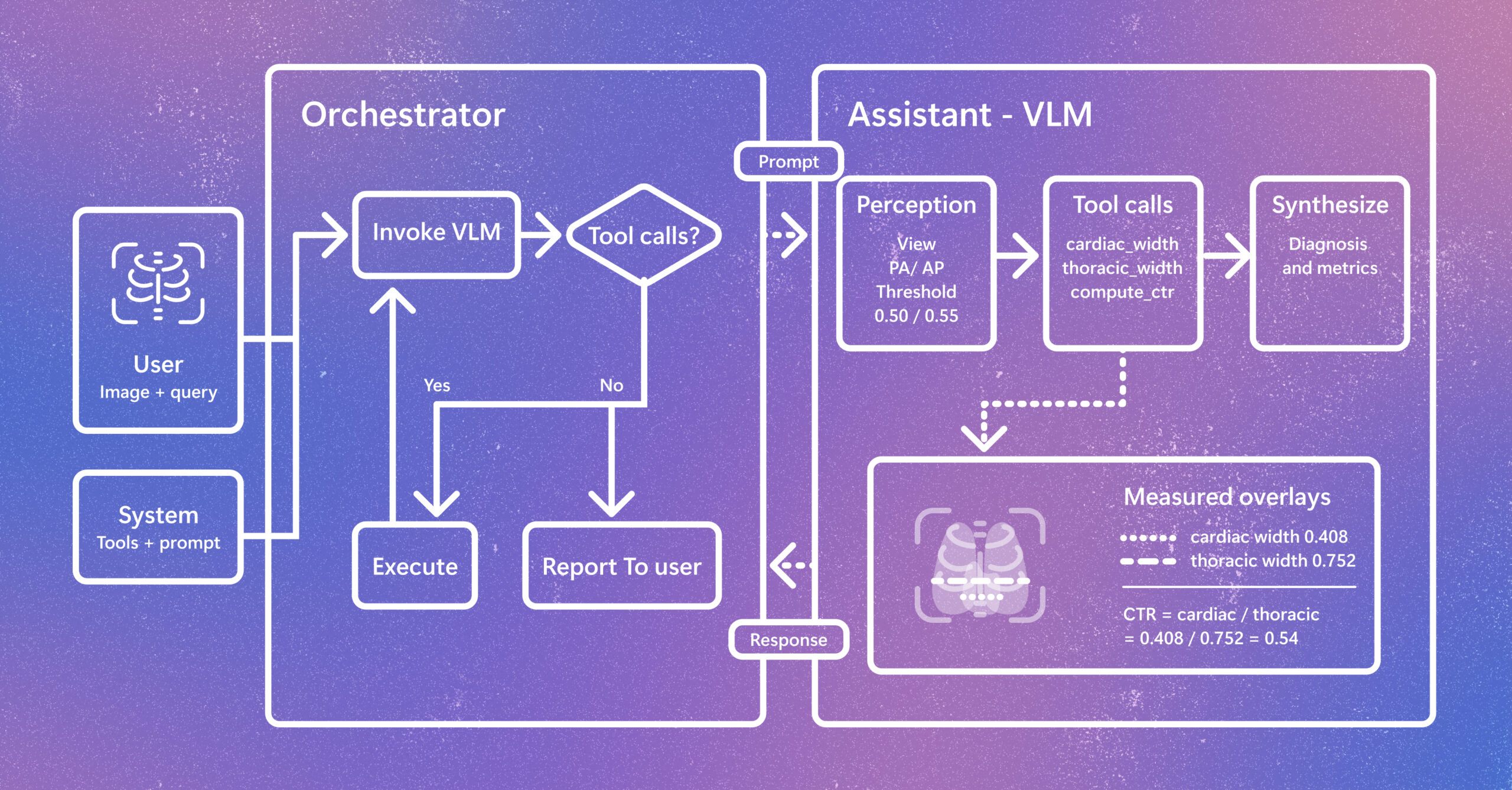
Radiology AI is evolving beyond report generation. CARE-X explores a unified approach that combines flexible reasoning, calibrated predictions, and measurement-based tools for chest X-ray interpretation. The post Introducing CARE-X: Towards Clinically Useful Radiology VLMs with Auxiliary Supervision, Reward-Aligned Learning, and Tool-Augmented Measurement appeared first on Microsoft Research.