View-Structured Conformal Prediction (VSCP) is proposed, which splits the pre-calibration scale into a spatial shape from the renderer and a transferable view-difficulty factor, which predicts the smallest view-wise multiplier that shape needs.
Abstract
3D Gaussian Splatting (3DGS) renders novel views in real time, but an uncertainty heatmap does not certify that a rendered view meets a certain prediction coverage. We treat novel-view synthesis as structured regression and ask that, with probability at least $1-\alpha$, RGB prediction boxes cover at least a $1-\beta$ fraction of pixels in a new view. We propose View-Structured Conformal Prediction (VSCP). It splits the pre-calibration scale into a spatial shape from the renderer and a transferable view-difficulty factor, which predicts the smallest view-wise multiplier that shape needs. A held-out quantile over views (View-CP) then gives finite-sample validity even when transferring to new scenes. The same factorization makes the analysis exact: a conformity score is the ratio of oracle to predicted view difficulty, and excess width separates into a test-side and a calibration-side term. Across 13 real scenes, pixel-pooled calibration reaches 89.9\% marginal pixel coverage but only 61.4\% view-event coverage at a 90\% target, while View-CP reaches 91.7--92.0\%. At matched coverage VSCP cuts width by 22.1\% against a constant scale, and matches a ten-model ensemble's 21.0\% reduction using only one model per scene and four rather than ten rasterization passes per query. VSCP also improves on the closest single-model baseline, the 3DGS-U field, by 4.7 points ($p=0.0225$). The view predictor transfers from bounded source families to all nine unbounded Mip-NeRF~360 scenes. There the full scale beats the constant scale with 20.7\% width saving on all nine scenes. It also keeps an 18.3\% saving under a different densification backbone and runs at 216--280 FPS on an RTX~4090.

Across datasets, major structures were generally reproduced well, whereas sparse foliage, low-contrast repetitive textures, fine surface details, and distant background objects required ROI-level verification, whereas sparse foliage, low-contrast repetitive textures, fine surface details, and distant background objects...
Tomohiro Mizoguchi· Italian National Conference...· 0 citations
3D Gaussian Splatting (3DGS) has become a standard representation for real-time novel-view synthesis. Yet, its quality-efficiency trade-off still relies heavily on adaptive density control. Existing cloning, splitting, and pruning rules use proxy signals, such as position gradients, opacity, and image-space error. Alth...
Q. Hong, Long Nguyen-Chi, B. T. Nguyen· 0 citations
3D Gaussian Splatting (3DGS) has become a vital tool in novel view synthesis. 3D Gaussian functions with attributes like color, opacity, and scale are stacked together to explicitly model a radiance field. However, discrete 3D Gaussians usually produce poor depth with few geometry details but lots of floaters, which hi...
N-dimensional splatting extends 3D Gaussian Splatting with view direction and time to model view-dependent and dynamic effects. Each primitive is lifted into a joint distribution over position and conditioning variables, then conditionally sliced at each rendering query. N-DGS and UBS share this step across Gaussian an...
Zhong-Pai Gao, B. Planche, Van Nguyen Nguyen et al.· 0 citations
3D Gaussian Splatting (3DGS) has emerged as a powerful paradigm for real-time photorealistic novel view synthesis. However, its training-time densification remains largely heuristic, often resulting in redundant Gaussian proliferation and inaccurate geometric reconstruction. Existing methods predominantly rely on first...
Hou-Qiang Zhong, Tian-Chi Zhu, Qiang Hu et al.· 0 citations
3D Gaussian Splatting (3DGS) has shown considerable potential for novel view synthesis (NVS) and 3D reconstruction. Feed-forward methods avoid costly per-scene optimization, but fixed image or spatial resolutions limit their ability to allocate primitives according to local complexity. We present OctreeSplat, a hierarc...
Yi-Bin Zhao, Yi-Han Pan, Wen-Li Yang et al.· 0 citations
Related blog posts
MIT News · Artificial Intelligence· news.mit.eduOct 28, 2026
Professor Paris Smaragdis develops computers with superhuman hearing for applications like speech recognition, music understanding, and environmental monitoring.
Exploring how generative AI could make machine vision more accessible to businesses. The post GenEye in a Box: Making Machine Vision Something You Can Just Ask For appeared first on GPT-Lab.
Microsoft Research Blog· microsoft.comAug 11, 2026
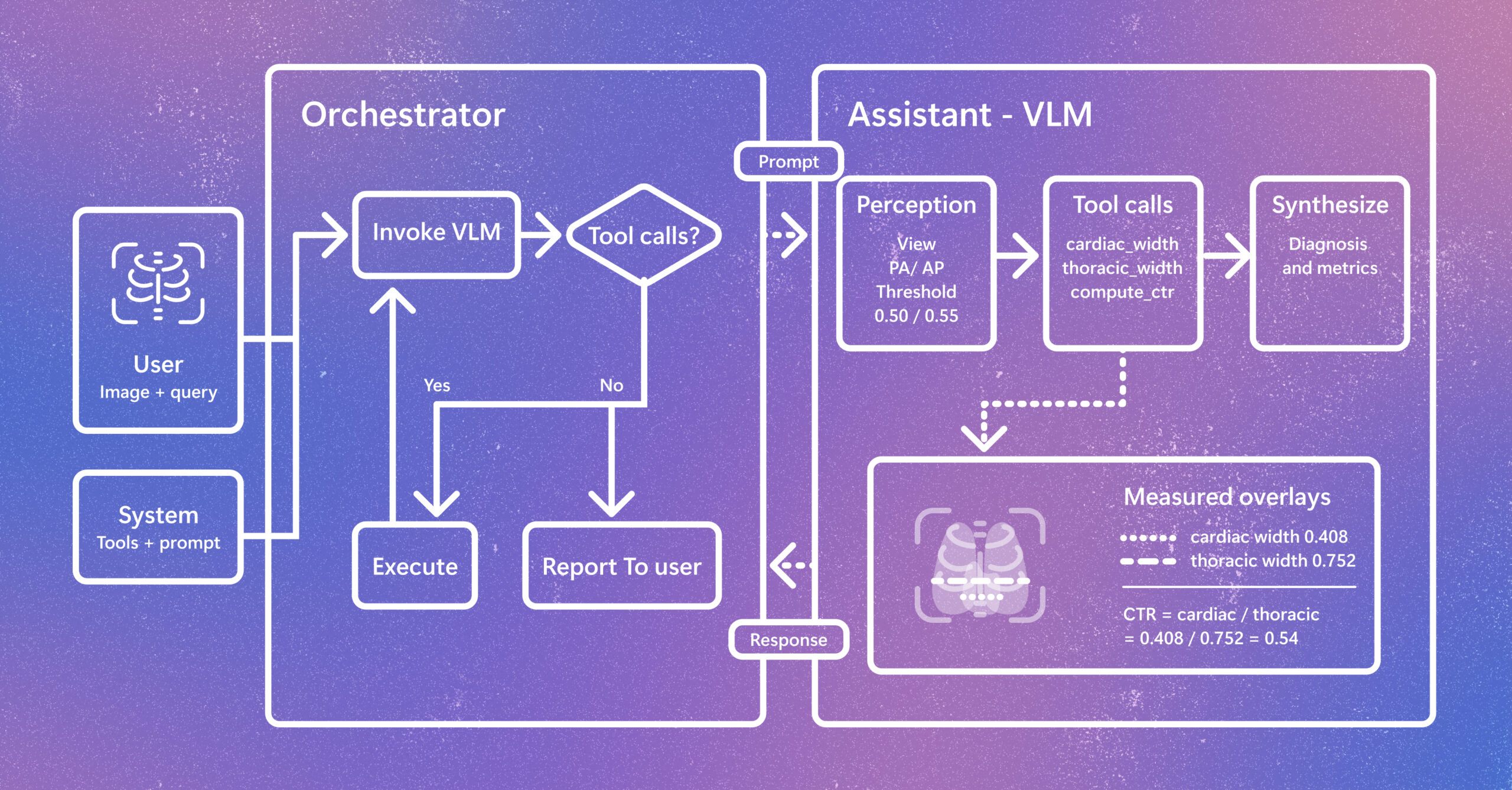
Radiology AI is evolving beyond report generation. CARE-X explores a unified approach that combines flexible reasoning, calibrated predictions, and measurement-based tools for chest X-ray interpretation. The post Introducing CARE-X: Towards Clinically Useful Radiology VLMs with Auxiliary Supervision, Reward-Aligned Learning, and Tool-Augmented Measurement appeared first on Microsoft Research.