
Bypassing inference bottlenecks: Accelerating complex AI search with Retrieve-for-Train
Algorithms & Theory
More from the blog
Improving synthesis prediction of small molecules at scale with RetroChimera
Custom-made molecules are advancing medicine, materials, and agriculture, but producing them is slow and expensive. A new Nature paper highlights RetroChimera, a predictive model that helps accelerate chemical synthesis, helping researchers explore a wide range of molecules. The post Improving synthesis prediction of small molecules at scale with RetroChimera appeared first on Microsoft Research.

Training a coding model to paint watercolours with TRL and OpenEnv
We’re on a journey to advance and democratize artificial intelligence through open source and open science.

Training and Finetuning Multi-Vector Embedding Models with Sentence Transformers
We’re on a journey to advance and democratize artificial intelligence through open source and open science.
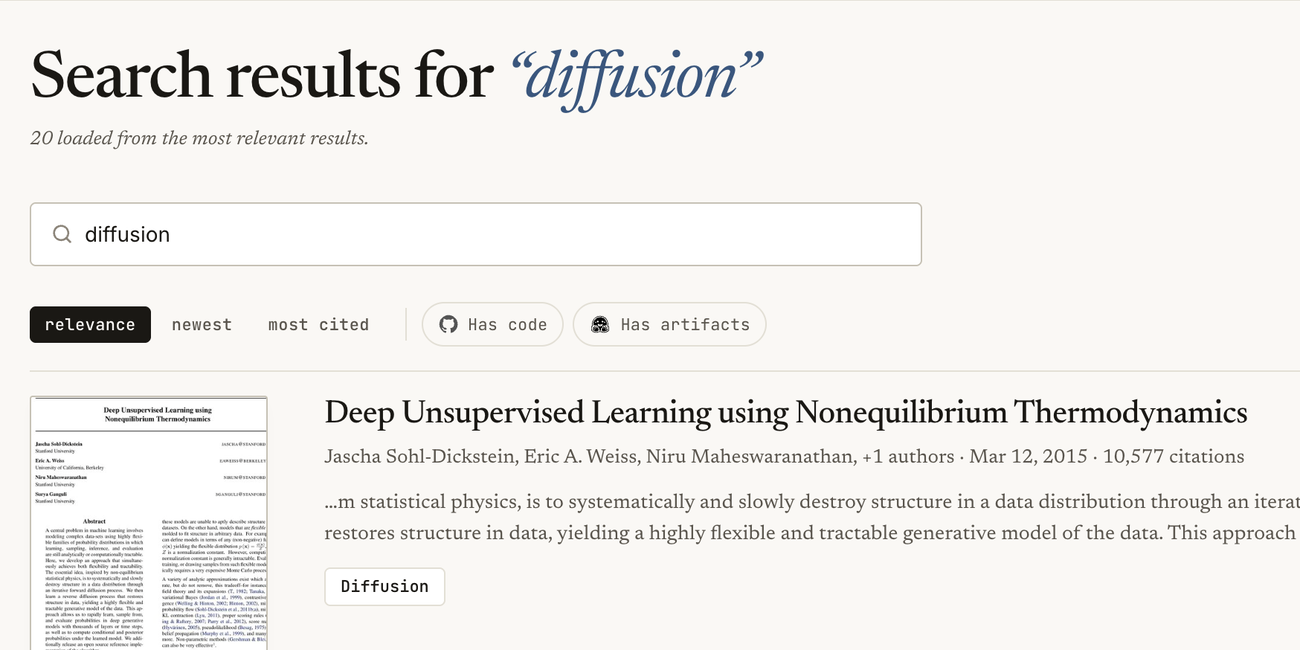
How Hugging Face Inference Endpoints, Jobs, and Buckets Power Search on Papers with Code
We’re on a journey to advance and democratize artificial intelligence through open source and open science.
Related papers
ECCOLA - a Method for Implementing Ethically Aligned AI Systems
The method, ECCOLA, is presented, which aims at making the high-level AI ethics principles more practical, making it possible for developers to more easily implement them in practice.
AI-powered Code Review with LLMs: Early Results
The goal is to not only refine the accuracy of the LLM-based tool but also to underscore its potential in streamlining the software development lifecycle through proactive code improvement and education.
LLM-based agents for automating the enhancement of user story quality: An early report
The use of large language models to automatically improve the user story quality in Austrian Post Group IT agile teams is explored, with a reference model for an Autonomous LLM-based Agent System developed and implemented at the company.
System for systematic literature review using multiple AI agents: Concept and an empirical evaluation
This paper introduces a novel multi-AI-agent system designed to fully automate SLRs, and demonstrates how it substantially reduces the time and effort traditionally required for SLRs while maintaining comprehensiveness and precision.