Several studies have revealed the fact that nearly two-thirds of all software process improvement (SPI) efforts have failed or have at least fallen short of expectations. Literature and practice have shown that commitment to SPI at all organizational levels is essential for the success of any SPI endeavor. A research model for studying the existence, development and interplay of SPI-related commitment is introduced in this paper. This study suggests that software organizations operate through strategic, operational and personal commitment nets. These nets consist of actors, drivers, concerns, actions, commitment, and outcomes. The commitment nets model is applied in a study of four industrial SPI initiatives. The results from two of these cases are reported here. The results show that SPI is driven through the formation and reformation of commitment nets. The contents of strategic, operational and personal commitment nets are laid out and implications are discussed.
P. Abrahamsson· Annals of Software Engineeri...· 35 citations· ⚡2
The application of agile software methods and more recently the integration of Lean practices contribute to the trend of continuous improvement in the software industry. One such area warranting proper empirical evidence is a project’s operational efficiency when using the Kanban method. This short paper takes a new angle and explores waste in the Kanban-driven software development project context. A preliminary research model is presented for helping the consequent replication of the study. The results from the empirical analysis suggest Kanban can be an effective method in visualizing and organizing the current work, but does not prevent waste from creeping in, although the overall project outcome may be successful.
Marko Ikonen, Petri Kettunen, Nilay V. Oza et al.· EUROMICRO Conference on Soft...· 67 citations· ⚡9
The field of software engineering has evolved significantly over the past decades. It can be argued that software has become the vital element of any system or service. Interestingly, even in the field of automotive industry, 90% of recent innovations stem from software and electronics (ITEA2 2005). Ever since the classic NATO conference in 1968, however, software has been argued to be in some state of crisis. From the 1990s, the crisis has been labeled as a chronic one. It is quite evident that several attempts to improve the state of software industry have taken place with varying levels of success. Software process improvement approaches have been developed since many decades ago. The results have been impressive, on the one hand, but many problems still exist. As an example, the business impact of software process improvement endeavors has been difficult to pinpoint, several of the improvement initiatives appear to fall short of their goals, and overemphasis on comparing processes with fixed reference models may lead an organization astray regarding the product or service perspective. The Profes conference series was established in 1999 to provide a venue for industry and academia to present and discuss the shift from model-based improvement to a product-oriented perspective in the field of software engineering and software process improvement. This includes a context-oriented understanding of the process-product relationships. Recently, the focus in practice and, consequently, in research has been on viewing software development as a global endeavor rather than a local one. There are several reasons for this. To name but a few: The distribution of software development enables the optimum use of competence regardless of the geographical location. The large software-intensive organizations operate in the global space and market, which makes distribution a necessity rather than a choice. On the positive side, distribution enables the development of software and services close to the prominent market area. Despite these relatively clear advantages and 2 benefits, global software development has brought with it several challenges due to increased complexity and cultural as well as technology issues. These challenges are now being tackled by means of research taking place in Europe and elsewhere as witnessed by this special issue of Profes conference research papers. Profes Conference series was established at the end of European IST project called PROFES (PROduct Focused Software process improvement) for disseminating the research results of the project area to industry. The PROFES Consortium included …
P. Abrahamsson, Jürgen Münch, P. Kuvaja· Software Process: Improvemen...· 4 citations
Crashes of software systems may have disruptive, and sometimes tragic effects on users. Being able to forecast such failures is extremely important, even when the failures are inevitable – at least recovery or rescue actions can be taken. In this paper we present a technique to predict the failure of running software systems. We propose to use log messages to predict failures running devices that read log files of running application and warns about the likely failure of the system; the prediction is based on the Cox Proportional Hazards (PH) model that has been applied successfully in various fields of research. We perform an initial validation of the proposed approach on real-world data.
P. Abrahamsson, I. Fronza, Jelena Vlasenko· International Conference on...· 1 citation
As opposed to more mature subjects, software engineering lacks general theories that establish its foundations as a discipline. The Essence Theory of software engineering (Essence) has been proposed by the Software Engineering Methods and Theory (SEMAT) initiative. The goal of Essence is to develop a theoretically sound basis for software engineering practice and its wide adoption. However, Essence is far from reaching academic- and industry-wide adoption. The reasons for this include a struggle to foresee its utilization potential and a lack of tools for implementation. SEMAT Accelerator (SematAcc) is a Web-positioning tool for a software engineering endeavor, which implements the SEMAT’s Essence kernel. SematAcc permits the use of Essence, thus helping to understand it. The tool enables the teaching, adoption, and research of Essence in controlled experiments and case studies.
D. Graziotin, P. Abrahamsson· arXiv.org· 33 citations· ⚡2
For decades now, it has been claimed that a way to improve software developers’ productivity is to focus on people. Indeed, while human factors have been recognized in Software Engineering research, few empirical investigations have attempted to verify the claim. Development tasks are undertaken through cognitive processing abilities. Affective states – emotions, moods, and feelings - have an impact on work-related behaviors, cognitive processing activities, and the productivity of individuals. In this paper, we report an empirical study on the impact of affective states on software developers’ performance while programming. Two affective states dimensions are positively correlated with self-assessed productivity. We demonstrate the value of applying psychometrics in Software Engineering studies and echo a call to valorize the human, individualized aspects of software developers. We introduce and validate a measurement instrument and a linear mixed-effects model to study the correlation of affective states and the productivity of software developers.
D. Graziotin, Xiaofeng Wang, P. Abrahamsson· International Conference on...· 55 citations· ⚡4
This article is a contribution towards an understanding of open access (OA) publishing. It proposes an analysis framework of 18 core attributes, divided into the areas of bibliographic information, activity metrics, economics, accessibility, and predatory issues. The framework has been employed in a systematic analysis of 30 OA journals in software engineering (SE) and information systems (IS), which were selected from among 386 OA journals in Computer Science from the Directory of OA Journals. An analysis was performed on the sample of the journals, to provide an overview of the current situation of OA journals in the fields of SE and IS. The journals were then compared between-group, according to the presence of article processing charges. A within-group analysis was performed on the journals requesting article processing charges from authors, in order to understand what is the value added according to different price ranges. This article offers several contributions. It presents an overview of OA definitions and models. It provides an analysis framework born from the observation of data and the existing literature. It raises the need to study OA in the fields of SE and IS while offering a first analysis. Finally, it provides recommendations to readers of OA journals. This paper highlights several concerns still threatening the adoption of OA publishing in the fields of SE and IS. Among them, it is shown that high article processing charges are not sufficiently justified by the publishers, which often lack transparency and may prevent authors from adopting OA.
D. Graziotin, Xiaofeng Wang, P. Abrahamsson· Scientometrics· 21 citations· ⚡1
Context: The increasing popularity of JavaScript (JS) has lead to a variety of frameworks that aim to help developers to address programming tasks. However, the number of JS Frameworks (JSF) has risen rapidly to thousands and more. It is difficult for practitioners to identify the frameworks that best fit to their needs and to develop new frameworks that fit such needs. Existing research has focused in proposing software metrics for the frameworks, which do not carry a high value to practitioners. While benchmarks, technical reports, and experts' opinions are available, they suffer the same issue that they do not carry much value. In particular, there is a lack of knowledge regarding the processes and reasons that drive developers towards the choice. Objective: This paper explores the human aspects of software development behind the decision-making process that leads to a choice of a JSF. Method: We conducted a qualitative interpretive study, following the grounded theory data analysis methodology. We interviewed 18 participants who are decision makers in their companies or entrepreneurs, or are able to motivate the JSF decision-making process. Results: We offer a model of factors that are desirable to be found in a JSF and a representation of the decision makers involved in the frameworks selection. The factors are usability (attractiveness, learnability, understandability), cost, efficiency (performance, size), and functionality (automatisation, extensibility, flexibility, isolation, modularity, suitability, updated). These factors are evaluated by a combination of four possible decision makers, which are customer, developer, team, and team leader. Conclusion: Our model contributes to the body of knowledge related to the decision-making process when selecting a JSF. As a practical implication, we believe that our model is useful for (1) Web developers and (2) JSF developers.
Amantia Pano, D. Graziotin, P. Abrahamsson· arXiv.org· 7 citations· ⚡1
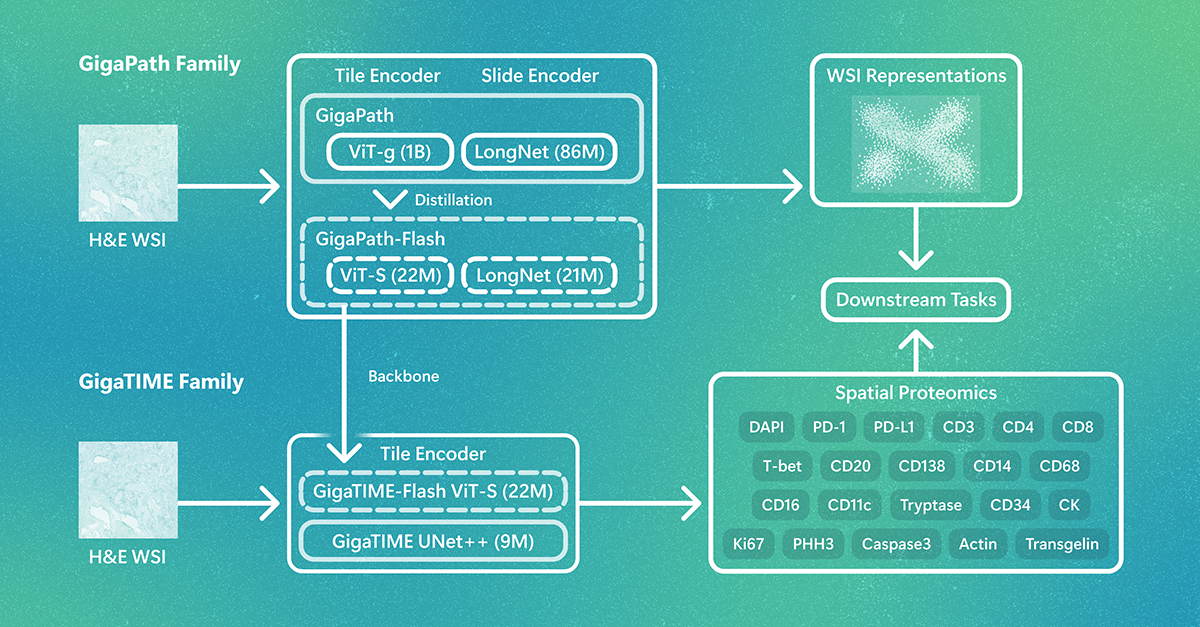
What if pathology foundation models could do more with less? GigaPath-Flash and GigaTIME-Flash cut computational demands while maintaining strong performance, opening the door to larger studies and broader exploration. The post GigaPath-Flash and GigaTIME-Flash: Toward population-scale discovery with efficient pathology foundation models appeared first on Microsoft Research.