Deep generative models---neural networks that learn data's distribution and sample from it---matured from variational autoencoders' latent geometry to diffusion models' state-of-the-art images. This article presents a narrative review of that arc's canonical line: Kingma and Welling's 2013 auto-encoding variational Bayes, Goodfellow and colleagues' 2014 generative adversarial networks, Mirza and Osindero's 2014 conditional GANs, Rezende and Mohamed's 2015 normalizing flows, Sohl-Dickstein and colleagues' 2015 nonequilibrium thermodynamics, Arjovsky and colleagues' 2017 Wasserstein GANs, Karras and colleagues' 2019 style-based generator, Ho and colleagues' 2020 denoising diffusion, Ramesh and colleagues' 2021 text-to-image generation, Dhariwal and Nichol's 2021 diffusion-beats-GANs result, Nichol and Dhariwal's 2021 improved diffusion, and Rombach and colleagues' 2022 latent diffusion. The synthesis is organized around three themes: latent foundations, in which autoencoders and flows made sampling principled; adversarial training, in which games between generator and discriminator produced realism; and diffusion's rise, in which denoising trajectories conquered synthesis. It is concluded that generative modeling's decade ran from likelihood's compromise to sampling's triumph---and that latent diffusion is the field's new foundation.
Zen Revista, 10 IA· Zenodo (CERN European Organi...· 0 citations
**The Carlo Void Call Canon** is a comprehensive theoretical continuum that unifies cognition, geometry, and logic into a single closed manifold. Across twenty expansions, it constructs the full mathematical and conceptual architecture of **Void Call** — the emergent signal of reflex–executive desynchronisation within hazard‑curved cognitive space. Beginning with **The Cognitive Mechanics of L’Appel du Vide**, the canon evolves through tensorial, geometric, algebraic, and topological formulations, culminating in the **Final Unified Carlo Void Call Equation** — the terminal synthesis of all prior structures. Each document represents a distinct layer of the Carlo‑Field system:- **Analytic Geometry** — hazard metrics, Ricci flow, Laplacian diffusion - **Algebraic Systems** — operator and gauge theory - **Symplectic & Field Dynamics** — Hamiltonian flow and Lagrangian structure - **Stochastic & Spectral Analysis** — probabilistic propagation and eigenmode decay - **Measure & Integration** — total hazard‑weighted intensity - **Quantum Analogue** — Hilbert‑space formalism of cognitive superposition - **Category, Functor, and Topos Theory** — structural logic and internal truth - **Sheaf & Cohomology** — local–global consistency and obstruction - **Unified Closure** — the final governing equation The canon is designed to be read sequentially, tracing the evolution of Void Call from its phenomenological origin to its mathematical completion. It ends with the total synthesis — the single equation that contains every prior form. --- The Final Unified Carlo Void Call Equation \[\boxed{\frac{\partial V}{\partial t}=\mathcal{C}'(\Delta)\left(\Delta_H \Delta+ \text{Ric}_H \cdot R- U'(\Delta)\right)+ \alpha \|F_{\mu\nu}\|+ \beta \|X_{\mathcal{H}_V}\|+ \gamma \kappa(t)+ \mathcal{C}'(\Delta)(\sigma_R - \sigma_E)\, dW_t+ \frac{1}{2}\,\mathcal{C}''(\Delta)(\sigma_R - \sigma_E)^2+ \sum_{j} \mathcal{L}_{ij} V_j+ \delta\Delta+ \left( V|_U \right)+ \mathfrak{V}(\Delta)}\] This equation unifies:- hazard geometry and curvature,- gauge and symplectic coupling,- stochastic diffusion,- multi‑agent leakage,- categorical and sheaf‑level projection,- cohomological obstruction. It is the **terminal object** of the Carlo‑Field architecture — the complete closure of the Void Call Canon. --- **Compiled by:** Matthew Carlo **Date of Completion:** 30 August 2026 **Location:** Quiet Village, Anglesey, United Kingdom **Canonical Status:** Fully Unified **Final Object:** The Carlo Void Call Equation Includes a standalone HTML file that encapsulates the complete Carlo Void Unified 3D Visualiser, bringing together real-time interactive geometry, WebGL shader dynamics, and advanced differential mathematical models. It runs entirely in the browser using Three.js for 3D manifold rendering, KaTeX for mathematical typography, and an underlying state engine governed by the formal canonical formulation. Mathematically, it simulates a coupled system tracking reflex generation $R(x,t)$, executive inhibition $E(t)$, and the cognitive gap $\Delta = R - E$, which drives the temporal evolution of the void variable $V(t)$ via a multi-perspective operator kernel incorporating Ricci curvature flows ($\Delta_H \Delta + Ric_H \cdot R$), Yang-Mills gauge curvature ($\Vert{}F_{\mu\nu}\Vert{}$), Hamiltonian symplectic vector fields ($\Vert{}X_{\mathcal{H}_V}\Vert{}$), stochastic Brownian noise ($dW_t$), and categorical sheaf cohomology ($V\vert{}_U$). Keywords & Subjects: Carlo Void Call Canon; hazard geometry; cognitive field dynamics; reflex–executive desynchronisation; Void Call; Carlo‑Field architecture; Ricci flow; hazard Laplacian; gauge theory; symplectic geometry; stochastic dynamics; spectral analysis; measure theory; quantum analogue; category theory; functorial mapping; topos theory; sheaf construction; cohomology; multi‑agent cognition; desynchronisation logic; unified field equation; mathematical cognition; geometric psychology; theoretical cognitive science. Contact: For enquiries or research questions related to this work, email matthewcarlo.research@gmail.com I can map the void because I’ve lived with the feeling long enough to know its contours — the flicker, the lag, the echo — until it became something I could draw instead of fear.-Matt
Matthew Arthur Carlo· Zenodo (CERN European Organi...· 0 citations
This paper introduces a rigorous mathematical framework named Sonic Cognition and Sensory Kinematics, bridging continuous cosmic/neural background fields with localized biophysical velocity responses. We define two infinite, unbounded coordinators—Sonic Light (\(SL\)) governing visual fields and Sonic Motion (\(SM\)) governing kinetics—which project into the tangible world as finite, localized agents (\(LS\) and \(MS\)) through discretization field operators. Focusing on vision-kinetic coupling during interactive physical events (e.g., a ball player tracking and striking a target), we formulate a coupled kinematic differential equation where mechanical motor velocity (\(\mathbf{v}_{MS}\)) accelerates proportionally to incoming visual information velocity (\(\mathbf{v}_{LS}\)), modulated by a central neural transfer tensor (\(\mathbf{T}_{brain}\)) and biological damping (\(\gamma \)). To map the temporal duality of human consciousness, we formalize the global Electro-Magnetic Biological (\(EMB\)) state using a time-dependent circadian switch matrix (\(\theta(t)\)). During the nighttime dream state (\(\theta(t) = 0\)), a strict boundary condition enforces total somatic motor disconnection (\(\mathbf{v}_{MS\_real} = \mathbf{0}\)), while the brain reconstructs an informational, virtual visual velocity (\(\mathbf{v}_{dream}\)) governed by non-linear memory diffusion equations. Numerical Python simulations of this complex dynamical system confirm a clean state transition at sleep onset, characterized by an instantaneous collapse of physical velocity alongside a computational spike and subsequent relaxation of virtual dream velocity. Finally, the framework applies this temporal integration to congenital blindness, proving analytically why a structural lack of lifetime visual source tokens results in an absolute zero value for visual dream vectors.
abdelhadi Abouelfida· Zenodo (CERN European Organi...· 0 citations
1. Summary This paper bridges the gap between macroscopic geotechnical engineering (soil consolidation and secondary creep) and microscopic pharmaceutical science (controlled-release polymer hydrogels). By replacing abstract phenomenological parameters with rigorous physical units, the framework demonstrates that both systems share an identical differential dissipation topology governed by coupled deformation and stress gradients. 2. Key Formulas & Equations Coupled State-Space Memory Equation: $$\frac{d}{dt} \begin{bmatrix} x(t) \\ p(t) \end{bmatrix} = \begin{bmatrix} 0 & \frac{1}{m_{eff}} \\ -k & -\gamma \end{bmatrix} \begin{bmatrix} x(t) \\ p(t) \end{bmatrix} - \int_{0}^{t} M(t-t') \begin{bmatrix} 0 \\ v(t') \end{bmatrix} dt'$$ (Where $x(t)$ is displacement/strain, $p(t)$ is momentum/stress, $k$ is structural stiffness, $\gamma$ is instantaneous damping, and $M(t-t')$ is the historical memory kernel). 3. Key Vocabulary & Keywords Isomorphic Topology: Identical mathematical structure governing disparate physical systems. Memory Kernel ($M(t)$): Integral term capturing historical relaxation and delayed energy dissipation over time. Non-Fickian Transport: Deviations from standard diffusion caused by polymer chain relaxation and swelling stress. Darcy Flow / Pore Pressure: Macroscopic hydraulic gradients driving fluid expulsion in granular media. 4. Physical Significance Eliminates the need for separate, disconnected empirical models for soil compaction and hydrogel drug delivery. Proves that apparent behavioral complexity across physical scales stems from parameter variation ($G, \eta, k_B$) rather than structural mathematical novelty. Provides a predictive pathway to fit experimental laboratory trial data directly into a unified differential framework. 5. License & Archival Metadata Repository Target: Zenodo Preprint Repository. License Recommendation:Creative Commons Attribution-NonCommercial-NoDerivatives 4.0 International (CC BY-NC-ND 4.0) Attribution: Independent Research Conspectus, under the Conserved Informational Modulation (CIM) and Systemic Relaxation Tensors framework.
Egidijus Kasiulevičius, Azuolas Kasiulevicius, Saule Kasiuleviciute et al.· Zenodo (CERN European Organi...· 0 citations
Reach audiences
Advertise in front of researchers, engineers, and readers.
Medical geography---the study of where disease occurs and why place matters to health---began with a map: John Snow's 1855 tracing of cholera's deaths to the Broad Street pump, the field's founding demonstration that contagion has an address. This article presents a narrative review of that arc's canonical line: Snow's 1855 On the Mode of Communication of Cholera, May's 1958 The Ecology of Human Disease, Learmonth's 1988 Disease Ecology, Cliff and Haggett's 1988 Atlas of Disease Distributions, Gould's 1993 The Slow Plague, Smallman-Raynor and Cliff's 2004 War Epidemics, Haggett's 2000 The Geographical Structure of Epidemics, Meade and Earickson's 2000 Medical Geography, Mayer's 2000 essay on emerging infections, Ostfeld, Keesing, and Eviner's 2008 Infectious Disease Ecology, Keeling and Rohani's 2008 Modeling Infectious Diseases, and Brockmann and Helbing's 2013 hidden geometry of networked contagion. The review is organized around three themes: origin, in which Snow's mapping established place's causal role; diffusion, in which the waves' and hierarchies' and war's structures of epidemic spread were mapped; and synthesis, in which ecology's, modeling's, and network science's frameworks unified the field. It is concluded that medical geography is epidemiology's spatial conscience---the discipline that remembers every epidemic is also a map---and that its methods now run the world's outbreak responses.
Zen Revista, 10 GEOGRAPHY· Zenodo (CERN European Organi...· 0 citations
Paper 02 showed that a pure solid angle of four pi appears in an inverse-square field. This paper asks when that four pi does not appear; the answer is the moment the source stops being a point. Raising the dimension of the source by one alone turns four pi into two pi and turns the one-over-r fall into a logarithm. No new mathematical theorem and no new law is claimed. Scope of this paper (scope note): no new mathematical theorem and no new law is claimed. The potentials of point, line and plane sources, the volume-conductor approximation, and Krogh's cylinder model are all standard. No electrophysiology is built ── what is used is three solutions, one square root, and a conversion of units. The origin of the four pi is not discussed ── Paper 02 treats that, and this paper treats only the converse, the condition under which that four pi disappears. Inverse problems are not entered ── Paper 99 asks whether the interior conductivity can be recovered from boundary data and Paper 159 separated the senses of ill-posedness, while this paper looks in the forward direction alone, asking which solid angle appears once the shape of the source is given. Capture rates are not treated ── Paper 249 treated the Smoluchowski capture rate for a sphere, in steady state, with an absorbing boundary, whereas this paper takes a cylinder, includes a consumption term, and asks not for a capture rate but for a reach. No physiological claim is made ── no account is offered of why capillaries are arranged as they are; an agreement is reported and no cause is asserted. Tissue is treated as isotropic and homogeneous ── real tissue is neither, and the numbers are values for seeing orders of magnitude rather than measurements on a particular tissue. The source is treated as an infinitely long cylinder ── at finite length the ends return towards four pi, and what is claimed is only that in the infinitely long limit the four pi does not appear. The relation to earlier papers. Paper 02 showed that a pure solid angle of four pi appears in an inverse-square field; this paper writes the domain of that four pi, namely that it appears only when point source, three dimensions and isotropy hold together. Paper 249 showed that the four pi that catches molecules and the four pi that spreads a field share a root; this paper sets out the cases where the same four pi does not appear, since confirming a shared root and confirming a domain are two halves of one thing. Paper 01 showed from four directions that n equals two is unique; what this paper moves is the dimension of the source rather than the exponent, a different axis. Paper 199 wrote that what decides whether you come home is the exponent in the denominator; the fourth section here likewise sets out the form of the denominator, but asks about the fall rather than about recurrence. Paper 112 counted resolution as one of six distinct roots; measurement resolution is not treated here. First, for a point source the four pi stands in the denominator. With a current of one microampere in a medium of conductivity 0.33 siemens per metre, the potential is 48.2288 microvolts at five millimetres, 24.1144 at ten, 12.0572 at twenty and 4.8229 at fifty. Doubling the distance halves the potential exactly, and the four pi in the denominator, 12.566371, is the whole solid angle of the sphere itself. Second, this is the core. Make the source an infinitely long line and the four pi disappears, leaving two pi and a logarithm. With a current of ten to the minus four amperes per metre the prefactor is 4.822877e-5 volts, and the potential difference is that prefactor times the logarithm of the ratio of distances: 33.4296 microvolts for a ratio of two, 111.0508 for ten, and 222.1017 for a hundred. Raising the dimension of the source from zero to one alone halved the solid angle in the denominator, from 12.566371 to 6.283185. Third, the fall itself reverses direction. Taking one millimetre as the reference for the line source and comparing over the same distances, the point source gives 120.5719 microvolts at two millimetres falling to 4.8229 at fifty, a factor of 25.0, while the line source gives 33.4296 rising to 188.6721, a factor of 5.64 in the other direction. The same distance is being travelled and the directions are opposite. One cannot say that a field weakens with distance without first writing down the shape of the source. The separator is raising the dimension of the source by one, and nothing else: neither the medium, nor the current, nor the number of dimensions of the space has been moved. Fourth, three sources are called over. A point, of dimension zero, gives four pi equal to 12.566371 and falls as one over r. A line or cylinder, of dimension one, gives two pi equal to 6.283185 and falls as a logarithm. A plane or layer, of dimension two, gives two pi and does not fall at all. Each rise in the dimension of the source flattens the fall by one step. The four pi appears in the first row alone, and written out the condition has three items, point source, three dimensions and isotropy, any one of which suffices to remove it when lost. Fifth, sources in living tissue are often cylinders. Oxygen diffuses out of a capillary and is consumed on the way, with a reach equal to the square root of twice the diffusion coefficient times the wall concentration divided by the consumption. With a diffusion coefficient of 2.0e-9 square metres per second, a solubility of 1.4e-3 moles per cubic metre per millimetre of mercury and a partial pressure of forty, the wall concentration is 0.056000 moles per cubic metre. Resting skeletal muscle, consuming 0.3 millilitres per hundred grams per minute, gives 2.232143e-3 moles per cubic metre per second and a reach of 316.8 micrometres; moderate work gives 100.2 micrometres; and maximal exercise, fifty times the resting demand, gives 1.116071e-1 and a reach of 44.8 micrometres. Sixth, that length is not set by the resting demand. The observed capillary spacing, the Krogh radius, is twenty to eighty micrometres. At the resting demand the reach extends to 316.8 micrometres, four times further, so the observed spacing looks excessive; what it matches is the demand at maximal exercise. The length is set by the maximum rather than the average. Since the reach falls as the inverse square root of the consumption, a demand fifty times larger shrinks the distance by the square root of fifty, 7.0711, and 316.8 divided by 7.0711 is 44.8, so the first and third rows correspond exactly. Stated honestly, this paper reports an agreement and no more; it does not claim that the arrangement of capillaries is set by the maximal demand, since that would require evidence from the developmental side which this paper does not have, and treating the tissue as isotropic and homogeneous is also a departure from the real thing. Closing. The four pi that Paper 02 found is not something that appears everywhere. It appears only when point source, three dimensions and isotropy hold together, and raising the dimension of the source by one alone removes it. What appears after it has gone is two pi and a logarithm, and the fall points the other way: over the same distance the point source becomes 25.0 times weaker while the line source becomes 5.64 times stronger. And sources in living tissue are often not points. A capillary is a cylinder, and the reach around it is 316.8 micrometres at rest and 44.8 at maximal exercise, the latter being what matches the observed spacing. One thing separates them, which is writing down the dimension of the source. Write it down, and the occasions where four pi may be used separate from the occasions where using it is wrong by a factor of two. Do not write it down, and one fits a one-over-r to a field that grows stronger with distance. On the making of this work: The ideas and content of this work stem from the author's own considerations. Assistance from an AI (a large language model) was used for structuring, English translation, and checking the algebra. Any remaining errors or misinterpretations are solely the author's. Feedback and corrections are sincerely appreciated. ----- 論文02 は、逆二乗場に純粋な立体角 4π が現れることを示した。本稿が問うのは、その 4π はいつ現れないのかである。答は、源が点でなくなった瞬間である。源の次元を一つ上げるだけで、4π は 2π になり、1/r という落ち方は対数に変わる。新しい数学定理も新しい法則も主張しない。 本稿の射程(射程注記):新しい数学定理も新しい法則も主張しない。点源・線源・面源の電位、容積導体という近似、クローの円柱模型は、いずれも標準的である。電気生理学を作らない──使うのは三つの解と、一つの平方根と、単位の換算だけである。4π の由来を論じない──論文02 が扱う。本稿は逆に、その 4π が消える条件だけを扱う。逆問題に入らない──論文99 は境界データから内部の導電率を復元できるかを問い、論文159 は不良設定を分けた。本稿は順方向であり、源の形が与えられたときにどの立体角が出るかだけを見る。捕捉率を扱わない──論文249 はスモルコフスキーの捕捉率を球・定常・吸収境界で扱った。本稿は円柱で、消費項があり、問うのが捕捉率ではなく到達距離である。生理学を主張しない──毛細血管の配置がなぜそうなっているかの説明を与えない。一致を報告するだけであり、因果を述べない。生体組織を等方均質として扱っている──現実の組織は異方的で不均質である。数値は桁を見るための値であり、特定の組織の測定値ではない。源を無限に長い円柱として扱っている──有限長では端で 4π 側へ戻る。本稿が言うのは、無限に長い極限で 4π が出ないという一点である。 既刊との関係。論文02 は逆二乗場に純粋立体角 4π が現れることを示した。本稿はその 4π の定義域を書く。点源・三次元・等方の三つが揃ったときだけである。論文249 は拡散が捕らえる 4π と場が広がる 4π が同根だと示した。本稿は同じ 4π が出ない場合を並べる。同根の確認と、定義域の確認は対になっている。論文01 は n = 2 が唯一であることを四方向から示した。本稿が動かすのは指数ではなく源の次元であり、別の軸である。論文199 は帰ってこられるかを分母の指数が決めると書いた。本稿の第4節も分母の形を並べるが、問うのは再帰性ではなく落ち方である。論文112 は分解能を六つの別根の一つに数えた。本稿は測定の分解能を扱わない。 第一に、点源では 4π がそのまま分母に立つ。電流 1 マイクロアンペア、導電率 0.33 S/m で、電位は 5 mm で 48.2288 マイクロボルト、10 mm で 24.1144、20 mm で 12.0572、50 mm で 4.8229 になる。距離を 2 倍にすると電位はちょうど半分になり、分母の 4π=12.566371 は球の全立体角そのものである。 第二に、これが本稿の芯である。源を無限に長い線にすると 4π が消え、2π と対数が出る。単位長あたり 10 のマイナス4乗アンペアなら前係数は 4.822877e-5 ボルトで、電位差はその前係数に距離の比の対数を掛けたものになる。比が 2 なら 33.4296 マイクロボルト、10 なら 111.0508、100 なら 222.1017 である。源の次元を 0 から 1 に上げただけで、分母の立体角が 12.566371 から 6.283185 に半分になった。 第三に、落ち方そのものが逆を向く。線源の基準を 1 mm にとって同じ距離で並べると、点源は 2 mm で 120.5719 マイクロボルト、50 mm で 4.8229 まで 25.0 分の 1 に落ちるのに、線源は 33.4296 から 188.6721 へ 5.64 倍に増える。同じ距離を離れているのに向きが逆である。源の形を書かずに「距離が離れれば弱くなる」と言うことはできない。分離子は源の次元を一つ上げることだけであって、媒質も、電流も、空間の次元数も動かしていない。 第四に、三つの源で立体角を点呼する。次元 0 の点は 4π=12.566371 で 1/r に落ち、次元 1 の線(円柱)は 2π=6.283185 で対数に落ち、次元 2 の面(層)は 2π で距離に依らない。源の次元を一つ上げるたびに、落ち方が一段平らになる。4π が出るのは一行目だけであり、条件を書き出すと点源・三次元・
Yuuki Yamagishi· Zenodo (CERN European Organi...· 0 citations
Deep generative models---neural networks that learn data's distribution and sample from it---matured from variational autoencoders' latent geometry to diffusion models' state-of-the-art images. This article presents a narrative review of that arc's canonical line: Kingma and Welling's 2013 auto-encoding variational Bayes, Goodfellow and colleagues' 2014 generative adversarial networks, Mirza and Osindero's 2014 conditional GANs, Rezende and Mohamed's 2015 normalizing flows, Sohl-Dickstein and colleagues' 2015 nonequilibrium thermodynamics, Arjovsky and colleagues' 2017 Wasserstein GANs, Karras and colleagues' 2019 style-based generator, Ho and colleagues' 2020 denoising diffusion, Ramesh and colleagues' 2021 text-to-image generation, Dhariwal and Nichol's 2021 diffusion-beats-GANs result, Nichol and Dhariwal's 2021 improved diffusion, and Rombach and colleagues' 2022 latent diffusion. The synthesis is organized around three themes: latent foundations, in which autoencoders and flows made sampling principled; adversarial training, in which games between generator and discriminator produced realism; and diffusion's rise, in which denoising trajectories conquered synthesis. It is concluded that generative modeling's decade ran from likelihood's compromise to sampling's triumph---and that latent diffusion is the field's new foundation.
Zen Revista, 10 IA· Zenodo (CERN European Organi...· 0 citations
The Langmuir adsorption isotherm of surface chemistry theta=Kp/(1+Kp), the Fermi distribution of solid-state physics f=1/1+e^(E-mu)/kT, and the Michaelis--Menten expression of enzyme kinetics v/V_max=[S]/(K_m+[S])──these three share a form. This paper asks whether that is an accidental likeness (a rhyme) or the same root──the answer is the same root. No new mathematical theorem and no new law is claimed. Scope of this paper (scope note): No new mathematical theorem and no new law is claimed──the Langmuir, Fermi--Dirac, Michaelis--Menten, Freundlich and BET expressions are all standard. We do not build statistical mechanics──all we use is one change of variable and one division. We do not derive the Fermi distribution──we do not enter the derivation from the grand canonical ensemble. We do not discuss the mechanism of adsorption──heat of adsorption, surface diffusion, and the distinction between chemisorption and physisorption are not treated at all. We do not discuss enzyme mechanism──the Michaelis--Menten expression follows from a steady-state approximation, and the validity of that approximation is not treated. Only the agreement of form is treated. We do not say the three are “the same phenomenon”──what agrees is the form of the distribution function, not the phenomena. The Fermi distribution comes from quantum statistics, Langmuir from an equilibrium constant, Michaelis from reaction rates: the routes of derivation differ. The Michaelis root is weaker──the agreement of Langmuir and Fermi rests on the same root, exclusion, whereas the Michaelis “site” is the separate circumstance that one enzyme molecule binds one substrate. This paper does not claim it as a third case of the same root, and keeps it to the agreement of form. Relation to earlier papers: Paper 112 counted “six distinct roots sharing one rhyme”──this paper is the converse case, an example where not only the rhyme but the root is the same. It is set as the counterpart to 112. Paper 265 showed that what separated the low-temperature models is the density of states──this paper is on the distribution-function side and does not treat the density of states. Paper 274 showed that Drude was right through the cancellation of two errors──the agreement here is not a cancellation but an identity. Paper 220 counted four things called “independence”──the “exclusion” there is the mutual exclusivity of probabilistic events, a different thing from the exclusion of sites here. What is added is confirming at five points that a change of variable makes the difference between the two expressions 0, naming the root as exclusion, confirming that 0.1->0.5 and 0.5->0.9 both take 9 times, and separating the three expressions by the presence or absence of saturation. First, changing the variable makes the difference 0. Setting Kp=e^(mu-E)/kT, the difference at five points is 0 or below 10^-16 (Section 2). Second, this is the core of the paper. The root is that one site takes only 0 or 1, and if the exclusion is the same, the distribution is the same (Section 3). Third, the fuller the sites, the less it acts. Raising theta from 0.9 to 0.99 takes 11 times the pressure; from 0.5 to 0.999 it takes 999 times (Section 4). Fourth, the first half is symmetric. Both 0.1->0.5 and 0.5->0.9 take exactly 9 times (Section 4). Fifth, the same 11 appears on the Michaelis side. Raising v/V_max from 0.9 to 0.99 takes 11 times the substrate concentration (Section 5). Sixth, the separator is whether the number of sites is finite. The Freundlich expression does not saturate, and the BET expression diverges as theta->infinity (Section 6). The Langmuir isotherm and the Fermi distribution are not alike; they are one and the same expression. Merely setting Kp=e^(mu-E)/kT makes the difference at all five points 0 or the size of rounding. The root is one line──a single site takes only 0 or 1. So the grand partition function stops at two terms, and if the exclusion is the same the distribution is the same. Numerical intuition transfers unchanged──the 11 times the pressure needed to raise theta from 0.9 to 0.99 is the same number as the 11 times the substrate needed to raise v/V_max from 0.9 to 0.99. And 0.1->0.5 and 0.5->0.9 both take exactly 9──symmetric about a half. One thing separates them──whether the number of sites is finite. If it is, this form follows; if not, it diverges as Freundlich and BET do. Not the field. Where Paper 112 counted six distinct roots under one rhyme, here the root is the same as well, and that is why the difference is 0. On the making of this work: The ideas and content of this work stem from the author's own considerations. Assistance from an AI (a large language model) was used for structuring, English translation, and checking the algebra. Any remaining errors or misinterpretations are solely the author's. Feedback and corrections are sincerely appreciated. ----- 表面化学のラングミュア吸着等温式 theta=Kp/(1+Kp)、固体物理のフェルミ分布 f=1/1+e^(E-mu)/kT、酵素反応のミカエリス=メンテン式 v/V_max=[S]/(K_m+[S])──この三つは同じ形をしている。本稿が問うのは、これが偶然の似姿(韻)か、同じ根かである──答は、同じ根である。新しい数学定理も新しい法則も主張しない。 本稿の射程(射程注記):新しい数学定理も新しい法則も主張しない──ラングミュア式、フェルミ=ディラック分布、ミカエリス=メンテン式、フロインドリヒ式、BET 式は、いずれも標準的である。統計力学を作らない──使うのは一つの変数変換と、一つの割り算だけである。フェルミ分布を導出しない──大正準集団からの導出には立ち入らない。吸着の機構を論じない──吸着熱も、表面拡散も、化学吸着と物理吸着の区別も一切扱わない。酵素反応機構を論じない──ミカエリス=メンテン式は定常状態近似の帰結であり、その近似の妥当性は扱わない。形の一致だけを扱う。三つが「同じ現象」だと言わない──一致するのは分布関数の形であって、現象そのものではない。フェルミ分布は量子統計から、ラングミュアは平衡定数から、ミカエリスは反応速度から出ており、導出の道筋は違う。ミカエリスの根は弱い──ラングミュアとフェルミの一致は排他という同じ根を持つが、ミカエリスの「席」は酵素分子一つが基質一つを結合するという別の事情である。本稿はこれを「同じ根の第三例」とは主張せず、形の一致にとどめる。既刊との関係:論文112 は「同じ韻を踏む六つの別根」を数えた──本稿は逆の場合であり、韻だけでなく根まで同じ例である。112 の対照として置く。論文265 は低温比熱を分けたのが状態密度だと示した──本稿は分布関数の側であり、状態密度は扱わない。論文274 はドルーデが二つの間違いの打ち消しで当たったと示した──本稿の一致は打ち消しではなく、同一性である。論文220 は「独立」が四つあると数えた──そこでの「排他」は確率事象の排反であり、本稿の「席の排他」とは別物である。加えたのは変数変換によって二式の差が 0 になることを五点で確かめたこと、根が排他であると名指したこと、0.1->0.5 と 0.5->0.9 がどちらも 9 倍だと確かめたこと、飽和の有無を分離子として三式を分けたことである。 第一に、変数を置き換えると差が 0 になる。 Kp=e^(mu-E)/kT と置くと、五点で差が 0 または 10^-16 以下である(第2節)。 第二に、これが本稿の芯である。根は「一つの席は 0 か 1 しか取れない」ことであり、排他が同じなら分布も同じである(第3節)。 第三に、席が埋まるほど効かなくなる。 theta を 0.9->0.99 にするのに圧力は 11 倍、0.5->0.999 には 999 倍要る(第4節)。 第四に、前半は対称である。0.1->0.5 も 0.5->0.9 もどちらもちょうど 9 倍である(第4節)。 第五に、ミカエリス側で同じ 11 倍が出る。 v/V_max を 0.9->0.99 にするのに基質濃度は 11 倍(第5節)。 第六に、分離子は「席の数が有限か」である。フロインドリヒ式は飽和せず、BET 式は theta->infinity に発散する(第6節)。 ラングミュア吸着等温式とフェルミ分布は、似ているのではなく同じ一つの式である。 Kp=e^(mu-E)/kT と置くだけで、五点すべてで差が 0 または丸め誤差の大きさになる。根は一行しかない──一つの席が 0 か 1 しか取れないこと。だから大分配関数が二項で止まり、排他が同じなら分布も同じになる。数値の直観もそのまま移る──theta を 0.9->0.99 にするのに要る圧力 11 倍は、酵素で v/V_max を 0.9->0.99 にするのに要る基質濃度 11 倍と同じ数である。そして 0.1->0.5 と 0.5->0.9 がどちらもちょうど 9 倍──半分のまわりで対称である。分けるものは一つ──席の数が有限かどうか。有限ならこの形になり、有限でなければフロインドリヒや BET のように発散する。分野ではない。論文112 が「同じ韻の別根」を六つ数えたのに対し、ここでは根まで同じであり、だから差が 0 になる。 作成にあたって:本稿の着想と内容は、著者自身の考察に基づくものです。文章の構成整理や英訳、数式の確認には AI(大規模言語モデル)の助力を得ました。最終的な内容の解釈や誤りがあれば、それらはすべて著者の責に帰します。お気づきの点があれば、ご教示いただければ幸いです。
Yuuki Yamagishi· Zenodo (CERN European Organi...· 0 citations
To mitigate the adverse health and environmental impacts of soot emissions from combustion, this study combines experimental measurements with numerical simulations to investigate the effects of H 2 and CO 2 /H 2 O addition on soot formation in ethylene laminar diffusion flames. Experimentally, a two-color pyrometry method was employed to map the two-dimensional distributions of temperature and soot volume fraction. Numerically, a detailed model incorporating PAH-based soot dynamics, gas-phase chemistry, and heat and mass transfer was applied. Results indicate that: The experimental results show good agreement with the simulations. Among the operating conditions examined, the combined addition of H 2 and CO 2 exerted the strongest inhibitory effect, reducing peak temperature and soot volume fraction by 16% and 58%, respectively. In contrast, simple dilution with hydrogen was considerably less effective than modifying the oxygen-enriched atmosphere. Notably, under identical oxygen-enriched conditions, the chemical effect of hydrogen reduced soot-related radiation and heat loss, leading to a slight temperature increase of 0.58%. Mechanistic analysis of intermediate species reveals that the H 2 +CO 2 synergy broadly suppresses soot formation pathways. For the H 2 +H 2 O case, while nucleation and condensation rates are moderately enhanced, the OH oxidation rate is significantly promoted, resulting in net soot inhibition. Sensitivity analysis further identifies key reaction channels: H 2 +CO 2 synergy inhibits the generation of A1 by consuming OH through R149 (upstream regulation), but also suppresses A1 formation by weakening R393 (i-C 4 H 5 + C 2 H 2 = A1 + H) (downstream regulation). Whereas R148 (H + H 2 O → H 2 +OH) dominates the inhibiting effect when H 2 O is present alongside H 2 . These findings provide valuable guidance for the development of carbon-free fuel combustion strategies aimed at reducing particulate emissions.
Bing Liu, Shuoran Wang, Hao Huang et al.· Thermal Science and Engineer...· 0 citations
Commercial LTA-type zeolite was evaluated for the adsorption of Mn2+ and Zn2+ from aqueous solutions, with emphasis on the relationship between framework properties and adsorption behavior. Despite its very low BET surface area, the zeolite showed rapid and highly efficient uptake of both metal ions, reaching near-equilibrium within the first minute. Kinetic modeling indicated site-controlled adsorption consistent with pseudo-second-order behavior, while equilibrium data were described by the Langmuir model, confirming monolayer adsorption on uniform exchange sites. Intraparticle diffusion played a secondary role, and Zn2+ exhibited faster site occupation than Mn2+. Stoichiometric analysis of Na+ release during adsorption, together with blank experiments, demonstrated that metal uptake occurs mainly through Na+/divalent ion exchange within the zeolite framework, with partial release of loosely bound sodium. This ion-exchange mechanism explains the high adsorption capacities obtained despite the very low external surface area, since performance is governed by framework charge density rather than surface adsorption. Germination assays with Cucumis sativus showed no acute phytotoxic effects for metal-loaded zeolites, indicating potential for safe reuse as a micronutrient source. These results demonstrate that commercial LTA zeolite enables fast and efficient metal removal and provide a proof-of-concept for sustainable post-adsorption valorization of the spent material.
A. Leite, T. S. Costa, T. L. M. Moura et al.· International Journal of Env...· 0 citations
The low-altitude economy, characterized by high-tech support, efficient operations, and high-quality development, has become a new engine for cultivating new quality productive forces in agriculture and accelerating the modernization of agriculture and rural areas. Based on the Chinese government’s new development philosophy, this study constructs a comprehensive index of high-quality agricultural development. Using panel data for 31 provinces in China from 2004 to 2024, this study employs a difference-in-differences model and a mediation-effect model to empirically examine the impact of the low-altitude economy on high-quality agricultural development. The results show that the low-altitude economy significantly promotes high-quality agricultural development. Further analysis indicates that the low-altitude economy indirectly drives high-quality agricultural development by promoting technology diffusion and labor mobility. Among the mediating channels, technology diffusion has the strongest mediating effect, while the coefficient of the mediating effect of capital flow is positive but statistically insignificant. The promotion effect of the low-altitude economy on high-quality agricultural development is more pronounced in major grain-consuming areas, eastern and central regions, and regions with higher levels of digital infrastructure. Accordingly, this study proposes policy recommendations in terms of rationally arranging agricultural low-altitude application scenarios, facilitating factor mobility, and implementing differentiated regional development paths for the low-altitude economy. These findings provide empirical references for relevant departments to scientifically formulate low-altitude economic development plans and promote high-quality agricultural development.
Fang-Xiang Jiang, Qiong Zhang· Frontiers in Sustainable Foo...· 0 citations
A task-relative theory of what may be forgotten, what may be ignored in practice, and what need not be physically maintained Reduced representations can be sufficient in at least three inequivalent senses: they may close under a declared family of future continuations, support near-optimal decisions for a specified objective, or admit economical physical realization. We formalize these as structural, operational, and physical future sufficiency. For finite-horizon controlled Markov systems, exact quotient conditions yield Bellman factorization. In finite-dimensional linear systems, backward propagation of task observables gives the minimal robust future-relevance family, with a continuous-time moving-null criterion characterizing exact closure. For finite-horizon linear-quadratic regulation, we define a strong closure residual, construct a nearby exactly closed surrogate problem, and obtain a local quadratic policy-regret certificate. A controlled perturbation experiment reproduces the predicted first-order gain deviation and second-order regret scaling. Exact counterexamples and a diffusion-control comparison show that strong closure is nevertheless not necessary for near-optimal control: performance-oriented reductions can tolerate substantial structural nonclosure and attain much smaller operational order. We then distinguish reduced control dimension from physical realization burden. Effective-support and mobility bounds show that low operational rank need not imply localized or inexpensive implementation, while a Clifford-circuit construction exhibits rank-one observable relevance with extensive Pauli support. The resulting framework treats closure as a robustness guarantee rather than a universal compression optimum and identifies the additional assumptions required to convert informational reduction into physical resource advantage. Keywords: future sufficiency; controlled quotients; model reduction; optimal control; LQR; state aggregation; bisimulation; physical realization; quantum control; coheroputation Scope and claim discipline This paper does not claim that task-oriented model reduction, state aggregation, bisimulation, balanced truncation, reduced Riccati control, observable backpropagation, or a posteriori reduced-control certification are new. Those are mature areas with substantial prior art [3–13]. The contribution is narrower: the paper places robust structural closure, task-performance sufficiency, and hardware-relative physical sufficiency in one explicit hierarchy; develops a particular strong-closure residual and exactly closed surrogate for finite-horizon LQR; and proves no-go separations showing why reduced informational dimension alone cannot be promoted to a physical resource claim.
Philip Lilien· Zenodo (CERN European Organi...· 0 citations
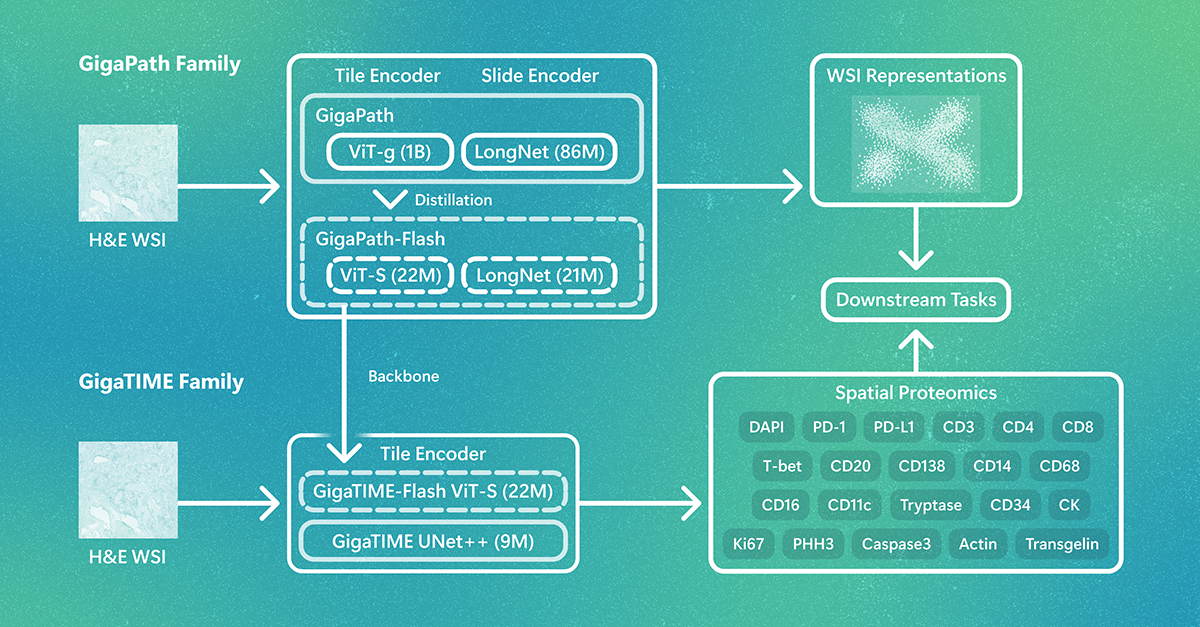
What if pathology foundation models could do more with less? GigaPath-Flash and GigaTIME-Flash cut computational demands while maintaining strong performance, opening the door to larger studies and broader exploration. The post GigaPath-Flash and GigaTIME-Flash: Toward population-scale discovery with efficient pathology foundation models appeared first on Microsoft Research.
We use cookies to run the site and, with your consent, for analytics and to show ads.
See our Cookie Policy.