TorchEBM is a PyTorch library for generative models defined either by a scalar potential or by a transport between densities. Energy-based models, diffusion, flow matching, and Schrödinger bridges are factored into one set of composable primitives: energies and fields, interpolants, couplings, training objectives, samplers, and numerical integrators. Simulation-free objectives such as flow matching, equilibrium matching, and denoising score matching require no sampling in the training loop; sampling-based objectives such as contrastive divergence remain available where a calibrated energy is needed.
Soran Ghaderi· Zenodo (CERN European Organi...· 0 citations
This dataset contains all input files, simulation results, and a master data table from molecular dynamics (MD) simulations of ion transport in electrolyte-filled slit nanopores, performed with GROMACS version 2024.2. Both charge-neutral and surface-charged pore systems are included. The associated publication is: "Interfacial adsorption and field-assisted hopping govern ion conductivity in electrolyte-filled nanopores" Simulation Input Files GROMACS input files necessary to reproduce the simulations are provided for both neutral and charged pore systems. The surface–ion interaction strength (ionophilicity) is controlled through the Lennard-Jones parameters in ffnonbonded.itp, which can be varied across eight values for the neutral case and two representative values (low and high ionophilicity) for the charged case. For the charged systems, the surface charge density is defined in ffnonbonded.itp and in the topology files CG_bot_charged.itp and CG_top_charged.itp, which specify the charge distribution on the bottom and top pore walls, respectively. Initial configuration files and run parameter files (grompp.mdp) are provided for all systems. Master Data Table A CSV file (simulation_master_table.csv) is included in which each row corresponds to a single simulation and columns specify the pore width, ionophilicity parameters, surface charge density, applied electric field, system composition, and all key extracted results (ionic current, Green–Kubo conductivity, ion-pairing correlation factor, diffusion coefficients, and adsorption free energies). This file provides a complete mapping between simulation parameters and results. Simulation Results — Neutral Pores Results are provided across five pore widths (H = 0.9, 1.9, 2.6, 4.8, and 9.2 nm) and eight ionophilicity values: Ionic current under applied electric fields of 0.0–1.0 V/nm, with block-averaging standard errors, extracted via the Helfand moment method. Green–Kubo conductivity (σ_GK), Nernst–Einstein conductivity (σ_NE), cross-correlation conductivity (σ_cross), and the ion-pairing correlation factor (β), computed from zero-field equilibrium simulations. In-plane diffusion coefficients for Na⁺ and Cl⁻ from mean-squared displacement analysis at zero electric field. Adsorption free energies (ΔG_min) for Na⁺ and Cl⁻ from Boltzmann inversion of the equilibrium density profiles. Simulation Results — Charged Pores Results are provided for three pore widths (H = 1.9, 4.8, and 9.2 nm), four surface charge densities (Σ_s = 0.5, 1.0, 1.5, and 2.0 e/nm²), and two ionophilicity values: Total, interfacial, and pore-center ionic currents under applied electric fields of 0.0–1.0 V/nm, with block-averaging standard errors. Simulation Protocols All simulations used the Nosé–Hoover thermostat at 300 K with a relaxation constant of 1.0 ps and the SPC/E water model. Electrolyte concentration was 1 M NaCl. For full details of the simulation protocols, theoretical framework, and analysis methods, please refer to the associated publication. If further clarification is needed, please contact the corresponding author: Mohammad Javad Abdolhosseini Qomi — mjaq@uci.edu
Jerry Peprah Owusu· Zenodo (CERN European Organi...· 0 citations
We study traveling wave solutions in a nonlinear reaction-diffusion model incorporating a weak spatiotemporal distributed memory kernel. The model describes a single-species population whose movement is influenced by both random diffusion and memory-based dispersal, with the latter expressed as a convolution term involving a temporal weighting function and a spatial Green’s function. This framework captures the gradual decay of spatial memory and its effect on dispersal dynamics. Using perturbation expansions, operator theory, and the Banach fixed-point theorem, we establish the existence of traveling wavefronts connecting equilibrium states in two parameter regimes: (i) a small memory-based diffusion coefficient and (ii) a large wave speed. The analysis addresses significant challenges arising from the nonlocal, nonlinear memory term by employing integral equation representations and precise estimates. Numerical simulations illustrate how the memory diffusion coefficient and mean delay influence wave speed, front shape, and population distribution. The results provide a rigorous characterization of wave propagation in systems with weak distributed memory, offering a unified approach applicable to models in population dynamics, biological invasion, and other spatiotemporal processes with memory effects.
Luhong Ye, Hao Wang· CSIAM transactions on life s...· 0 citations
Reach audiences
Advertise in front of researchers, engineers, and readers.
The continuous scaling of microelectronic technologies has made back-end-of-line (BEOL) interconnect reliability increasingly sensitive to non-uniform thermal conditions. Reduced interconnect dimensions, high current densities, Joule heating, and nearby heat sources can generate pronounced temperature gradients along metal lines. Under such conditions, temperature is no longer merely a scalar parameter controlling diffusion kinetics: its spatial gradient introduces an additional driving force for atomic transport, known as thermomigration (TM). The resulting mass transport can interact with electromigration (EM) and stress migration (SM), thereby modifying void nucleation, void growth, and ultimately interconnect lifetime. This PhD investigates the impact of thermal gradients on the reliability of metal interconnects, with a particular focus on Cu interconnects. Experimental studies are combined with finite-element simulations and analytical modelling to quantify temperature distributions, thermally driven atomic transport, and the resulting reliability degradation. Dedicated test structures are used to investigate TM-induced void formation and growth under controlled non-uniform temperature fields. Analytical and numerical models are developed to describe TM-driven mass transport and to predict critical regions for void nucleation and growth. The interaction of TM with other driving forces, particularly EM and mechanically induced stress gradients, is also investigated to establish a more complete description of atomic flux under realistic operating conditions. The developed framework further enables lifetime estimation under combined electrical and thermal loading. The results demonstrate that sufficiently strong and non-uniform temperature distributions can significantly alter interconnect degradation and, under relevant conditions, make TM an important contributor to reliability failure. This work provides a physics-based framework for assessing interconnect reliability in the presence of thermal gradients and supports more accurate lifetime prediction for advanced microelectronic technologies.
Abstract Traditional mathematical models of traffic flow and driver behavior rely on integer-order calculus, which assumes localized, instantaneous changes. However, real-world traffic systems exhibit strong memory effects, non-local interactions, and anomalous diffusion. This paper explores the application of fractional calculus utilizing non-integer orders in reducing road accidents. By integrating fractional derivatives into traffic flow dynamics, viscoelastic tire-road friction models, and advanced driver assistance systems (ADAS), we demonstrate how capturing hereditary properties can optimize highway design, vehicular control, and active safety systems to actively prevent collisions.
S. V. Nakade· Zenodo (CERN European Organi...· 0 citations
Abstract Traditional mathematical models of traffic flow and driver behavior rely on integer-order calculus, which assumes localized, instantaneous changes. However, real-world traffic systems exhibit strong memory effects, non-local interactions, and anomalous diffusion. This paper explores the application of fractional calculus utilizing non-integer orders in reducing road accidents. By integrating fractional derivatives into traffic flow dynamics, viscoelastic tire-road friction models, and advanced driver assistance systems (ADAS), we demonstrate how capturing hereditary properties can optimize highway design, vehicular control, and active safety systems to actively prevent collisions.
S. V. Nakade· Zenodo (CERN European Organi...· 0 citations
X‐ray absorption spectroscopy (XAS) is a critical technique for probing the local structural and electronic properties of materials. Advanced synchrotron radiation facilities generate complex, high‐dimensional spectra, which pose significant challenges for traditional analysis methods while simultaneously offering unprecedented opportunities for machine learning (ML). This review systematically elaborates how ML models are driving the transformation of XAS data analysis. We not only cover supervised and unsupervised learning methods for spectral classification and clustering but also delve into cutting‐edge deep learning architectures. These include graph neural networks for precise “structure‐to‐spectra” mapping and diffusion models for generative tasks and structure prediction. We provide a comprehensive overview of the key challenges in data‐driven XAS, including the feature engineering of spectra and structures, strategies for solving the “spectra‐to‐structure” Inverse Problem, and Sim2Real methods for bridging the “Domain Gap” between simulated and experimental data. Furthermore, we emphasize the importance of model eXplainable artificial intelligence and uncertainty quantification for building trust in scientific research. Finally, this review looks ahead to the future of the field, driven by materials informatics and autonomous experiments. Active Learning techniques, represented by Bayesian optimization, are pioneering “self‐driving” smart XAS experiments, which will greatly accelerate the discovery and design of new materials.
Melaku Lake Tegegne, Haodong Yao, Liyuan Wu et al.· Advanced Intelligent Systems· 0 citations
The Cognitive Familiarity Supremacy Theory (CFST) proposes that a substantial portion of human certainty, ideological attachment, collective identity formation, and perceived superiority emerges not primarily from objective rational evaluation, but from repeated familiarity encoding mechanisms operating within subconscious cognitive architectures.This framework argues that repeated environmental exposure, social conditioning, emotional reinforcement, identity fusion, symbolic repetition, and institutional amplification collectively construct familiarity-driven epistemic structures that are frequently mistaken for objective truth, rational certainty, or universal superiority. The theory synthesizes and mathematically formalizes principles from cognitive neuroscience, psychology, sociology, political theory, philosophy of mind, epistemology, systems theory, information theory, complexity science, behavioral economics, evolutionary biology, communication studies, artificial intelligence, anthropology, cybernetics, and cultural theory into a unified explanatory framework.CFST introduces a comprehensive causal chain model:Repeated Exposure \rightarrow Subconscious Encoding \rightarrow Identity Fusion \rightarrow Emotional Reinforcement \rightarrow Bias Formation \rightarrow Perceived Superiority.The theory proposes that human cognition operates through familiarity-weighted interpretive systems, where the subjective sensation of certainty often emerges from accumulated familiarity intensity rather than objective verification.The framework further integrates: Bayesian epistemology, predictive processing, Hebbian learning, social identity theory, information entropy, network propagation, algorithmic amplification, memetic evolution, cultural conditioning, political hegemony, and neurocognitive attractor-state dynamics.The theory also develops: formal mathematical models, belief topology equations, dynamic systems formulations, stochastic familiarity propagation systems, agent-based ideological simulations, network-theoretical belief diffusion structures, and computational cognitive equilibrium equations.At the civilizational level, CFST proposes that societies are partially constructed upon collectively reinforced familiarity architectures rather than purely objective truth systems. At the individual level, it explains ideological rigidity, nationalism, fanaticism, cultural supremacy perception, identity-protective cognition, and epistemic polarization.Finally, the theory proposes that genuine epistemic liberation requires conscious disruption of subconscious familiarity monopolies through critical reasoning, diversity exposure, meta-cognitive awareness, and reflective epistemological reconstruction.
Shamiul Hoque Shan· Zenodo (CERN European Organi...· 0 citations
This work repurposes pretrained video generative models as a unified and data-efficient framework for geometry estimation, formulated innovatively as a next-frames prediction task, and inherits naturally structured knowledge and richer priors from the video model, enabling more data efficient and effective learning of geometry.
Haosen Yang, Jifei Song, Zhensong Zhang et al.· 0 citations
Deep generative models have recently emerged as powerful priors for solving ill-posed inverse problems in CT, with diffusion-based approaches achieving state-of-the-art reconstruction performance. However, diffusion models typically rely on stochastic sampling procedures, long inference trajectories, and carefully tuned noise schedules, which can limit computational efficiency and numerical stability, especially at high spatial resolutions. In this work, we investigate Flow Matching as an alternative generative prior for CT reconstruction. We train a high-resolution Rectified Flow Matching model on 256x256 chest images from the Mayo Clinic Low-Dose CT dataset. To mitigate overfitting and limited anatomical variability, we employ a two-stage training strategy consisting of an initial phase with strong, anatomically informed data augmentation, followed by a fine-tuning phase with reduced or no augmentation to refine structural fidelity. The resulting model is capable of generating high-quality and anatomically coherent CT-like images, serving as a strong learned prior. We then evaluate multiple reconstruction methods specifically designed for Flow Matching models, including Plug-and-Play Flow, FlowDPS, Flower, and Flow-Priors (ICTM), and compare them against state-of-the-art diffusion-based reconstruction algorithms such as DDRM, DPS, and DiffPIR. Experimental results across several CT inverse problem settings show that Flow Matching-based approaches consistently outperform diffusion-based methods in terms of PSNR, SSIM, and perceptual quality, while requiring fewer sampling steps. Finally, we publicly release the trained Flow Matching model and accompanying code to facilitate reproducibility and future research. Overall, this work demonstrates that Flow Matching provides a stable, efficient, and effective alternative to diffusion models for high-resolution CT image reconstruction.
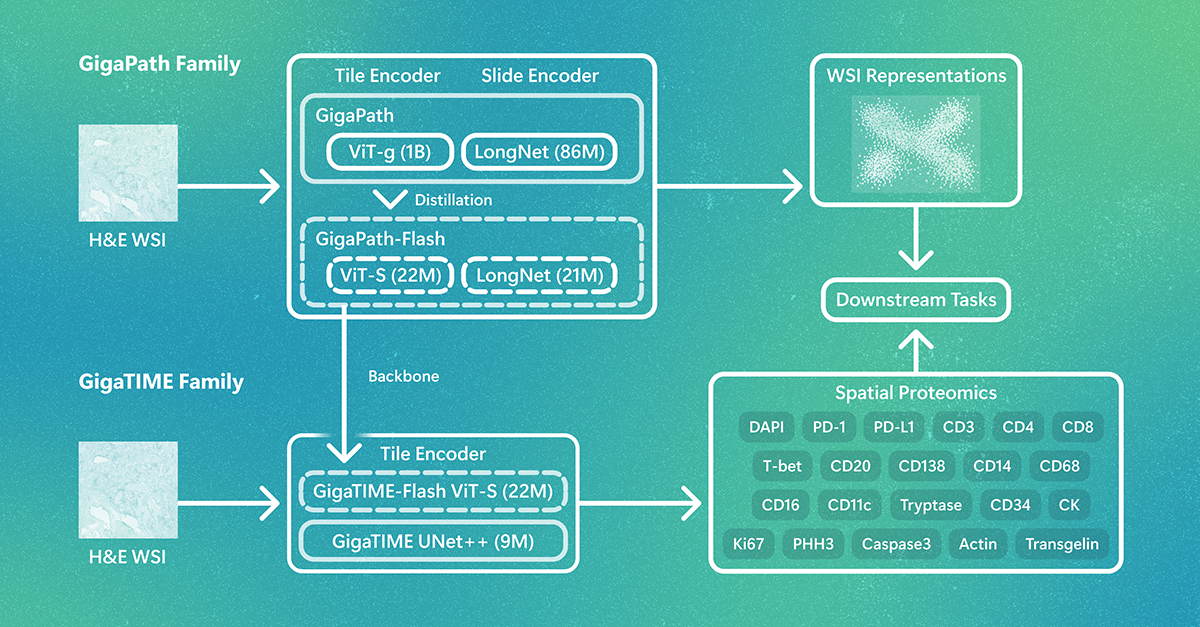
What if pathology foundation models could do more with less? GigaPath-Flash and GigaTIME-Flash cut computational demands while maintaining strong performance, opening the door to larger studies and broader exploration. The post GigaPath-Flash and GigaTIME-Flash: Toward population-scale discovery with efficient pathology foundation models appeared first on Microsoft Research.
We use cookies to run the site and, with your consent, for analytics and to show ads.
See our Cookie Policy.