Post-training alignment is often shallow, eroding under fine-tuning. It remains untested as to whether constitutional midtraining interventions can produce durable alignment when cleanly isolated from post-training. We build a 394M-token constitutional corpus from Anthropic's Constitution and apply constitutional midtraining at 120B scale, where principled, values-based content is inserted into midtraining. A 2x2 design (curriculum ordering x deliberative reasoning) was used to produce four constitutionally midtrained conditions, plus a control, which were evaluated on self-generated and established benchmarks including alignment under pressure, value conflict resolution, blackmail, and emergent misalignment. All models were evaluated across three stages: post-midtraining, post-SFT, and post-benign fine-tuning. Constitutionally midtrained models outperformed the control on alignment generalization and durability, notably on blackmail: SFT instilled a blackmail propensity in all models, but constitutional midtraining blunted it, with the advantage surviving benign fine-tuning (-17.5pp). This durability did not extend to settings that required active resistance to in-context pressure or conflict, where the advantage attenuates after SFT. The presence of constitutional content at midtraining also mattered more than its structure, and constitutional midtraining incurred no capability cost, on average, at any stage (MMLU, ARC-Easy, piqa, GSM8K). A modest amount of constitutional content at midtraining could therefore yield broad, persistent alignment gains, offering a cheap, complementary addition to SFT-centered pipelines. Code, data, and models are available.
Desiree Cho, Cameron Tice, Bernie Hogan et al.· 0 citations
The first $poly(\Delta,\log n)-round algorithm for $(\Delta + 1)$-edge coloring in the CONGEST model is presented and the $n$-dependency of its runtime, $\tilde{O}(\log^5 n)$, matches the best published dependency in the LOCAL model.
Sebastian Brandt, Ananth Narayanan, Alexandre Nolin· 0 citations
The Ramsey number $R(m,n)$ is the smallest order at which every red-blue edge coloring of a complete graph must contain a blue clique (a complete subgraph) of size $m$ or a red clique of size $n$. Determining these numbers exactly is extremely hard, and even certifying a lower bound requires exhibiting an explicit coloring that avoids both cliques. We develop an integer programming framework for certifying such lower bounds, restricting the search to circulant graphs, whose rotational symmetry lets us reformulate the problem in a projected distance space, reducing the number of binary variables from quadratic to linear in the graph order. We strengthen this projected model through coefficient reduction and solve it with a branch-and-cut algorithm whose separation routine exploits the common neighborhood structure of circulant graphs, combining heuristic and exact maximum-clique algorithms. In an extensive computational campaign on circulant graphs with up to 410 vertices, we improve the best lower bounds previously obtained by other methods by up to 11 points for 25 values of $R(3,n)$ with $24\le n\le49$ and $n\neq27$, each backed by an explicit graph certificate that can be independently verified with a stand-alone exact clique solver. To the best of our knowledge, our method also provides the first reproducible optimization-based procedure for certifying circulant Ramsey numbers $R_C(m,n)$, which we use to establish eight new values of $R_C(3,n)$ with $13\le n\le20$. Our framework, graph certificates, and stand-alone checker are provided as supplementary material to support independent verification and reuse.
Stefano Coniglio, Fabio Furini, I. Ljubić et al.· 0 citations
Experimental results demonstrate that the proposed sequential pipeline preserves high specificity while reducing missed detections compared to radar-only processing and indicates that sequential processing can offer a viable alternative to parallel fusion for edge-based drone detection under SNR and computing constraints.
Faizal Mohd Amin Sharifuldin, N. E. Abdul Rashid, Mohd Adli Md Ali et al.· Sensing and Imaging· 0 citations
Reach audiences
Advertise in front of researchers, engineers, and readers.
The proposed rigid motion artifact correction algorithm demonstrates good performance in estimating motion trajectories and compensating for image artifacts, thus providing a viable and robust solution for suppressing rigid motion artifacts in clinical CBCT imaging.
Hao Jiang, Yongbo Wang, Z. Bian· Nan fang yi ke da xue xue ba...· 0 citations
Опрокидывание стреловых самоходных кранов сохраняет положение одного из наиболее тяжёлых по последствиям отказов на строительных площадках. Штатный ограничитель грузового момента настраивается по паспортной грузовой характеристике для горизонтальной опорной площадки и не воспринимает ни фактический угол наклона опорного контура, ни просадку выносных опор. Цель работы – построение авторской расчётной модели непрерывного контроля грузовой устойчивости, сводящей измерение реакций опор, углов наклона рамы и стрелы и скорости ветра к одному вычисляемому в реальном времени коэффициенту. Расчёт выполнен по схеме предельного равновесия относительно ребра опрокидывания для модельного крана грузоподъёмностью 25 т с базой выносных опор 5,62 на 5,84 м; ветровая нагрузка принята по ГОСТ 1451-77, нормативная рамка прослежена по редакциям 2020-2026 гг. Критический уклон, при котором паспортная грузоподъёмность ещё отвечает нормативному коэффициенту 1,15, изменяется от 1,76 градуса на вылете 6,0 м до величин свыше 6 градусов на вылете 16 м и более, а при уклоне 3 градуса коэффициент на малых вылетах опускается до 1,02. Расширенная неопределённость вычисляемого коэффициента составила 2,7% при доминирующем вкладе погрешности определения массы груза. Наименьший запас устойчивости приходится на короткие вылеты с тяжёлым грузом, и это обращает привычное представление о максимальном вылете как о самой опасной конфигурации.
Overturning of mobile boom cranes remains one of the most severe failures at construction sites. A standard load moment limiter is tuned to the rated load chart obtained for a horizontal supporting area and registers neither the actual tilt of the supporting contour nor the settlement of outriggers. The aim of the work is an author's computational model of continuous load stability control that reduces the measurement of outrigger reactions, frame and boom angles and wind speed to a single coefficient computed in real time. The calculation follows the limit equilibrium scheme about the tipping edge for a model crane with a rated capacity of 25 t and an outrigger base of 5,62 by 5,84 m; the wind load is taken according to GOST 1451-77 and the regulatory framework is traced through the 2020-2026 editions. The critical tilt at which the rated capacity still corresponds to the normative coefficient of 1,15 varies from 1,76 degrees at a radius of 6.0 m to values above 6 degrees at a radius of 16 m and more, and at a tilt of 3 degrees the coefficient at short radii drops to 1,02. The expanded uncertainty of the computed coefficient amounted to 2,7%, with the dominant contribution from the error in determining the load mass. The smallest stability margin occurs at short radii with a heavy load, which reverses the customary view of the maximum radius as the most hazardous configuration.
Владимир Алексеевич Вяткин, Данис Айратович Сафин, Олег Антонович Сидоренко et al.· Stroitelʹnye i dorožnye maši...· 0 citations
Настройка силового контура фронтального погрузчика на площадке с несколькими штабелями остаётся ручной, из-за чего одна и та же машина работает на песке и на разборно-скальном грунте с одинаковыми уставками подачи и тяги. Действующие стандарты описывают результат черпания геометрически: вместимость ковша рассчитывается по ГОСТ 29290-92 через плотную часть и материал над кромками при откосе 2:1, номинальная грузоподъёмность определяется по ГОСТ ISO 14397-1-2015, а коэффициент наполнения ковша не нормирован ни одним из них. Цель работы состояла в построении и расчёте модели системы, опознающей класс материала по силовым и кинематическим сигналам начальной фазы внедрения и назначающей режим работы силового контура без участия оператора. Расчёт выполнен на авторской модели процесса черпания для модельного погрузчика класса 5 т с ковшом вместимостью 3,0 м³; численный эксперимент охватил серию из 1 240 циклов. Материалы сведены в пять классов по значению авторского индекса трудности черпания от 1,00 до 2,35. Предельная глубина внедрения по условию сцепления снижается с 1,35 до 0,88 м, коэффициент наполнения – с 1,06 до 0,76, а масса материала в ковше при этом изменяется всего на 8,7% между сухим песком и щебнем крупной фракции. Класс материала опознаётся по четырём признакам окна 0,4 с с долей верных отнесений 0,914; наибольшая путаница приходится на пару смежных гранулометрических классов. Переход к адаптивному назначению режима увеличивает эксплуатационную производительность на 1,4-10,7% и снижает удельный расход топлива на 12,9-17,4% в зависимости от класса. Выигрыш растёт с трудностью черпания и распределяется между производительностью и топливной экономичностью неодинаково: на связном грунте прирост выработки максимален при наименьшем снижении удельного расхода. Соотношение показывает, что коэффициент наполнения ковша ведёт себя как управляемая переменная, а не как справочная константа машины, и подлежит включению в контур управления наравне с давлением и частотой вращения.
Power train tuning of a front loader operating at a site with several stockpiles remains manual, so the same machine handles sand and blasted rock with identical feed and traction settings. Current standards describe the outcome of the digging phase geometrically: bucket capacity is computed under GOST 29290-92 from the struck volume plus the material above the cutting edges at a 2:1 slope, rated operating load follows GOST ISO 14397-1-2015, and the bucket fill factor is not covered by either document. The purpose of the study was to construct and compute a model of a system that recognises the material class from force and kinematic signals of the initial penetration phase and assigns the power train mode without operator involvement. The computation rests on the author's model of the digging process for a modelled 5 t class loader with a 3.0 м³ bucket; the numerical experiment covered a series of 1,240 cycles. Materials are grouped into five classes by the author's digging difficulty index ranging from 1,00 to 2,35. The limiting penetration depth under the traction condition falls from 1,35 to 0,88 m and the fill factor from 1,06 to 0,76, while the mass carried in the bucket varies by only 8,7% between dry sand and coarse crushed stone. The material class is recognised from four features of a 0,4 s window with a correct assignment share of 0,914, the heaviest confusion falling on the pair of adjacent granulometric classes. Adaptive mode assignment raises operational output by 1,4-10,7% and lowers specific fuel consumption by 12,9-17,4% depending on the class. The gain grows with digging difficulty and splits unevenly between output and fuel economy: on cohesive soil the output gain peaks while the specific consumption gain is smallest. This relation shows that the bucket fill factor behaves as a controlled variable rather than a reference constant of the machine and belongs in the control loop alongside pressure and engine speed.
Михаил Валерьевич Митякин· Stroitelʹnye i dorožnye maši...· 0 citations
This paper introduced an Intelligent Portable Edge – Cloud Computing Architecture (IPECA) that combines the portable computing hardware, AI-based workload prediction, adaptive resource optimization, container-based virtualization and secure edge-cloud collaboration into a single computing architecture.
Pradeep Kachakayala, Akshith Kachakayala· International Journal for Re...· 0 citations
This review aims to examine how AI can help optical sensors overcome major barriers limiting their adoption in clinical settings and to identify the major barriers limiting their adoption in clinical settings.
Siyi Zeng, Haoyu Li, Guoliang Ying et al.· Translational Medical Engine...· 0 citations
The massive influx of uplink task offloading in Multi-access Edge Computing (MEC) systems poses a significant challenge to the capacity of wireless networks. This challenge highlights a fundamental trade-off between Orthogonal Multiple Access (OMA), which provides interference-free but spectrally inefficient communication, and Non-Orthogonal Multiple Access (NOMA), which enhances capacity at the cost of significant inter-user interference. To navigate this trade-off, we introduce a novel Hybrid NOMA (H-NOMA) framework that offers differentiated communication services. The framework allows users to choose between premium OMA channels for latency-sensitive tasks and shared NOMA channels for others, creating an economy where performance can be traded for cost. Within this framework, we formulate the resource allocation problem with the objective of maximizing the total system utility, defined as the sum of all individual user utilities, under budget, computation, and communication constraints. To solve this NP-hard problem, we devise a novel multi-stage game-theoretic algorithm, the Matching-Coalition Game with Coordinate Descent (MCGCD). Our approach synergistically combines matching theory for a fast and initial channel assignment, a cooperative coalition game to refine allocations by explicitly managing NOMA externalities, and a coordinate-descent-based algorithm for optimal power control. Extensive simulations demonstrate that our proposed algorithm significantly outperforms benchmark methods in improving system utility, reducing average task completion latency, and increasing the number of admitted tasks.
Haolin Liu, Hao Yin, Haibo Zhou et al.· IEEE Transactions on Mobile...· 0 citations
This paper presents a reliability analysis framework for distributed computing in extreme edge computing (XEC) with limited information availability. XEC pushes computation to the outermost boundaries of networks by leveraging consumer-owned devices, known as Extreme Edge Devices (XEDs). Unlike traditional distributed systems with defined computational resource states, XEC operates under uncertainty due to consumer device usage patterns, varying computational capacities, and local scheduling algorithms. In this work, we address discrete task assignment particularly. The framework analyzes scenarios for computational reliability assessments with minimal knowledge of XED capabilities and service requirements. The framework adapts to different levels of available information, from operational limits to historical performance data, providing refined reliability estimates. The aim of this work is to provide generalized reliability models for distributed computing in XEC that allow decision-makers (e.g. service orchestrators) to make informed decisions about task allocation, service placement, and resource allocation under uncertainty in XEC. Simulations and experimental analysis demonstrate the framework’s effectiveness in estimating reliability under various system conditions.
Mhd Saria Allahham, Hossam S. Hassanein· IEEE Transactions on Mobile...· 0 citations
Cohesive subgraph mining has been extensively studied and finds numerous graph mining applications such as link farm identification, community detection, and product recommendation. Among various cohesive subgraph structures, the <inline-formula><tex-math notation="LaTeX">$k$</tex-math><alternatives><mml:math><mml:mi>k</mml:mi></mml:math><inline-graphic xlink:href="yu-ieq3-3701433.gif"/></alternatives></inline-formula>-truss is particularly notable for its strong structural cohesiveness based on triangles. However, the classical <inline-formula><tex-math notation="LaTeX">$k$</tex-math><alternatives><mml:math><mml:mi>k</mml:mi></mml:math><inline-graphic xlink:href="yu-ieq4-3701433.gif"/></alternatives></inline-formula>-truss problem aims to find the <inline-formula><tex-math notation="LaTeX">$k$</tex-math><alternatives><mml:math><mml:mi>k</mml:mi></mml:math><inline-graphic xlink:href="yu-ieq5-3701433.gif"/></alternatives></inline-formula>-truss with the maximum number of vertices, which is often extremely large and complex in practice. To fully leverage the benefits of the <inline-formula><tex-math notation="LaTeX">$k$</tex-math><alternatives><mml:math><mml:mi>k</mml:mi></mml:math><inline-graphic xlink:href="yu-ieq6-3701433.gif"/></alternatives></inline-formula>-truss, we consider a novel problem called the <italic>minimum <inline-formula><tex-math notation="LaTeX">$k$</tex-math><alternatives><mml:math><mml:mi>k</mml:mi></mml:math><inline-graphic xlink:href="yu-ieq7-3701433.gif"/></alternatives></inline-formula>-truss problem</italic>, which seeks to identify a <inline-formula><tex-math notation="LaTeX">$k$</tex-math><alternatives><mml:math><mml:mi>k</mml:mi></mml:math><inline-graphic xlink:href="yu-ieq8-3701433.gif"/></alternatives></inline-formula>-truss with the minimum number of vertices, where <inline-formula><tex-math notation="LaTeX">$k\geq 2$</tex-math><alternatives><mml:math><mml:mrow><mml:mi>k</mml:mi><mml:mo>≥</mml:mo><mml:mn>2</mml:mn></mml:mrow></mml:math><inline-graphic xlink:href="yu-ieq9-3701433.gif"/></alternatives></inline-formula> is a positive integer. We first formally prove the NP-hardness of the problem. We then design a baseline algorithm <monospace>MTEnum</monospace> that is based on the vertex enumeration and a heuristic method for computing an upper bound. Despite these efforts, <monospace>MTEnum</monospace> still faces practical efficiency issues which may be due to the fact that the <inline-formula><tex-math notation="LaTeX">$k$</tex-math><alternatives><mml:math><mml:mi>k</mml:mi></mml:math><inline-graphic xlink:href="yu-ieq10-3701433.gif"/></alternatives></inline-formula>-truss lacks the hereditary property. To address this issue, we develop a novel decomposition-based framework <monospace>DSA</monospace>, which elegantly transforms the problem into a sequence of problems that are based on a new cohesive subgraph model called <italic>edge-based <inline-formula><tex-math notation="LaTeX">$s$</tex-math><alternatives><mml:math><mml:mi>s</mml:mi></mml:math><inline-graphic xlink:href="yu-ieq11-3701433.gif"/></alternatives></inline-formula>-plex (<inline-formula><tex-math notation="LaTeX">$s$</tex-math><alternatives><mml:math><mml:mi>s</mml:mi></mml:math><inline-graphic xlink:href="yu-ieq12-3701433.gif"/></alternatives></inline-formula>-eplex)</italic>. With the hereditary property of <inline-formula><tex-math notation="LaTeX">$s$</tex-math><alternatives><mml:math><mml:mi>s</mml:mi></mml:math><inline-graphic xlink:href="yu-ieq13-3701433.gif"/></alternatives></inline-formula>-eplex, we design a branch-and-bound algorithm with several customized techniques for the newly formulated problem. Extensive experiments demonstrate the effectiveness of our studied problem and the efficiency of our proposed algorithm <monospace>DSA</monospace>. In particular, <monospace>DSA</monospace> runs up to five orders of magnitude faster than the baseline <monospace>MTEnum</monospace>.
Qifan Zhang, Yang Liu, Kaiqiang Yu et al.· IEEE Transactions on Knowled...· 0 citations
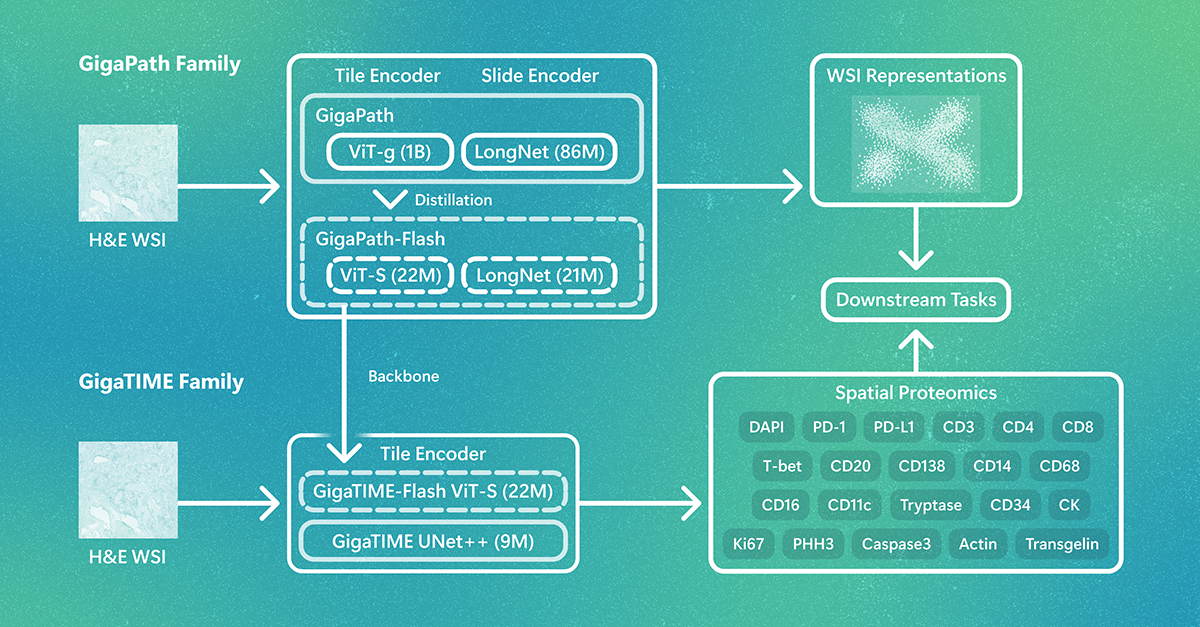
What if pathology foundation models could do more with less? GigaPath-Flash and GigaTIME-Flash cut computational demands while maintaining strong performance, opening the door to larger studies and broader exploration. The post GigaPath-Flash and GigaTIME-Flash: Toward population-scale discovery with efficient pathology foundation models appeared first on Microsoft Research.
MIT News · Artificial Intelligence· news.mit.eduAug 31, 2026
With millions of users across the world, Julia has been used to conduct cutting-edge research and to design new drugs, jet engines, heat pumps, and more.
MIT News · Artificial Intelligence· news.mit.eduAug 27, 2026
A new machine-learning framework aims to improve the success rate of computational protein design while moving away from results that reproduce sequences found in nature.