A novel conceptual framework integrating Artificial Intelligence (AI) across descriptive, predictive, and prescriptive tiers is developed, offering a structured basis for transparent and adaptive ESG‐cost integration, advancing the practice of cost engineering and sustainable project delivery.
Zi-Ru Tao, P. Baguley, Rashid Maqbool et al.· Sustainable Development· 1 citation
Neonatal sepsis remains a major cause of morbidity and mortality worldwide, while timely diagnosis continues to be challenging because of nonspecific clinical manifestations and limitations of conventional diagnostic methods. Recent advances in artificial intelligence (AI) have created new opportunities for the early p...
Aikaterini I. Nikolaou, N. Dermitzaki, N. Chatzigiannis et al.· Applied Sciences· 0 citations
A review of recent literature exploring AI capabilities and ethics and their relationship with organizational trust identifies gaps in current literature and suggests a future research agenda including multilevel trust, industry differences in AI and ethical considerations, and measurement of responsible AI.
Fajer Danish, Muneera Alkhalifa· Journal International Review...· 0 citations
By integrating high-accuracy prediction with human-focused explainability in a single lightweight framework, KRISHI.AI advances accessible and trustworthy decision support for technology-driven agriculture, with particular relevance to agricultural decision-support applications serving India's smallholder farming commu...
As AI and data-driven systems pervade practice, there is an imperative for instructors to embed societal impact and ethics content into computing courses. In response, we present the Human-Centered Education for Learning in Information and eXplainable Computing (HELIX) framework for information science programs, organi...
Victoria Chui, Kelly McConvey, Daniel Chui et al.· 0 citations
Three minimal copying models, one per decision and with a single free parameter each, reproduce the heavy-tailed distribution of how many agents met on a page, the frequency of the pieces from which the agents built their names, and the patchwork of pages that are internally consistent and different from one another.
G. De Marzo, Nicola Alboré, David García· 4 citations· ⚡1
Machine learning has shown its largest gains in the band below 10 ms inside a 3GPP new radio (NR) 5G distributed unit (DU): link adaptation, per-slot scheduling, channel estimation, and the receiver itself. No open platform has let independently built software run there. Prior dApp frameworks reached the band only as e...
Timothy J. O'Shea, M. Pennybacker, A. Kharchenko· 0 citations
The silent revision rate, the share of material changes to a framework's commitments that the developer's published account does not identify, is introduced, and the versioned, hash-pinned corpus needed to compute it is released.
Agentic AI systems built on large language models fail in two persistent ways that scaling does not fix: they break under distribution shift, and they cannot explain the decisions they make. We argue these are co-symptoms of one structural deficiency in the data lifecycle that governs how agents are trained, evaluated,...
A methodological framework for autonomous, AI-based harvesting of cultural knowledge from the open web, designed to expand corpus coverage while intensifying per-entry data depth is presented, including the architectural guarantee that the machine never overwrites human contributions.
This work presents a post-hoc XAI framework that transforms a lengthy agent's execution trace into a structured report and a faithful natural-language explanation explicitly grounded in its observable behavior, outperforming naive LLM-generated explanations.
Vittoria Vineis, Fabiano Veglianti, Lorenzo Antonelli et al.· 0 citations
This study demonstrates the application of explainable artificial intelligence (XAI) specifically the deep learning model for oil spill detection, which integrates the SpillNet, a customised Convolutional Neural Network architecture with five XAI techniques and unique evaluation metrics suitable for marine environmenta...
Tokula I. Umaha, F. Ale, I. D. Ikpaya et al.· Frontiers of Mechanical Engi...· 0 citations
Research Manager Mike Walker reflects on a career spanning hacker culture, cybersecurity, and AI, sharing lessons about trust, teamwork, leadership, and why solving difficult problems requires curiosity, judgment, agility—and an understanding of the rules. The post Learn the rules: The hacker mindset appeared first on Microsoft Research.
Is your company’s AI sovereign? A practical guide for CIOs on AI vendor lock-in, EU Data Act switching, cloud sovereignty, and testing your exit plan before you need it. The post Sovereignty Is the Option to Leave appeared first on GPT-Lab.
MIT News · Artificial Intelligence· news.mit.eduNov 2, 2026
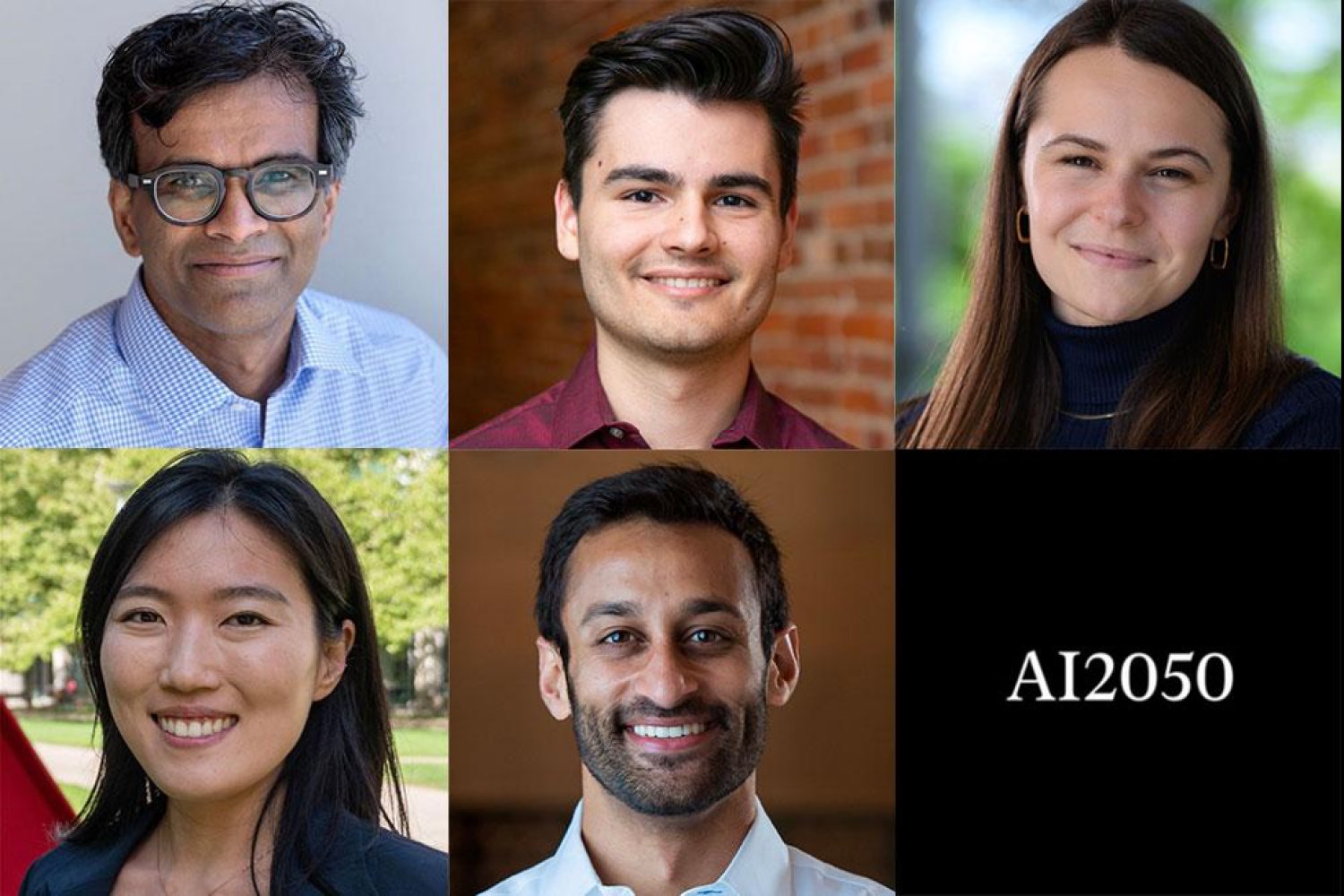
The MIT professors collaborated to identify the first AI-discovered antibiotic, a scientific breakthrough that is widely recognized as a milestone in AI-driven drug discovery.
MIT News · Artificial Intelligence· news.mit.eduOct 30, 2026
MIT professors Adam Berinsky and Chara Podimata discuss a new project to track how AI chatbots are responding to questions about the 2026 U.S. midterm elections.
We use cookies to run the site and, with your consent, for analytics and to show ads.
See our Cookie Policy.