Large Language models for banking supervision: reliability evidence from European systemic banks
Carlos García-Llorente, I. Olmeda
· Finance Research Letters · 0 citations
Category
552 papers
Mobile phase selection in thin-layer chromatography (TLC) still relies heavily on empirical trial-and-error. Existing machine learning methods often exhibit limited predictive performance, as they depend on manual descriptor engineering and are sensitive to data quality. Here, a reference-guided large language model (LLM) workflow for TLC mobile phase recommendation is proposed. The LLM is used as a flexible inference interface that integrates structural similarity, polarity descriptors, and example-based analogical inference. The key methodological contribution is a polarity-space tetrahedron strategy for selecting reference compounds. Three polarity descriptors, including molecular refractivity, topological polar surface area, and n-octanol-water partition coefficient, are used to construct a three-dimensional space, and a target compound is constrained within a tetrahedron formed by four reference compounds to enable interpolation-based inference. A similarity-weighted version of this tetrahedron strategy is also developed. Using a publicly available high-throughput automated TLC dataset and DeepSeek-Reasoner as the inference engine, four reference selection strategies are compared. The similarity-weighted tetrahedron method achieves the best performance, with an availability of 81.48% and a final score of 0.8436 across 45 compound pairs evaluated in triplicate. The success rate of 92.16% confirmed by independent experimental validation supports the practical relevance of the recommendations. The framework also provides interpretable outputs, including structured rationales and experimental suggestions. This work demonstrates that combining a locally constrained reference construction strategy with an LLM offers a practical and interpretable tool for TLC mobile phase optimization, without requiring large labeled datasets or task-specific model training.
Large language models (LLMs) are rapidly entering civil engineering research and practice, yet little is known about their use in educational contexts. This study reports results from an institutional case study based on a taxonomy-aligned survey of 109 respondents (103 undergraduates, four graduate students, and two faculty) in civil engineering–related programs at a large US university. The survey examined adoption patterns, task functions, verification practices, disclosure norms, and training needs. Undergraduates primarily used LLMs for tutoring and concept explanation (83%) and design ideation (67%), with limited adoption in coding (7%) and technical reasoning (41%). Verification practices were robust: 86% recalculated manually, 52% checked against standards, and only 4% reported nonverification, yielding a median of two methods per user. Ethical orientations favored conditional disclosure for major contributions (53%) and placed primary responsibility for errors on the human user (75%). Demand for formal training was high, especially among those with greater adoption, familiarity, and verification breadth. Results reveal a developmental gap between student practices, which emphasize low-risk learning and ideation, and research and faculty practices, which emphasize technically rigorous applications. The study underscores the need for curricular pathways that guide students from exploratory uses toward responsibly verified technical tasks within similar educational contexts. By linking a civil engineering–specific taxonomy of LLM functions with educational survey data, this work offers institutionally grounded empirical evidence on artificial intelligence (AI) literacy in civil engineering education and highlights directions for curriculum and assessment design.
Reach audiences
Advertise in front of researchers, engineers, and readers.
Coordinating a team of robots in aircraft skin fabrication requires allocating and sequencing tightly coupled subtasks under spatio-temporal constraints, while the fleet must react to runtime disturbances such as robot failures and urgent task arrivals. Mixed-Integer Linear Programming (MILP) yields provably optimal coordination, but a disturbance often introduces new constraint logic rather than a mere parameter change, leaving the existing formulation structurally inadequate and requiring expert-led reformulation to accommodate the new logic. This letter proposes a Large Language Model (LLM)-based framework that automates the path from natural-language scheduling requirements to MILP formulation, executable solver code, and event-driven rescheduling, so that the optimization model can be restructured online without expert intervention. Two compact LLMs are specialized for complementary roles: a modeling LLM, empowered via knowledge augmentation, supervised fine-tuning on industrial constraint descriptions, and direct preference optimization on self-generated negatives; and a code LLM, trained via sandbox-validated knowledge distillation. On ten industrial constraint classes, the 8B modeling LLM reaches 100% constraint-level accuracy, exceeding cloud-scale general-purpose LLMs equipped with retrieval over the same knowledge base, while the 8B code LLM attains 86% under fully on-premises deployment. When a disturbance occurs, an event-triggered mechanism regenerates only the affected constraints. A case study on multi-robot scheduling for aircraft skin fabrication shows that the framework matches the schedule quality of baselines while shifting adaptation cost from offline expert labour to a bounded online inference budget.
An Evaluation Agent, middleware that combines Natural Language Inference factual verification, a five-signal poison detector with relevance-weighted aggregation, and a Trust Index is proposed, which reliably blocks instruction injection of unsafe advice while contradiction and subtle semantic weakening remain hard.
This record contains two papers: (1) A proof of the Dixmier conjecture for the first Weyl algebra; (2) Commutation is isomonodromy: spectral rigidity in the first Weyl algebra. Produced through a collaboration between large language models and an anonymous human researcher.
Sintesi di Software tramite Rappresentazioni Intermedie Ipergrafiche in Formato NDJSON-LD: Formalizzazione di un Framework di Generazione Vincolata per Modelli Linguistici Autoregressivi Autore: Luigi Usai Affiliazione / Località: Quartucciu (CA), Italia Data: 29 Agosto 2026 ORCID: https://orcid.org/0009-0003-3001-717X Identificatore di Categoria (Zenodo/ACM): Computer Science – Software Engineering (cs.SE); Artificial Intelligence (cs.AI); Formal Languages (cs.FL). Abstract La generazione di software strutturato e monolitico tramite modelli linguistici di grandi dimensioni (LLM) presenta storicamente tassi elevati di allucinazione dell'interfaccia, violazioni di invarianti logici e divergenza sintattica nei contesti zero-shot non vincolati. Questo lavoro formalizza una metodologia di sintesi single-prompt a due stadi basata sull'induzione preventiva di un ipergrafo matematico $H=(V,E)$ serializzato nello standard NDJSON-LD (Newline Delimited JSON for Linked Data). Attraverso la scomposizione delle dipendenze $n$-arie tra tipi, funzioni, invarianti e canali di I/O prima dell'emissione del codice target (Python), il modello riduce drasticamente l'entropia condizionale nello spazio di decodifica autoregressiva. Il formalismo proposto converte il task da un problema di generazione a sintassi libera a una proiezione isomorfa guidata da uno schema topologico. Vengono presentati il framework matematico, la specifica della grammatica NDJSON-LD, l'architettura della pipeline di inferenza e il protocollo sperimentale di falsificazione empirica. Parole chiave: Program Synthesis, Neurosymbolic AI, Hypergraph Theory, NDJSON-LD, Prompt Engineering, Large Language Models, AST Generation, Code Reliability. 1. Introduzione e Definizione del Problema Nei modelli autoregressivi basati sull'architettura Transformer, la probabilità di emissione di una sequenza di codice sorgente $C = (c_1, c_2, \dots, c_T)$ a partire da una specifica informale in linguaggio naturale $P$ è descritta dal prodotto: $$P(C \mid P) = \prod_{t=1}^T P(c_t \mid c_{ [ V_func: PureTransformer ] | | │ | | ▼ | | [ V_inv: BoundaryCheck ] <-- [ V_type: ValidatedOutput ] | +-------------------------------------------------------------+ 3. Specificazione della Sintassi NDJSON-LD La scelta dello standard NDJSON-LD (Newline Delimited JSON-LD) garantisce tre proprietà computazionali ottimali per gli LLM: Streaming line-by-line deterministico: Ogni riga costituisce un'asserzione topologica autosufficiente, minimizzando la complessità dell'albero sintattico durante il parsing. Semantica formale esplicita (@context, @id, @type): Riduzione dell'ambiguità polisemica dei token. Compressione del footprint di contesto: Eliminazione dell'indentazione ricorsiva del JSON standard, massimizzando il throughput della context window. Schema formale di un record NDJSON-LD JSON Data format: RDF-Turtle JSON-LD JSON CSV RDF/XML Markdown RSS Atom {"@context": "https://schema.org/SoftwareSourceCode", "@id": "node:State", "@type": "TypeNode", "signature": "typing.NamedTuple", "properties": {"id": "UUID", "payload": "bytes"}} {"@context": "https://schema.org/SoftwareSourceCode", "@id": "node:Inv1", "@type": "InvariantNode", "predicate": "len(payload) <= 4096"} {"@context": "https://schema.org/SoftwareSourceCode", "@id": "edge:Transform", "@type": "HyperEdge", "sources": ["node:State"], "targets": ["node:Result"], "guards": ["node:Inv1"], "complexity": "O(N)"} 4. Architettura della Pipeline di Sintesi La pipeline di generazione si struttura su un processo deterministico a fasi sequenziali all'interno della medesima sessione di campionamento: Data format: RDF-Turtle JSON-LD JSON CSV RDF/XML Markdown RSS Atom +-------------------------------------------------------------------------+ | Prompt di Vincolo Epistemico + Requisiti Funzionali | +-------------------------------------------------------------------------+ │ ▼ +-------------------------------------------------------------------------+ | Generazione dell'Ipergrafo $H$ in NDJSON-LD | | (Allocazione di token per pianificazione topologica e contrattuale) | +-------------------------------------------------------------------------+ │ ▼ +-------------------------------------------------------------------------+ | Ordinamento Topologico degli Iperarchi | | (Risoluzione delle dipendenze $n$-arie dei nodi sorgente) | +-------------------------------------------------------------------------+ │ ▼ +-------------------------------------------------------------------------+ | Emissione del Codice Python Target | | (Implementazione di protocolli, tipi algebrici, contratti e runtime) | +-------------------------------------------------------------------------+ Regole di Traslazione $H \to \text{Python}$ Ogni $v \in V_{\text{type}}$ viene traslato in classi immutabili @dataclass(frozen=True) o typing.Protocol. Ogni $v \in V_{\text{inv}}$ viene mappato in asserzioni di runtime esplicite o clausole contrattuali (icontract / clausole di guardia). Ogni $e \in E$ viene compilato come funzione pura tipizzata staticamente con annotazioni rigorose (mypy --strict). 5. Analisi Comparativa Parametro di Valutazione Zero-Shot Diretto (P→C) Chain-of-Thought (CoT) Program Dependence Graph (PDG) NDJSON-LD Hypergraph (P→H→C) Modellazione Relazionale Implicita / Sequenziale Sequenziale informale Grafi binari ($\vert{}e\vert{}=2$) Ipergrafi $n$-ari ($\vert{}e\vert{} \ge 2$) Overhead di Parsing Assente Variabile (testo libero) Elevato (XML/DOT) Basso (NDJSON streaming) Preservazione Invarianti Bassa (Decadimento $t > 10^3$) Media Buona (strutturale) Elevata (vincolo esplicito) Allucinazione dei Tipi Elevata Media Bassa Minima (topologia chiusa) 6. Limiti Epistemologici e Protocollo di Falsificazione Per conferire al metodo validità scientifica, sono stabiliti i seguenti criteri di falsificabilità e limitazioni: Limiti intrinseci Complessità degli Iper-cicli: La presenza di dipendenze cicliche tra iperarchi $n$-ari non risolvibili genera blocchi logici che richiedono algoritmi di condensazione topologica a monte della compilazione. Consumo di Output Budget: La generazione dell'ipergrafo NDJSON-LD consuma tra il $20\%$ e il $40\%$ della finestra di generazione massima, limitando la dimensione netta del codice sintetizzabile in singolo turno. Protocollo Sperimentale di Validazione (Ablation Study) Il framework deve essere validato tramite un benchmark quantitativo strutturato come segue: Dataset di Test: SWE-bench Verified (500
Intermediate-task training---fine-tuning a pretrained model on an intermediate task before fine-tuning again on the target task---often improves model performance substantially on language understanding tasks in monolingual English settings. We investigate whether English intermediate-task training is still helpful on non-English target tasks. Using nine intermediate language-understanding tasks, we evaluate intermediate-task transfer in a zero-shot cross-lingual setting on the XTREME benchmark. We see large improvements from intermediate training on the BUCC and Tatoeba sentence retrieval tas Research goal: How does adding a language identification loss during intermediate task training on XTREME-M affect mT5's zero-shot cross-lingual EXACT match performance compared to standard fine-tuning? Autonomous synthesis report generated by Assignee Research. Tribunal consensus score: 9.2/10.
Data Management
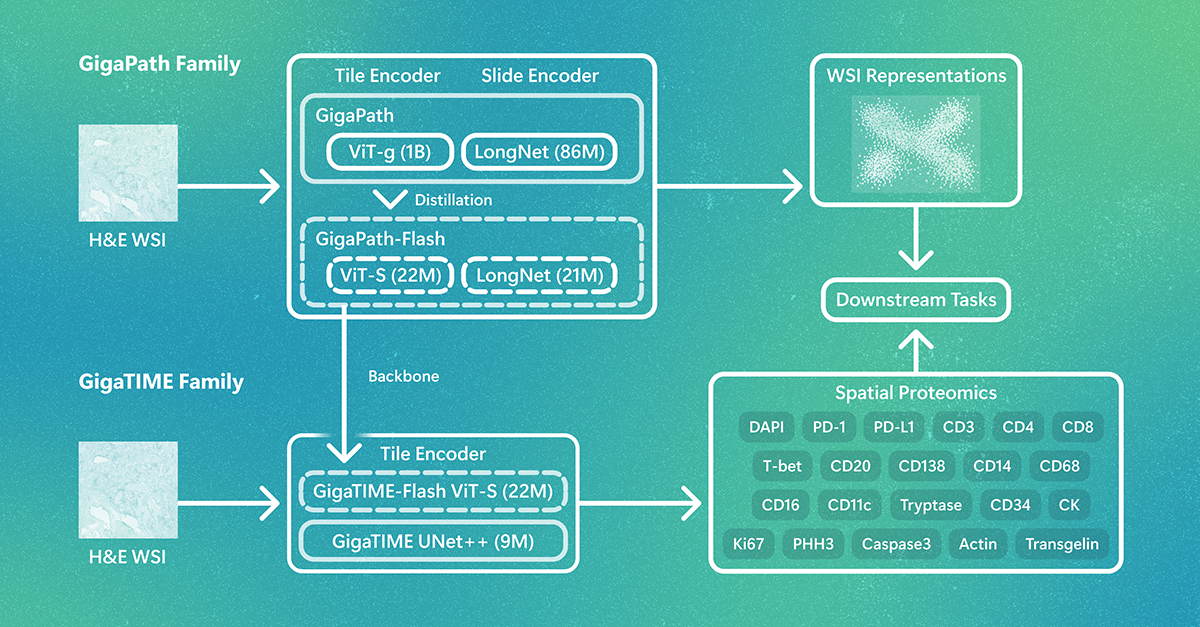
What if pathology foundation models could do more with less? GigaPath-Flash and GigaTIME-Flash cut computational demands while maintaining strong performance, opening the door to larger studies and broader exploration. The post GigaPath-Flash and GigaTIME-Flash: Toward population-scale discovery with efficient pathology foundation models appeared first on Microsoft Research.
We use cookies to run the site and, with your consent, for analytics and to show ads. See our Cookie Policy.