Multimodal large reasoning models (MLRMs) have demonstrated remarkable capabilities in complex visual understanding. However, this very power introduces a critical yet underexplored privacy threat: adversaries can exploit MLRMs to precisely infer users' geographic locations from casually shared photographs, by performi...
In the early stages of a pandemic, identification of a small number of infected individuals through large-scale screening is critical for pandemic control, yet remains challenging under limited reagents and testing capacity. Existing group testing methods suffer from either high computational complexity or low identifi...
Modern text and image representations are often matrix-valued, with rows corresponding to tokens, patches, or other local feature vectors. Predictive information is often sparse but sample-specific, making classical sparse regression methods with a common support poorly suited to this heterogeneity. This paper formaliz...
Bo-Rui Peng, Li-Wei Lin, Fei-Fei Wang et al.· 0 citations
Product abuse is an individually rare, but growing, problem across the SaaS industry. Highly sophisticated threat actors can misuse security platforms within customer environments or conduct bypass experiments on the product itself. Threat actors can leverage living-off-the-land (LOTL) attacks to avoid using cumbersome...
Shaefer Drew, Michael Brautbar, Paul Knight et al.· 0 citations
Reach audiences
Advertise in front of researchers, engineers, and readers.
Embedding-based retrieval on user-generated content at the trillion-document scale exposes a sharp conflict between two production demands: deep, expressive personalization for queries with rich user intent, and broad coverage of a massive inventory under fixed latency and resource budgets. We characterize this as the...
Hao-Hao Fu, Ji-Chao Sun, Bai-Ting Zhu et al.· 0 citations
How many human judgments does a panel of language models represent? The answer depends on what is matched. We audit categorical judge panels against empirical human label distributions, retaining disagreement that binary errors relative to one gold label collapse. We measure spectral residual diversity by matching the...
Spatial NPUs such as AMD XDNA place compute tiles beside small local memories and leave data movement between them to software. Mapping a multi-stage workload onto such a device is largely a question of where the intermediate tensors live. We report what we learned making those choices for FlashAttention with the open-...
Erwei Wang, Ephrem Wu, Victor J. B. Jung et al.· 0 citations
Barren plateau diagnostics characterize whether gradient signal remains available for training, but surviving signal need not translate into successful optimization. We study this trainability--optimization gap at the level of optimizer steps. Treating coefficient-weighted Hamiltonian-term gradients as task-like compon...
Producing accurate annotations for deep learning based image segmentation is both costly and labor intensive. This challenge is especially evident in wildland fire applications, where accurately labeled datasets are scarce due to the difficulty of collecting and annotating dynamic fire scenes. To address this problem,...
Joon Tai Kim, Nishanth Kunchala, Vishv Patel et al.· 0 citations
Octopus crawling motivates soft robots that exploit redundancy, yet discovering and organizing diverse coordination modes for adaptation remains challenging. To address this, we introduce a Diffusion-based Uncertainty-aware Optimization (DUO) algorithm that learns demonstration-free crawling controllers for a simulated...
Seung Hyun Kim, Heng-Sheng Chang, Kimia Kazemi et al.· 0 citations
A matrix-free equivariant full-GP implementation that combines an exact Kronecker reduction with preconditioned conjugate-gradient solves is developed, enabling fast and scalable evaluation of the full joint predictive density, and triply scalable equivariant Gaussian processes are introduced.
We study data-driven early stopping for spectral regularisation methods in the classical non-parametric regression setting. Building on the discrepancy principle, we propose a multi-scale stopping rule that applies to general kernel estimators and show that, unlike previous approaches, it achieves full adaptivity over...
Martin Trust Center Managing Director Bill Aulet introduces Dear Dreamer, a free platform for middle and high school students who want to learn about entrepreneurship.
Microsoft Research Blog· microsoft.comSep 30, 2026
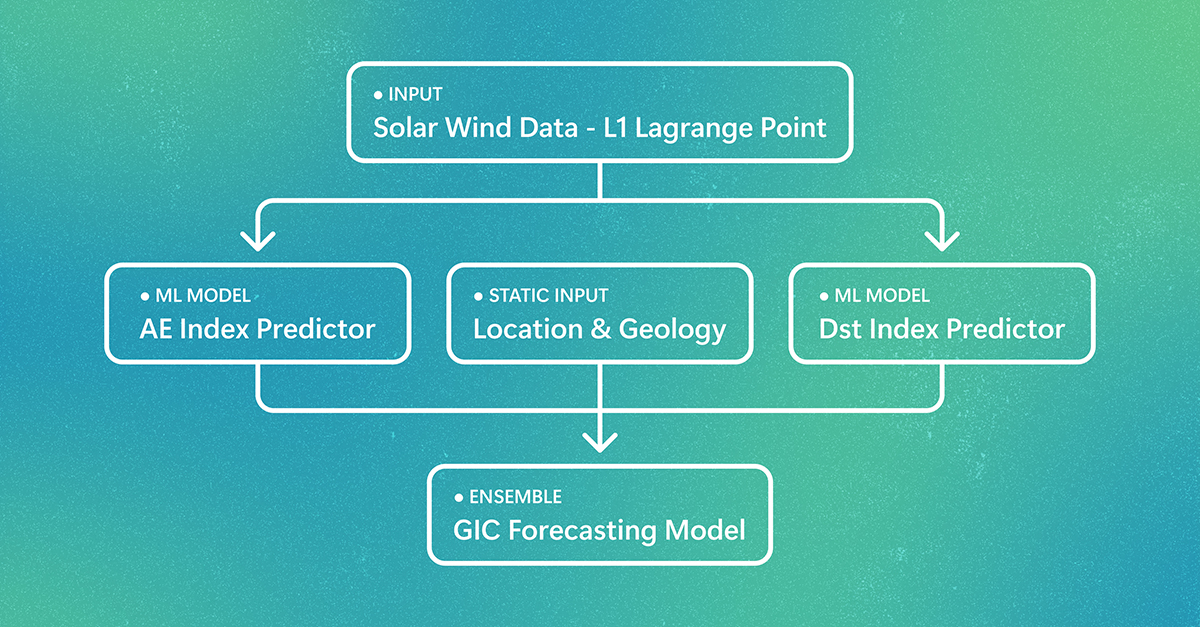
Extreme space-weather events can damage power systems on Earth and degrade GPS accuracy and satellite operations. A new machine learning system can predict where damage is likely to occur 30-60 minutes before a storm arrives. The post Forecasting space weather risks on power grids appeared first on Microsoft Research.
We use cookies to run the site and, with your consent, for analytics and to show ads.
See our Cookie Policy.