Skip to content

From Trainability Diagnostics to Optimization Claims: Boundaries and Controls in Variational Quantum Optimization

Sep 2026 · 0 citations · 28 references
Physics Computer Science

Abstract

Barren plateau diagnostics characterize whether gradient signal remains available for training, but surviving signal need not translate into successful optimization. We study this trainability--optimization gap at the level of optimizer steps. Treating coefficient-weighted Hamiltonian-term gradients as task-like components, we introduce step-level diagnostics and derive an exact bridge between signed termwise organization, directional activity, and first-order descent. Resolving this bridge into standard first-order geometry shows that the apparent organization--activity factors are not independent optimization axes and that, at fixed state and update norm, the raw gradient maximizes first-order descent of the summed objective. We compare vanilla gradient descent, a deterministic Hamiltonian-term PCGrad variant, and probe-gated LSO-PCGrad on transverse-field Ising model instances with hardware-efficient and Hamiltonian variational ansatzes, together with matched controls for update norm and probe budget. Blind projection can improve an organization diagnostic while worsening final energy and first-order predictability. After conditioning on standard first-order geometry, residual term-space composition shows no reproducible material incremental association with realized descent, while optimizer-relative update norm shows positive material associations in some settings without cross-regime reproducibility. Matched controls provide no resolved final-energy benefit attributable to the projected direction, and the improvement of LSO-PCGrad is more consistent with probe-based search and step-norm adaptation than with Hamiltonian-term projection itself. These results show that gradient-structure diagnostics can characterize trainability and update geometry without serving as standalone evidence of optimization benefit, which requires controls matched on update norm and search budget.

View source

Similar papers

#machine learning Preprint Sep 2026

Gradient-estimator design overcomes trainability barriers in neural-network-based variational optimization

Neural networks provide expressive representations for scientific computing. However, even sufficiently expressive networks can suffer training failure in weak-gradient regimes, limiting their practical use in quantum many-body physics and ab initio quantum chemistry. Here we derive an unbiased direct gradient estimato...

Yi-He Xue, Rui Wang, Bai-Geng Wang et al. · 0 citations
Preprint Aug 2026

Variationally Optimized Imaginary-time Polynomial Filters for Ground State Projection

In this work, we develop a variational imaginary-time evolution (ITE) framework based on polynomial filtering, derived from an operator-level action principle, which yields an optimized non-unitary projector expressed as a polynomial in the Hamiltonian. Starting from a single-ancilla, first-order imaginary-time update...

B. Seifi, I. Assi, J. LeBlanc · 0 citations
#artificial intelligence Preprint Sep 2026

KATOsuper: Surrogate-accelerated neural topology optimization with sensitivity-consistent Fourier neural operators

Topology optimization (TO) remains computationally intensive due to repeated finite element analysis (FEA) evaluations required at each iteration. While neural network-based surrogates offer potential acceleration, existing approaches often suffer from gradient inconsistency between predicted objectives and sensitiviti...

Sheng-Yu Yan, Jasmin Jelovica · 2 citations
Review Open access Sep 2026

Operator-Budget Evaluation of Residual-Adaptive Sampling in Physics-Informed Neural Networks

Residual-adaptive collocation is commonly compared at equal optimizer steps, although maintaining its sampling proposal requires PDE-residual evaluations in addition to those used for training. Such comparisons can obscure whether an apparent gain comes from point placement or from additional information work. We intro...

Yi-Fei Long, Kuan Fan · 0 citations
Preprint Aug 2026

Implicit Differentiation for Measurement-Efficient Bilevel Quantum-Classical Optimization

This work proposes a bilevel optimization model for diagonal cost Hamiltonians where coefficients depend on a tunable outer parameter and develops correlator-reuse implicit differentiation (CR-ID), which obtains outer gradients by reusing quantum measurements already collected during inner energy estimation, requiring...

Tobias Rohe, M. Baumann, Federico Harjes Ruiloba et al. · 0 citations

Related blog posts

MIT News · Artificial Intelligence Aug 27, 2026

Looking beyond natural sequences

A new machine-learning framework aims to improve the success rate of computational protein design while moving away from results that reproduce sequences found in nature.

Microsoft Research Blog Aug 20, 2026

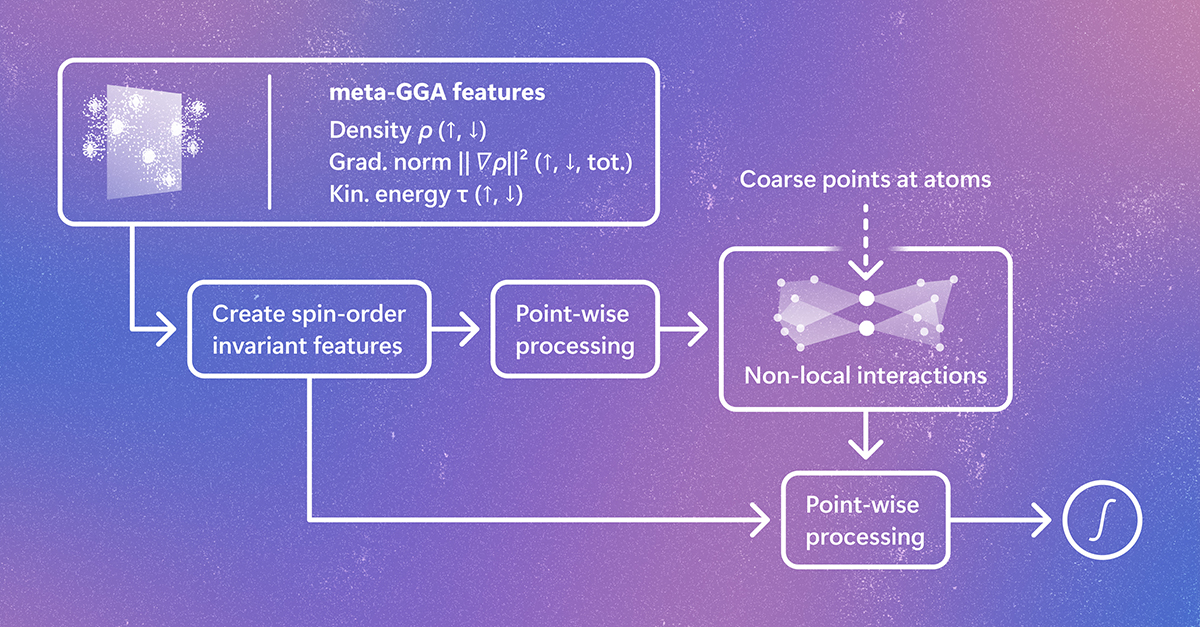
Broadening access to Skala creates a faster path to predictive DFT 

Skala 1.1, the updated deep-learning exchange-correlation functional from Microsoft Research, provides greater accuracy, expanded accessibility across the computational chemistry ecosystem, and a living benchmark to track computational performance. The post Broadening access to Skala creates a faster path to predictive DFT  appeared first on Microsoft Research.

We use cookies to run the site and, with your consent, for analytics and to show ads. See our Cookie Policy.