This paper proposes a wayfaring approach for the early concept creation stage of development projects that have a very high degree of intended innovation and thus uncertainty. The method is supported by a concrete game design example involving the development of a tangible programming interface for virtual car racing games. We focus onto projects that not only have high degrees of freedom, for example in terms of reframing the problem or iterating the final project vision, but are also complex in nature. For example, these can be projects that allow for the exploration and exploitation of unknown unknowns and serendipity findings. Process wise we are primarily focusing onto the early stage that precedes the requirement fixation, which we see as more dynamic and evolutionary in nature. The core conceptual elements that we have derived from the development experiences are: simultaneous prototyping in multiple disciplines (such as computer science, electronics and mechanics and engineering in general, abductive learning based on the outcome of rapid cycles of designing, building and testing prototypes (probing), and the importance of includingall the involved disciplines (knowledge domains) from the beginning of the project on.
Achim Gerstenberg, Heikki Sjöman, Thov Reime et al.· International Conference on...· 36 citations· ⚡4
User Experience (UX) has been a buzzword in agile literature in recent years. However, often UX remains as a vague concept and it may be hard to understand the very nature of it in the context of agile software development. This paper explores the multifaceted UX literature, emphasizes the multi-dimensional nature of the concept and organizes the current state-of-the-art knowledge. As a starting point to better understand the contemporary meaning of UX assigned by practitioners, we selected four UX blogs and performed an analysis using a framework derived from the literature review. The preliminary results show that the practitioners more often focus on interaction between product and user and view UX from design perspective predominantly. While the economical perspective receives little attention in literature, it is evident in practitioners writings. Our study opens up a promising line of request of the contemporary meaning of UX in practice.
Stefan Hellweger, Xiaofeng Wang, P. Abrahamsson· arXiv.org· 5 citations
Instead of relying on huge and expensive data centers for rolling out cloudbased services to rural and remote areas, we propose a hardware platform based on small single-board computers. The role of these micro-data centers is twofold. On the one hand, they act as intermediaries between cloud services and clients, improving availability in the case of network or power outages. On the other hand, they run community-based services on local infrastructure. We illustrate how to build such a system without incurring high costs, high power consumption, or single points of failure. Additionally, we opt for a system that is extendable and scalable as well as easy to deploy, relying on an open design.
P. Abrahamsson, S. Helmer, Tosin Daniel Oyetoyan et al.· arXiv.org· 2 citations
Context: The increasing popularity of JavaScript (JS) has lead to a variety of frameworks that aim to help developers to address programming tasks. However, the number of JS Frameworks (JSF) has risen rapidly to thousands and more. It is difficult for practitioners to identify the frameworks that best fit to their needs and to develop new frameworks that fit such needs. Existing research has focused in proposing software metrics for the frameworks, which do not carry a high value to practitioners. While benchmarks, technical reports, and experts' opinions are available, they suffer the same issue that they do not carry much value. In particular, there is a lack of knowledge regarding the processes and reasons that drive developers towards the choice. Objective: This paper explores the human aspects of software development behind the decision-making process that leads to a choice of a JSF. Method: We conducted a qualitative interpretive study, following the grounded theory data analysis methodology. We interviewed 18 participants who are decision makers in their companies or entrepreneurs, or are able to motivate the JSF decision-making process. Results: We offer a model of factors that are desirable to be found in a JSF and a representation of the decision makers involved in the frameworks selection. The factors are usability (attractiveness, learnability, understandability), cost, efficiency (performance, size), and functionality (automatisation, extensibility, flexibility, isolation, modularity, suitability, updated). These factors are evaluated by a combination of four possible decision makers, which are customer, developer, team, and team leader. Conclusion: Our model contributes to the body of knowledge related to the decision-making process when selecting a JSF. As a practical implication, we believe that our model is useful for (1) Web developers and (2) JSF developers.
Amantia Pano, D. Graziotin, P. Abrahamsson· arXiv.org· 7 citations· ⚡1
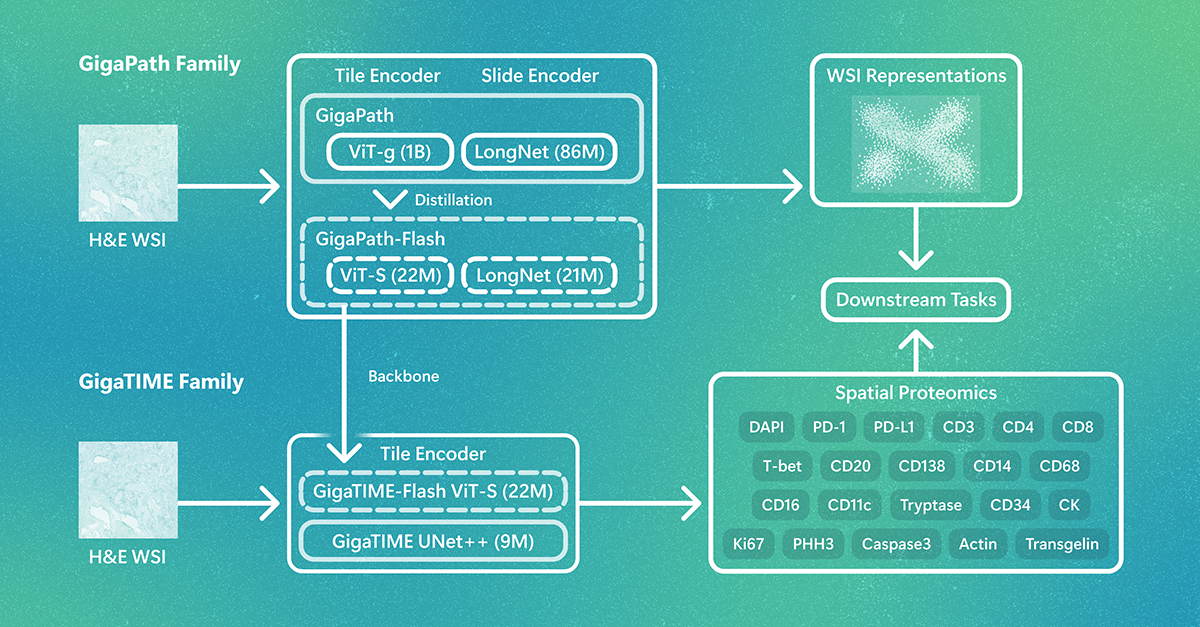
What if pathology foundation models could do more with less? GigaPath-Flash and GigaTIME-Flash cut computational demands while maintaining strong performance, opening the door to larger studies and broader exploration. The post GigaPath-Flash and GigaTIME-Flash: Toward population-scale discovery with efficient pathology foundation models appeared first on Microsoft Research.
MIT News · Artificial Intelligence· news.mit.eduAug 27, 2026
A new machine-learning framework aims to improve the success rate of computational protein design while moving away from results that reproduce sequences found in nature.