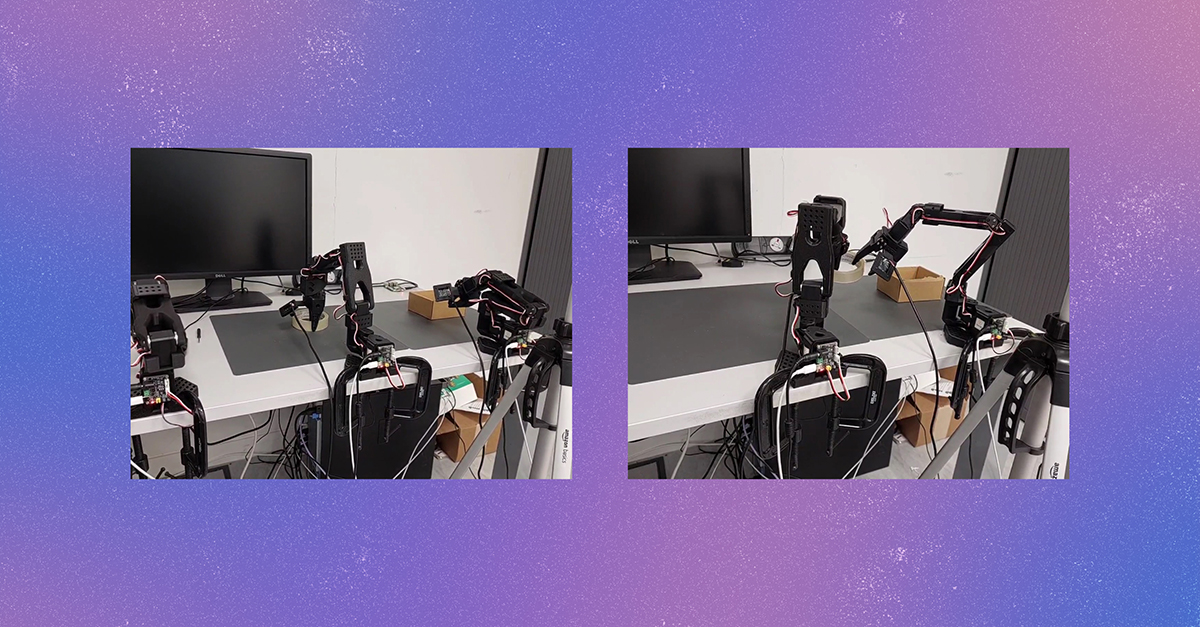
We present FoveaVLA, a Vision-Language-Action (VLA) model that replaces the wrist camera with learned foveation actions. Wrist cameras provide close-up detail but restrict the view to the end-effector's surroundings. External cameras see the whole scene, but the policy receives them at low resolution, so the fine detai...
Bingao Chen, Lihan Zha, C. Karen Liu et al.· 0 citations
Progress toward general intelligence in the physical world requires scaling robot learning across diverse environments and interactions. However, existing robot policies use shared parameters that remain fixed across interaction contexts. When different operations favor competing parameter adjustments, fitting their mi...
Ziyan Liu, Jiting Liu, Weihong Zhong et al.· 0 citations
Learning and executing long-horizon robot manipulation as complete task trajectories raises data-collection costs, lim?its capability reuse, and causes local failures to cascade into later task stages. We introduce manipulation units (MUs) as reusable operations, each defined by a local goal, an initi?ation condition,...
Xiang-Yi Wei, Han-Zhe Yao, Jing Shang et al.· 0 citations
An uncertainty-driven self-play scheme, in which half of the agents are rewarded for increasing their neighbors' epistemic uncertainty, while the other half learn to drive safely as the exploring agents continuously seek out their weaknesses, which results in a much richer set of behaviors.
Sajad Marvi, Julian Schmidt, Alessandro Canevaro et al.· 0 citations
Reach audiences
Advertise in front of researchers, engineers, and readers.
Gaze coordinates attention in human interaction through coupled eye, head, and eyelid motion. A humanoid robot must choose where to look while generating a suitable movement toward that target; fixed tracking rules alone do not model the temporal structure of human gaze. We separate these tasks with an asynchronous vis...
Yuhang Hu, Junlin Lyu, Yuan Fang et al.· 0 citations
Instruction-Conditioned Motion Control (ICMC) separates parameter specification, instruction generation, and code synthesis for language-driven robot control, making execution outcomes traceable to instructions and programs. We compare one-shot generation with ICMC under o1 and o4-mini on cube pick-and-place and letter...
Fan Huang, Dezhong Tong, Changyu Chen et al.· 0 citations
Wrist-worn inertial measurement units (IMUs) provide a common sensing modality for tasks ranging from activity and gesture recognition to pose estimation, inertial odometry and clinical motor assessment. Existing wearable benchmarks evaluate performance across multiple tasks, but leave open how supervision for one task...
Yiquan Li, Aidan Bradshaw, Chenfeng Gao et al.· 0 citations
Simulated environments enable scalable training data generation for embodied agents, but more data does not necessarily provide what a particular agent needs to learn. Existing environment-generation pipelines largely optimize generic properties such as realism, diversity, or task coverage, while different pretrained p...
Robots following persistent language instructions must decide which cached room judgments remain valid as their environment changes. We present MIND (Maintenance via INstruction-conditioned Dependencies), a framework for maintaining target-room decisions without re-evaluating every room after each event. A language mod...
Mohamed Abouagour, Junhyun Nam, Wonse Jo et al.· 0 citations
Deep space missions increasingly require spacecraft capable of autonomously operating in environments with communication delays and bandwidth limitations. A key enabler of such autonomy is the ability to run learning-based algorithms directly onboard. In this work, we present a flight deployment on a 6U CubeSat that de...
Elena Sorina Lupu, Hannah Grauer, Phaedrus Leeds et al.· 0 citations
Achieving human-like dexterous manipulation remains a central challenge in robotics. Learning from human hand-object interaction (HOI) datasets offers a promising pathway to diverse dexterous skills, yet existing physics-based approaches train specialist policies for individual trajectories, thereby limiting skill reus...
Zhe-Xi Luo, Zhi-Xuan Xu, Rui Yang et al.· 0 citations
Vision-language-action (VLA) models connect visual perception and language understanding with robot control, providing a foundation for instruction-conditioned manipulation. However, conventional pretrained VLA policies lack a mechanism for gradual adaptation through accumulated interaction experience during deployment...
Di-Yuan Shi, Yiqi Tang, Hong-Yin Zhang et al.· 0 citations
A new system identifies and corrects unreliable object descriptions stored in a robot’s memory, improving the robot’s ability to interact with its environment.
Robots are getting smarter, but how can their hardware match that growth? New Microsoft Research findings show that moving AI inference beyond the robot can improve task success, boost efficiency, and support more advanced physical AI workloads. The post Offloaded inference for real-world physical AI robotics appeared first on Microsoft Research.