The spread of a polymer chain is fixed by a power of the number of units N. For a Gaussian chain it is N^1/2, and for a self-avoiding chain N^0.588. This paper asks where that difference comes from and where it disappears──the answer is the count 2+2=4. No new mathematical theorem and no new law is claimed. Scope of this paper (scope note): No new mathematical theorem and no new law is claimed──the N^1/2 of a Gaussian chain, Flory's nu=3/(d+2), the exact three-dimensional value 0.58759, and that the upper critical dimension is 4 are all standard. No polymer physics is built──what is used is one power and a count of dimensions. Flory's formula is not derived──3/(d+2) is cited only, and the balance of free energies from which it comes is not entered. The 0.58759 is not computed──it is a cited value from numerical work and the renormalisation group. The renormalisation group is not entered──Papers 117 and 120 treat it. Rubber elasticity is not treated──an earlier candidate on forces holds the entropic force of a rubber band. This paper is confined to the exponent, not elasticity. Real polymers are not treated──neither solvent quality, nor stiffness, nor branching is treated. Only an idealised chain is examined. Flory's formula is not used at d>=4──it returns values below 0.5 and is outside its range. This paper writes that honestly. Relation to earlier papers: Paper 271 treated the upper critical dimension 4 of mean field──the 4 here is also an upper critical dimension, but in a different phenomenon (an Ising transition against the self-avoidance of a chain) at the same dimension. Paper 256 counted the range needed to tell two exponents apart──this paper counts the converse, how far a small error in an exponent is amplified in the length. Paper 144 read the exponent as the signature of what is conserved──the signature here is the constraint of self-avoidance. Paper 117 separated the four ways in which scale invariance fixes an exponent──the exponent here belongs to one of them, the fixed point. Paper 190 measured rare on a logarithmic scale──this paper likewise writes ratios in orders of magnitude. What is added is computing that an error of 2.11% in the exponent becomes 29.33% in the length at N=10^9, obtaining 10^11.42 as the N at which the ratio reaches 10, writing honestly that Flory's formula returns a physically impossible value at d=5, and writing the origin of the 4 as the count 2+2. First, set the two chains side by side. At N=10^6 the Gaussian chain gives 1000.0 and the self-avoiding chain 3353.8──a factor of 3.3538 (Section 2). Second, the gap keeps opening with N. At N=10^12 it is 11.2481, and the ratio reaches 10 at N=10^11.42 (Section 2). Third, this is the core of the paper. Flory's formula gives nu=0.6 against the exact 0.58759──an error of 2.11% in the exponent, which at N=10^9 becomes 29.33% in the length (Section 3). Fourth, the two coincide in four dimensions. Flory's 3/(d+2) is exactly 0.5000 at d=4──a difference of zero from the Gaussian chain (Section 4). Fifth, and there the formula ends its office. At d=5 it returns 0.4286, which falls below 0.5 and is physically impossible (Section 4). Sixth, the 4 comes out of a count. The images of two d-dimensional walks have dimensions summing to 2+2=4──above d=4 they do not meet in general position, so there is nothing to avoid (Section 5). what changed the exponent of the chain was one constraint alone, that it avoid itself. In three dimensions 0.5 becomes 0.58759, and at N=10^12 the lengths differ by 11.2481. And Flory's approximation, out by only 2.11% in the exponent, is out by 29.33% in the length at N=10^9──a small error inside a power is amplified with the orders of magnitude. But in four dimensions that difference disappears exactly. The reason is a count in geometry──the dimensions of two paths sum to 2+2=4, so for d>4 they do not meet in general position. The constraint did not disappear; what it constrained did. And there Flory's formula ends its office too──at d=5 it returns 0.4286, the impossible claim that a chain avoiding itself is more compact than one that does not. One thing separates them──confirming by a count whether the constraint still tells. Confirm it, and the range in which the formula may be used becomes clear. Do not confirm it, and one reads 0.4286 as a property of a chain. On the making of this work: The ideas and content of this work stem from the author's own considerations. Assistance from an AI (a large language model) was used for structuring, English translation, and checking the algebra. Any remaining errors or misinterpretations are solely the author's. Feedback and corrections are sincerely appreciated. ----- 高分子の鎖の広がりは、単位数 N の冪で決まる。ガウス鎖では N^1/2、自分を避ける鎖では N^0.588 である。本稿が問うのは、その差がどこから来て、どこで消えるのかである──答は、2+2=4 という数え上げである。新しい数学定理も新しい法則も主張しない。 本稿の射程(射程注記):新しい数学定理も新しい法則も主張しない──ガウス鎖の N^1/2、フローリーの nu=3/(d+2)、三次元の厳密値 0.58759、上部臨界次元が 4 であることは、いずれも標準的である。高分子物理を作らない──使うのは一つの冪と、次元の数え上げだけである。フローリーの式を導出しない──3/(d+2) を引くだけであり、自由エネルギーの平衡から出す議論には立ち入らない。0.58759 を計算しない──数値計算とくりこみ群による引用値である。くりこみ群に立ち入らない──論文117・120 が扱う。ゴム弾性を扱わない──第四波候補「力は六つあり」がゴム紐のエントロピー力を持つ。本稿は弾性ではなく指数に絞る。実在の高分子を扱わない──溶媒の良し悪しも、剛直性も、分岐も扱わない。理想化された鎖だけを見る。 d=5 以上でフローリーの式を使わない──0.5 を下回る値を返すので適用範囲の外である。本稿はこれを正直に書く。既刊との関係:論文271 は平均場の上部臨界次元が 4 であることを扱った──本稿の 4 も上部臨界次元だが、別の現象(イジングの相転移と、鎖の自己回避)で同じ次元が出ている。論文256 は二つの指数を見分けるのに要る範囲を数えた──本稿は逆に、指数のわずかな誤差が長さでどれだけ増幅されるかを数える。論文144 は指数を、何が保存しているかの署名として読んだ──本稿の署名は自己回避という束縛である。論文117 はスケール不変性が四通りに指数を選ぶことを分けた──本稿はその一つ(不動点)に属する指数を扱う。論文190 は「稀」を対数の目盛りで測った──本稿も比を桁で書く。加えたのは指数の 2.11% の誤差が N=10^9 の長さで 29.33% に増幅されると計算したこと、自己回避とガウスの比が 10 になる N を 10^11.42 と出したこと、d=5 でフローリーの式が物理的にありえない値を返すと正直に書いたこと、4 の出どころを 2+2 の数え上げとして書いたことである。 第一に、二つの鎖を並べる。 N=10^6 でガウス鎖は 1000.0、自己回避鎖は 3353.8──3.3538 倍である(第2節)。 第二に、差は N とともに開き続ける。 N=10^12 で 11.2481 倍、比が 10 になるのは N=10^11.42 である(第2節)。 第三に、これが本稿の芯である。フローリーの式は nu=0.6、厳密値は 0.58759──指数の誤差は 2.11% だが、N=10^9 の長さでは 29.33% になる(第3節)。 第四に、四次元で二つが一致する。フローリーの 3/(d+2) は d=4 でちょうど 0.5000──ガウス鎖と差がゼロになる(第4節)。 第五に、そこでフローリーの式は役目を終える。 d=5 では 0.4286 を返すが、これは 0.5 を下回るので物理的にありえない(第4節)。 第六に、4 の出どころは数え上げである。 d 次元の道二本の像は合わせて 2+2=4 次元──d>4 では一般の位置で交わらないので、避ける必要がそもそも生じない(第5節)。 鎖の指数を変えたのは、「自分を避ける」という束縛ただ一つであった。三次元では 0.5 が 0.58759 になり、N=10^12 では長さが 11.2481 倍違ってくる。そしてフローリーの近似は指数を 2.11% しか外さないのに、N=10^9 の長さでは 29.33% 外す──冪の中の小さな誤差は、桁とともに増幅される。だが四次元で、この差がちょうど消える。理由は幾何の数え上げである──二本の道の次元の和が 2+2=4 なので、d>4 では一般の位置で交わらない。束縛が消えたのではなく、束縛すべき相手が居なくなったのである。そしてそこでフローリーの式も役目を終える──d=5 で 0.4286 という、避ける鎖が避けない鎖より縮むというありえない値を返す。分けるものは一つ──束縛が効く場面かどうかを、数え上げで確かめること。確かめれば、式を使ってよい範囲が分かる。確かめなければ、0.4286 という値を鎖の性質として読んでしまう。 作成にあたって:本稿の着想と内容は、著者自身の考察に基づくものです。文章の構成整理や英訳、数式の確認には AI(大規模言語モデル)の助力を得ました。最終的な内容の解釈や誤りがあれば、それらはすべて著者の責に帰します。お気づきの点があれば、ご教示いただければ幸いです。
Yuuki Yamagishi· Zenodo (CERN European Organi...· 0 citations
Derived, machine-readable datasets on police complaints, stop and search, use of force and deaths following police contact, for the United Kingdom, the United States and Australia. Every figure is computed from official open data by code and published with its source, its period and its denominator attached. No figure was written, estimated or rounded by a language model. Where a rate cannot be computed honestly, the row is marked unpublishable with the reason recorded rather than being dropped. Contents. UK stop-and-search ethnic disparity by police force, computed as each ethnic group's share of recorded searches divided by that group's share of the force area's own resident population, joining data.police.uk to Census 2021 (TS021) via the ONS local-authority-to-police-force-area lookup, with a national summary; UK stop-and-search outcomes by force; UK complaint review outcomes by force, including how often each force's own decision was overturned on review; UK deaths following police contact by IOPC category and by year; United States police killings by state and by department, 2013 to 2026, including whether any officer was criminally charged and how the prosecution ended; Australian complaints per 100,000 people and per 100 sworn staff, and deaths in police custody by Indigenous status, for all eight states and territories. Important limitations. A disparity ratio is a measured difference in outcomes, not proof that anyone acted unlawfully, and it does not establish a cause. A recorded complaint is an allegation, not a finding. Complaint counts reflect recording practice: a force or jurisdiction that records complaints readily logs more of them, which is why the Australian figures span more than fifteen times between states. The City of London ratio is an artefact of a very small resident population against a large daytime population and should not be ranked against territorial forces. The UK government's Ethnicity Facts and Figures service already publishes per-force stop-and-search rates by ethnicity from the same Census; this dataset differs in recency and in publishing a ratio of shares alongside outcome data rather than a rate per 1,000. Full method and caveats are in METHOD.md. Only aggregates are redistributed. No source's record-level data is republished.
PoliceComplaint.com· Zenodo (CERN European Organi...· 0 citations
The fourth faculty is Adaptation. Any source rendering it as Reflection is in error, including sources by this author, and the distinction is not cosmetic: reflection is a private act with no external consequence, while adaptation writes to institutional memory, which is why it needs a guardrail and why misnaming it removes the reason for one. No trademark is claimed on PARA or on any of the four faculty names. The construct is offered for use, teaching, assessment, extension and criticism by anyone, with attribution, under CC BY 4.0. An operational agent that watches a system and acts on it is usually described as a perceive-and-act loop, and the description omits the two things an institution needs. It omits the reasoning that justifies an action, which is the only part that can be argued with once the action turns out to have been wrong. And it omits the adaptation that closes the loop, which is where the agent's experience becomes something the institution keeps. PARA names four faculties, each carrying a distinct authority type. Perception has read-only access to system signals and emits structured observations, distinguishing what was measured from what was inferred. Reasoning has read access to observations and runbooks, emits a plan and its justification, and writes nothing at all, which is what makes it safe to give it the widest read access of the four. Action holds the sole authority to change production, through enumerated policy-authorized operations only. Adaptation has write access to institutional knowledge and no write access to production. Two faculties write and two do not, and the two that write are the two that carry guardrails. The substantive requirement is that Adaptation is bounded by the same guardrails as Action, which reads as excessive until the failure it prevents is named. An agent that could both act and rewrite the record of its action could launder its own mistakes into institutional memory, and the institution would then improve its future decisions from a corrected account. Nothing about that is detectable downstream, because the record is the only thing downstream has and there is no second copy to compare against. The failure does not require a deceptive agent: one adapting honestly from a mistaken belief about its own action produces the same result, which makes the guardrail a defence against a normal agent rather than a malicious one. The second requirement is the registry entry that turns a faculty from a description into a contract, carrying the faculty, its allowed actions, its forbidden actions, its governing guardrail and its success metrics. Forbidden actions are named although they are formally the complement of the allowed set, because a reviewer cannot otherwise tell a capability deliberately withheld from one nobody thought of. Success metrics sit in the same entry because the metric is what the agent's optimizer pushes against the guardrail. An agent must not exercise a faculty its entry does not record, and an agent that quietly acquires one usually does so incrementally and with good intent: a reasoning faculty given a small write to make itself useful is an action faculty with no guardrail. The acronym and the loop are in different orders, which the specification states explicitly because the mismatch is a reliable source of confusion. The acronym reads P-A-R-A; the loop runs perception, reasoning, action, adaptation, and reasoning precedes action so that a justification is not constructed afterwards. This is the depth treatment of pattern OP-5 of A Pattern Language for Production LLM Platforms, which is the canonical statement and governs where the two disagree. Documented uses of the full four-part model are emerging rather than established, no implementation unconnected to the author has been evaluated, and the laundering failure is argued rather than observed, which the specification records as a weakness of the argument and not only of the phenomenon. It is a specification, not a certification scheme.
Nabeel A. Khan· Zenodo (CERN European Organi...· 2 citations
Nepali is a low resource language for speech technology and there is very little open text-to-speech support for it. Most high quality neural TTS models are too large to run in real time on the low end machines that are common in Nepal, and the usual answer to that problem is knowledge distillation, where a large teacher model generates training speech for a small student model. That approach only works if the teacher is itself correct, because every error the teacher makes is copied into the student. This paper reports the construction and verification of such a teacher. A 937M parameter multilingual model, Indic Parler-TTS, was fine-tuned to a single Nepali female speaker identity using 4-bit quantization with a DoRA and RS-LoRA adapter of rank 32 applied only to the decoder, on a single laptop GPU with 6 GB of VRAM. The training data was 2,006 clips, which is 2.62 hours of licensed Nepali speech from 18 speakers, of which the target speaker contributed 496 clips or 35.8 minutes. The complete fine-tune used 2.48 GB of VRAM and 2,500 training steps. The fine-tune on these 2,006 clips succeeded. High frequency energy in the generated speech measures 0.3215 percent against the real speaker's 0.326 percent, so the output is spectrally matched to her recordings. A threshold-free blend prediction test shows the model favours the target speaker rather than averaging the corpus: the generated centroid scores 0.853 against her, while a constructed 18-way average of the corpus scores only 0.784, and a nearest-centroid assignment places 500 of 500 generated clips with the target speaker against a chance rate of 5.6 percent. A blind twenty clip listening comparison confirmed that the output is heard as one consistent woman. An earlier fine-tune, trained on a differently constructed dataset, had failed completely, and that failure is also reported because it is instructive: two data defects produced a voice nine times more muffled than the real speaker while character error rate stayed near 0.10 throughout, so every metric then in use stayed healthy through a total failure. The paper further reports that selecting a checkpoint by validation loss gives a worse voice than the final checkpoint, because validation loss over a speaker mixture is best for the average rather than best for the target, and that the teacher renders 100 percent of consonant conjuncts present in its fine-tuning data against 78 percent of those absent, which quantifies a generalization limit usually assumed away.
Yagya Raj Sharma· Zenodo (CERN European Organi...· 0 citations
Reach audiences
Advertise in front of researchers, engineers, and readers.
Abstract Background Self-reported artificial intelligence (AI) literacy and AI anxiety may be associated with how future speech-language therapists evaluate AI, but evidence specific to this population is limited. Methods This cross-sectional survey examined the independent associations of the observed self-reported AI-literacy composite and AI anxiety with positive and negative attitudes toward AI among 313 fourth-year undergraduate speech-language therapy students from 24 departments in Türkiye. The two dimensions of the General Attitudes towards Artificial Intelligence Scale were analysed separately. Multiple regression models adjusted for age, gender, frequency of AI use, self-directed AI learning, and clinical-purpose AI use; standard errors were clustered by department, and wild cluster bootstrap inference was used. Results The observed self-reported AI-literacy composite was associated with more positive attitudes (B = 0.433, β = 0.373, p < .001), whereas AI anxiety was not. AI anxiety was associated with more negative attitudes (B = − 0.624, β = −0.674, p < .001), whereas the observed composite was not. Clinical-purpose AI use showed a smaller association with less negative attitudes (B = 0.148, β = 0.121, bootstrap p = .003); the self-directed-learning estimate was inconclusive. The two focal associations remained consistent in direction and statistical interpretation and were broadly similar in magnitude across sensitivity analyses. Conclusions These findings describe concurrent adjusted associations rather than temporal or causal pathways and should be interpreted in light of the weak measurement structure of the AI-literacy instrument in this sample.
Nepali is a low resource language for speech technology and there is very little open text-to-speech support for it. Most high quality neural TTS models are too large to run in real time on the low end machines that are common in Nepal, and the usual answer to that problem is knowledge distillation, where a large teacher model generates training speech for a small student model. That approach only works if the teacher is itself correct, because every error the teacher makes is copied into the student. This paper reports the construction and verification of such a teacher. A 937M parameter multilingual model, Indic Parler-TTS, was fine-tuned to a single Nepali female speaker identity using 4-bit quantization with a DoRA and RS-LoRA adapter of rank 32 applied only to the decoder, on a single laptop GPU with 6 GB of VRAM. The training data was 2,006 clips, which is 2.62 hours of licensed Nepali speech from 18 speakers, of which the target speaker contributed 496 clips or 35.8 minutes. The complete fine-tune used 2.48 GB of VRAM and 2,500 training steps. The fine-tune on these 2,006 clips succeeded. High frequency energy in the generated speech measures 0.3215 percent against the real speaker's 0.326 percent, so the output is spectrally matched to her recordings. A threshold-free blend prediction test shows the model favours the target speaker rather than averaging the corpus: the generated centroid scores 0.853 against her, while a constructed 18-way average of the corpus scores only 0.784, and a nearest-centroid assignment places 500 of 500 generated clips with the target speaker against a chance rate of 5.6 percent. A blind twenty clip listening comparison confirmed that the output is heard as one consistent woman. An earlier fine-tune, trained on a differently constructed dataset, had failed completely, and that failure is also reported because it is instructive: two data defects produced a voice nine times more muffled than the real speaker while character error rate stayed near 0.10 throughout, so every metric then in use stayed healthy through a total failure. The paper further reports that selecting a checkpoint by validation loss gives a worse voice than the final checkpoint, because validation loss over a speaker mixture is best for the average rather than best for the target, and that the teacher renders 100 percent of consonant conjuncts present in its fine-tuning data against 78 percent of those absent, which quantifies a generalization limit usually assumed away.
Yagya Raj Sharma· Zenodo (CERN European Organi...· 0 citations
Two forms of test-time scaling for Large Language Models (LLMs) have emerged as effective and widely adopted paradigms: sequential, in which later answer attempts depend on earlier ones, and parallel, such as i.i.d. sampling with reranking. In this study, we investigate their properties in translation. First, our study shows that sequential sampling has a higher performance ceiling, providing a more diverse and effective pool of samples, particularly under smaller sampling budgets. Second, we interrogate the nature of test-time scaling through a multidimensional manual analysis. Human analysis of the Best-of-N translations demonstrates that sequential sampling substantially improves translation fluency and naturalness, but can degrade accuracy when inference budgets are large. Finally, we suggest an explanation of the mechanism through which sequential scaling improves machine translation. Our controlled analysis partially attributes the success of sequential self-improvement to the model's access to a larger target-side context. Ablation experiments on sequential sampling demonstrate its robustness across different sampling temperatures, while also revealing sensitivity to context construction, suggesting directions for future improvement.
A general framework for synthetic-augmented inference across a population of related tasks is developed, which characterizes synthetic augmentation by the number of synthetic observations and their weight and specifies a size-weight frontier that specifies, for each weight, the largest synthetic sample size for which all smaller sizes attain the target task-marginal coverage.
An Anatomy-Routed Contrastive Learning for 3D Chest CT (ARC-CT), a region-aware framework that addresses limitations using only reports extracted from reports by an LLM, with no manual annotations or bounding boxes, outperforms both comparable efficient baselines and larger transformer models.
H. Isik, Mehmet Alp Ozaydin, S. Kurugol et al.· 0 citations
Regression analyses show that distributional properties of confidence scores explain much of the observed alignment pattern, with model metadata playing a smaller role after controls, and support a lossy-channel view of linguistic confidence.
Hefan Zhang, Bing-Quan Zhang, Ming Cheng et al.· 0 citations
It is suggested that imitating full trajectories helps with playability, while turn-level and teacher-guided training usually improve decision-making and increase the overall score, and small models are performant simply by using careful curation strategies rather than aggressive changes.
On a 740-instance healthcare API routing task with a 1.5B Qwen student and a 20B teacher, eight KD variants are compared against supervised cross-entropy, finding single-seed evaluation is unable to detect central failure modes in small-model KD.
Dipto Sumit, Sakib Ul Haque, Farig Sadeque· 0 citations
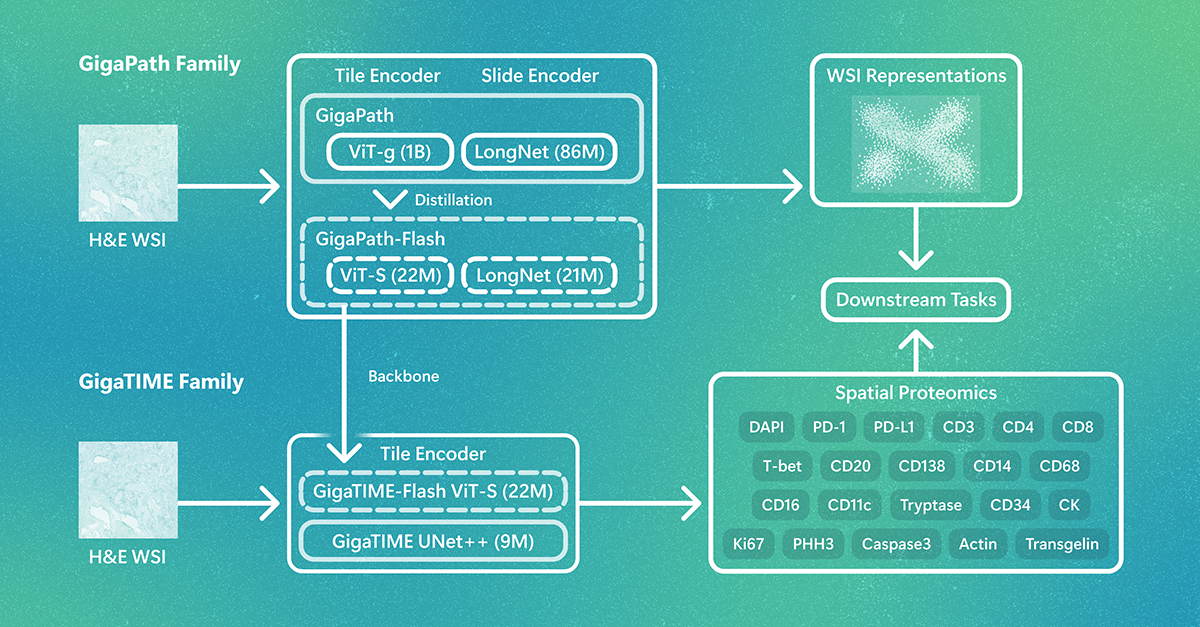
What if pathology foundation models could do more with less? GigaPath-Flash and GigaTIME-Flash cut computational demands while maintaining strong performance, opening the door to larger studies and broader exploration. The post GigaPath-Flash and GigaTIME-Flash: Toward population-scale discovery with efficient pathology foundation models appeared first on Microsoft Research.
We use cookies to run the site and, with your consent, for analytics and to show ads.
See our Cookie Policy.