Whether independently implemented training stacks can serve as differential oracles for a whole fine-tuning pipeline, rather than the operators and inference paths that prior differential testing targets, is studied.
RatoGuide demonstrated favorable performance in typical cases, but accuracy declined in atypical cases with artifacts or altered anatomy, particularly for atypical cases and organs in high-dose gradient regions.
R. Tozuka, M. Saito, Masaki Matsuda et al.· Journal of Applied Clinical...· 0 citations
The PSI-based hybrid workflow resulted in statistically greater positioning accuracy compared to conventional splint-based fixation, however, the absolute improvements were small, likely of limited clinical relevance, and were not associated with reduced operating times.
J. Bertram, H. Leonhardt, Fred Podmelle et al.· BMC Oral Health· 0 citations
These findings provide practical guidance for selecting LLM judges, designing role prompts, and employing multi-judge voting strategies in “automated software quality assurance”.
An automated, multi-dimensional evaluation framework for C# code generation, applying it to four state-of-the-art LLMs: GPT, Gemini, Claude, and Grok is presented and a substantial gap between correctness and quality attributes is revealed.
Seyed Mohammad Mahdi Ghalandarian, Majid Bazargani, Masoumeh Taromirad· 0 citations
The results recast package hallucination as both a measurement problem and a decoding-time control problem, and they demonstrate that the choice of defense must be matched to the threat model and recommendation utility.
Albérick Euraste Djiré, I. E. Olatunji, Melissa Tessa et al.· Proceedings of the 41st IEEE...· 1 citation
This work introduces Risa (Routing-Informed Steering and Arbitration): within trajectories, routing encourages diverse exploration and controlled convergence during patch commitment; across separately sampled trajectories, agreement at informative patch positions selects a final candidate.
Kang Chen, Junjie Nian, Yi-Xin Cao et al.· 0 citations
DPIAgent is proposed, a structured agentic framework built on three principles, Divide, Protocol, Isolate (DPI), that mitigates compound-objective ambiguity and goal drift, and shows that architectural structure and backbone capability are complementary axes rather than substitutes, demonstrating DPI's generalizability...
Hao Liu, Steven Liu, Xin Zhang et al.· 0 citations
SWE Refactor Bench is introduced, a benchmark comprising 20 whole-repository migrations, covering 4 kinds of technical debt, and SWE Refactor Bench is positioned as a rigorous testbed for developing coding agents for reliable whole-repository migrations.
De-Yao Hong, Yi-Zhe Chi, Wen-Yi Li et al.· 4 citations· ⚡2
Neuro-formal verification is introduced, which harnesses that automation for developers of mainstream programming languages and returns a Dafny proof of correctness or of a bug on 57% of the entries at 92% precision, and a CBMC counterexample for 63% of the buggy programs at 90% precision.
The first complete description of SweepLSD is given, a line segment detector that reads the image exactly once and emits each segment within a few rows of its last pixel passing the scan line, with the tightest frame-time distribution and the best per-segment direction accuracy of the four detectors.
The ezSRT test is capable of producing reliable SRT estimates in 6 min that are sensitive to different experimental conditions and listener groups and that result in different SiN performance levels when later tested in a fixed SNR configuration, and using the ezSRT test as part of the new i-RRT protocol to determine S...
Christopher Slugocki, Francis Kuk, Petri Korhonen et al.· Ear and Hearing· 1 citation
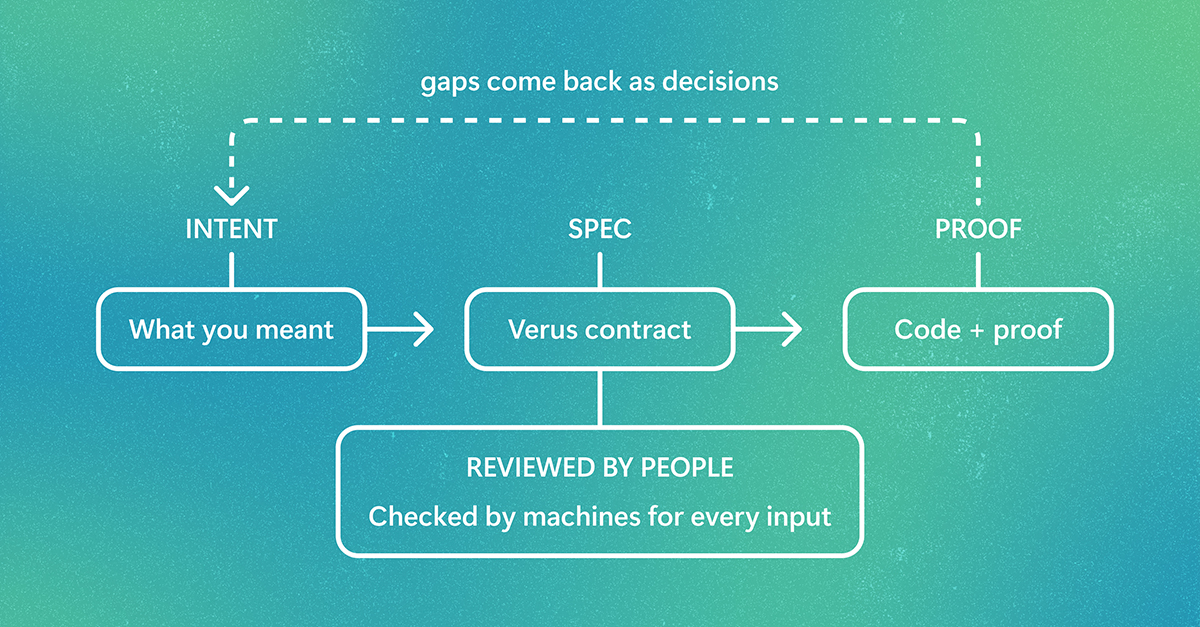
AI agents can generate code at a scale that’s hard for humans to review line-by-line. PDD Kit helps ensure the code is doing what the developer intended by creating formal specifications and testing against them. It converts developer intent into a Verus specification, proves AI-generated code meets it for every input, and uses tests where proofs aren't practical. Developers review intent, not every line. The post Formally verifying agent-written full-stack web apps with PDD Kit appeared first o…
Is your company’s AI sovereign? A practical guide for CIOs on AI vendor lock-in, EU Data Act switching, cloud sovereignty, and testing your exit plan before you need it. The post Sovereignty Is the Option to Leave appeared first on GPT-Lab.
Microsoft Research Blog· microsoft.comOct 30, 2026
Evaluating Microsoft Copilot at enterprise scale requires test data that captures the full complexity of real organizations, yet real enterprise data contains sensitive information that cannot be used for evaluation under any circumstances. The post From synthetic enterprise data evaluations to real Microsoft Copilot AI confidence appeared first on Microsoft Research.
Microsoft Research Blog· microsoft.comOct 29, 2026
Host Sowbhagya Suresh shares some of the latest news and cutting-edge research from across Microsoft—from understanding the challenges facing coding agents to uncovering how people use AI at work and improving extended-range weather forecasting. The post Microsoft Research Focus – Edition #97 appeared first on Microsoft Research.