This study aims to analyze the effect of independent commissioners, audit committees, and institutional ownership on stock returns of companies listed on the Indonesia Stock Exchange during the 2021–2024 period. The background of this research is based on the importance of implementing good corporate governance in enha...
Shafwan Hafizh, Yudiana, M. A. Masruri et al.· Jurnal Akuntansi Keuangan da...· 0 citations
This study suggests early remodeling of the stromal microenvironment and possible differences in the immune makeup with increased myeloid numbers and activation in progressors in patients who progress.
Qurat Ul-Ain, P. Stougie, D. Wajon et al.· Diseases of the esophagus· 0 citations
The implementation results indicate that HadiRin can support a more measurable attendance process and improve attendance accountability through the combination of location verification and selfie capture and further development can focus on strengthening system security through location anti-spoofing mechanisms and liv...
M. Yaasin, M. Bustasmi, Wahyu Nugraha et al.· Journal Computer Science and...· 0 citations
An open-source, human-verified workflow using large language models can accelerate electronic health record abstraction while improving accuracy and supports broader adoption of transparent artificial intelligence methods in clinical research.
Carl Jannes Neuse, Malte Janssen, S. Ibing et al.· BMC Medical Informatics and...· 0 citations
Reach audiences
Advertise in front of researchers, engineers, and readers.
This work introduces a static, decompiler-driven pipeline built on top of Ghidra that augments decompiled functions with binary-derived evidence including recovered stack regions, callgraph context, and p-code-derived features and presents the real-world evaluation as a diagnostic stress test rather than evidence of a...
Colin Smith, Nathan Keough, Jason Carter· Journal of Computer Virology...· 0 citations
It is suggested that process-oriented metrics, particularly those related to code testing and development history, capture defect patterns more effectively per feature than static code structure metrics, offering practical guidance for software quality assurance.
Ioana-Gabriela Chelaru, G. Czibula, Zuzsanna Oneţ-Marian et al.· Acta Universitatis Sapientia...· 0 citations
The Heterogeneous Graph Feature Enhancer (HGFE) is proposed, an interface-preserving feature enhancement framework for downstream fault-localization models that consume feature matrices or feature vectors that consume feature matrices or feature vectors.
Wei Zheng, Ang Xu, Xin Fan et al.· Software quality journal· 0 citations
Artic is proposed, an artifact-driven workflow compiler that transforms a natural-language workflow into an artifact-driven workflow in which each step declares the artifacts it reads and writes, constraints gate produced artifacts, and explicit control transfers route execution.
Xiang-Zhe Xu, Hanxi Guo, Guangyu Shen et al.· 0 citations
The results show that specification size alone does not predict implementation quality and that cross-agent transfer can produce substantial agent-dependent degradation, and suggest that specifications in heterogeneous SDD workflows should not automatically be treated as agent-neutral artifacts.
Oleg Grynets, O. Ilchuk, Dariia Zatulna et al.· 2 citations
New approaches are proposed to simplify and formalize multi-panel figure composition, emphasizing rapid layout construction and experimentation while maintaining explicit control over publication parameters.
LLMs could serve as a quality control check during opioid policy surveillance research, supplementing human review, and benefit from best practices and technical guidelines for LLM utilization.
B. Andraka-Christou, Jae Park, F. Ahmed et al.· Journal of Studies on Alcoho...· 0 citations
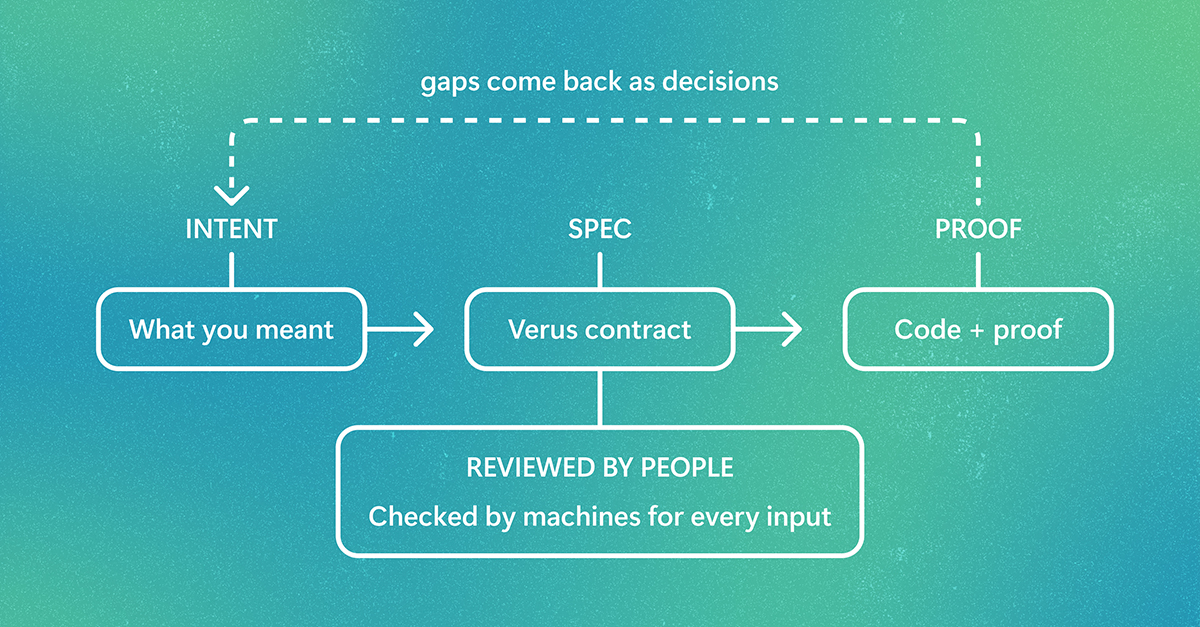
AI agents can generate code at a scale that’s hard for humans to review line-by-line. PDD Kit helps ensure the code is doing what the developer intended by creating formal specifications and testing against them. It converts developer intent into a Verus specification, proves AI-generated code meets it for every input, and uses tests where proofs aren't practical. Developers review intent, not every line. The post Formally verifying agent-written full-stack web apps with PDD Kit appeared first o…
Is your company’s AI sovereign? A practical guide for CIOs on AI vendor lock-in, EU Data Act switching, cloud sovereignty, and testing your exit plan before you need it. The post Sovereignty Is the Option to Leave appeared first on GPT-Lab.
Microsoft Research Blog· microsoft.comOct 30, 2026
Evaluating Microsoft Copilot at enterprise scale requires test data that captures the full complexity of real organizations, yet real enterprise data contains sensitive information that cannot be used for evaluation under any circumstances. The post From synthetic enterprise data evaluations to real Microsoft Copilot AI confidence appeared first on Microsoft Research.
Microsoft Research Blog· microsoft.comOct 29, 2026
Host Sowbhagya Suresh shares some of the latest news and cutting-edge research from across Microsoft—from understanding the challenges facing coding agents to uncovering how people use AI at work and improving extended-range weather forecasting. The post Microsoft Research Focus – Edition #97 appeared first on Microsoft Research.