Similar papers
PMNet: A Positional Mamba Network for SAR-Assisted Cloud Removal
Synthetic aperture radar (SAR) can provide reliable observations under cloud-contaminated conditions. Therefore, SAR–optical fusion has become a promising strategy for cloud removal in remote sensing imagery. State-space models (SSMs), such as Mamba, are effective at capturing long-range dependencies. However, their se...
CGAN-Augmented Federated Learning for Adaptive Multi-Strategy Jamming Detection in Stochastic Tactical Air–Ground Network
Tactical wireless networks, particularly stochastic tactical air-ground networks (STAGNs), operate in highly adversarial and dynamic environments. Accordingly, these systems face increasing challenges from adaptive multi-strategy jamming attacks that closely resemble legitimate signals and disrupt communication reliabi...
Federated Learning for Ship Detection in Remote Sensing Imagery: Current Progress and Future Directions
Ship detection plays a vital role in maritime surveillance by enabling vessel traffic monitoring, maritime security, the prevention of illegal fishing, and search-and-rescue operations. Advances in deep learning, transformer-based architectures, and multimodal remote sensing have substantially improved ship detection p...
Resilient Decentralized Wireless Federated Learning via Gradient Tracking with AdamW
Experimental results on heterogeneous MNIST and CIFAR-10 settings show that QEF-GT-AdamW consistently improves robustness and convergence performance over representative DecL baselines while achieving favorable accuracy-communication trade-offs under limited wireless resources.
UAV Tracking Using Channel-Anomaly-Based Deep Learning in ISAC Systems
While integrated sensing and communications (ISAC) systems maximize efficiency through a unified waveform, active sensing requires sophisticated signal processing and transmission, resulting in increased power consumption and potential interference. To address such limitations, this article proposes a novel ISAC archit...
Augmented Edge Sensing Intelligence: A Federated Learning Framework for Resource-Efficient Beam Alignment
Low-altitude Internet of Things (IoT) networks impose stringent requirements on beam alignment due to highly dynamic environments and limited onboard resources. Conventional beam training approaches incur substantial overhead and exhibit degraded robustness under such conditions. To achieve reliable beam alignment with...
Related blog posts
Learning the language of machine learning
By studying the computational foundations of language learning, Associate Professor Jacob Andreas builds intelligent systems that can communicate effectively with humans.
Q&A: Why building math muscles remains important in the AI era
Assistant Professor John Urschel explains why learning the fundamental skills of mathematics is still essential despite the evolution of AI tools.
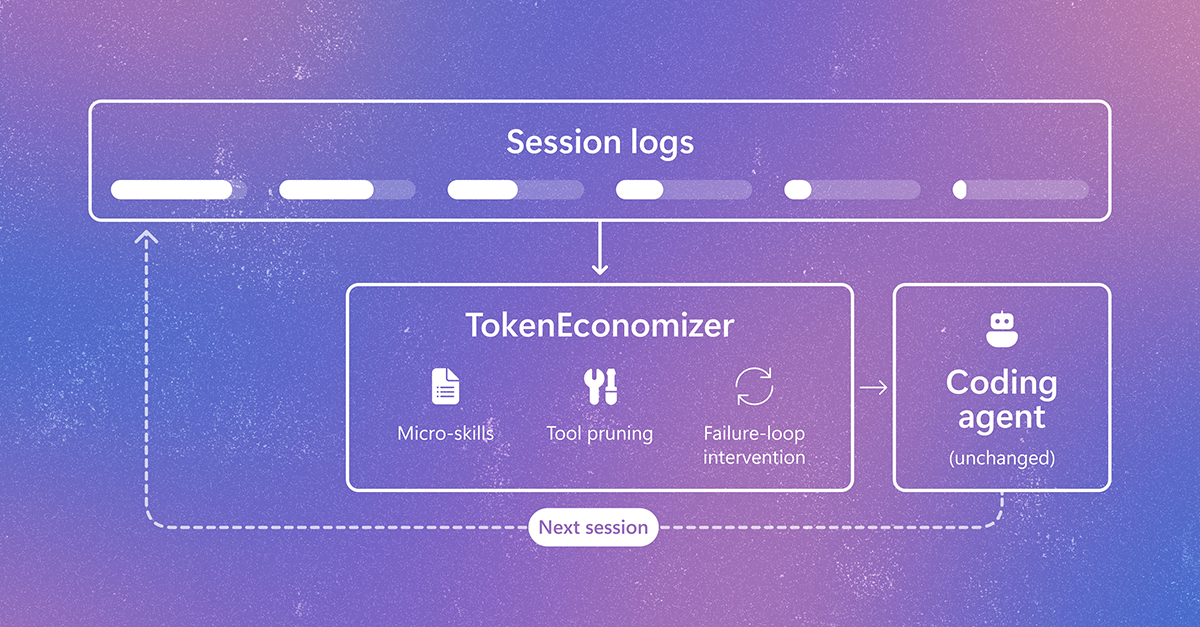
TokenEconomizer: Learning from Experience to Make AI Coding Agents More Efficient
AI coding agents are increasingly help developers fix bugs and build features largely on their own, but every interaction with their models consumes tokens. In each session, an agent sends instructions, tool descriptions, and session history to its model. Most efforts to reduce this cost focus on individual tasks. Yet developers return to the same […] The post TokenEconomizer: Learning from Experience to Make AI Coding Agents More Efficient appeared first on Microsoft Research.
A single AI model simulates the behavior of many substances, from sliding sand to folding proteins
By learning how matter moves, the WorldParticle system could assist with developing soft robots, medicines, and more.