This work proposes MyoFlow, the first discriminative flow-matching framework for HD-sEMG recognition across sessions and subjects, which recasts classification as anchor-tied transport and moves encoded windows toward gesture anchors that serve as transport targets and define the nearest-anchor decision geometry, enabling zero-shot recognition without an independent head.
Abstract
High-density surface electromyography (HD-sEMG) gesture recognition supports prosthetic control, assistive robotics, and rehabilitation, but electrode re-donning and physiological variability cause distribution shifts that degrade accuracy across sessions and subjects. Generative HD-sEMG models primarily synthesize signals for augmentation; although diffusion models enhance representation learning, prediction still relies on a separate classifier. To tie learned dynamics to the decision rule, we propose MyoFlow, the first discriminative flow-matching framework for HD-sEMG recognition across sessions and subjects. It recasts classification as anchor-tied transport: a domain-conditioned rectified flow moves encoded windows toward gesture anchors that serve as transport targets and define the nearest-anchor decision geometry, enabling zero-shot recognition without an independent head. On the Hyser dataset, MyoFlow improves mean cross-session and cross-subject accuracy over the strongest diffusion-based baseline by 4.24% and 6.37%, respectively, and achieves 91.71% mean zero-shot accuracy and 97.39% mean few-shot accuracy across multiple days on the CEMHSEY dataset.
Surface electromyography (sEMG) signals facilitate intuitive human-machine interaction and are widely employed in applications such as prosthetics and rehabilitation. However, sEMG signal distributions are highly sensitive to variations in electrode placement, user physiology, and session conditions, which significantl...
Ying-Tong Ma, Ya-Lin Wang, Chen-Yun Dai et al.· International Journal of Neu...· 0 citations
Surface electromyography (sEMG)-based gesture recognition has attracted considerable attention in intelligent prosthesis control, human–computer interaction, and rehabilitation assistance. However, practical deployment remains challenging because new users can usually provide only a few labeled samples for calibration....
Qi Li, Ying He, An-Yuan Zhang· Italian National Conference...· 0 citations
EMGBlend shows how heterogeneous EMG datasets can be combined through explicit mechanism design rather than simple concatenation, and consistently outperforms matched random initialization and waveform reconstruction controls.
Yu-Wei Jia, Cheng Zhong, Jin-Yang Yu et al.· 0 citations
This study proposes SVP-Fusion, a source-validated personalized fusion framework for calibration-efficient static wrist-sEMG gesture recognition in unseen participants. Cross-participant surface electromyography (sEMG) gesture recognition remains challenging because population-level models often generalize poorly to ne...
Feature fusion enables joint classification of surface electromyography (sEMG) and acceleration (ACC) signals, but classification supervision alone does not explicitly optimize statistical dependence between their learned representations. To address this gap, we propose a dual-branch gesture recognition method that com...
An-Yuan Zhang, Hao-Wen Zheng, Yan Wu· Italian National Conference...· 0 citations
The proposed SE-MSCFormer offers an efficient and robust solution for low-sampling-rate sEMG gesture recognition and confirms that the synergy between the multi-scale temporal configuration and channel recalibration enhances overall recognition performance.
Chao Xian, Lei Liu, Bo Yang et al.· Conference on Advanced Algor...· 0 citations
Related blog posts
Microsoft Research Blog· microsoft.comNov 16, 2026
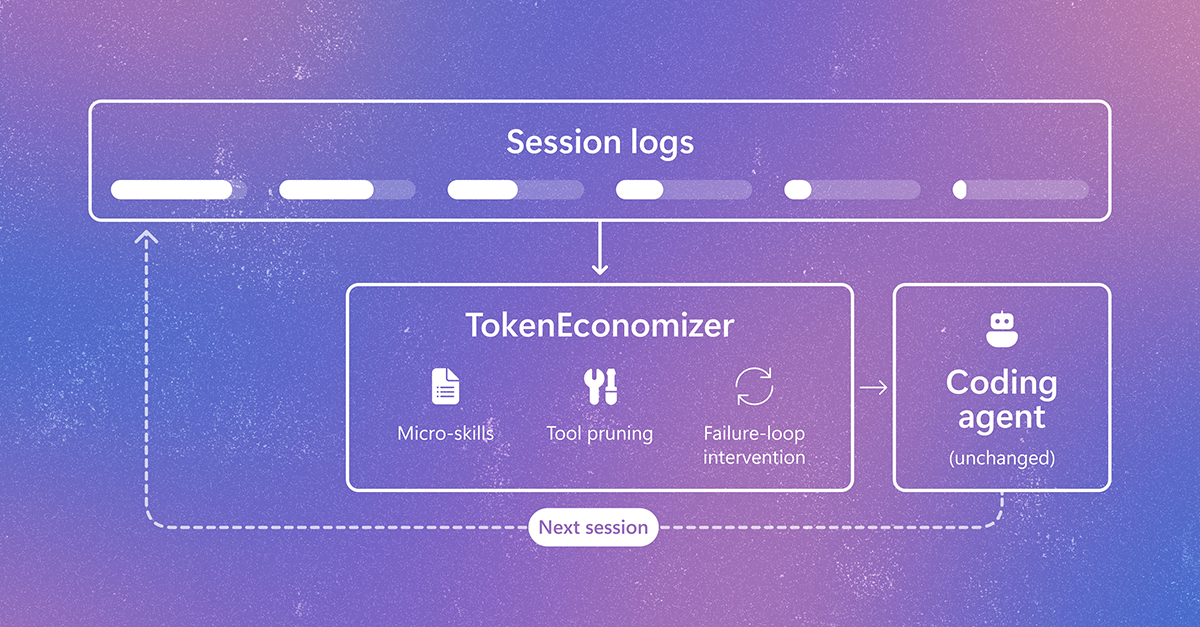
AI coding agents are increasingly help developers fix bugs and build features largely on their own, but every interaction with their models consumes tokens. In each session, an agent sends instructions, tool descriptions, and session history to its model. Most efforts to reduce this cost focus on individual tasks. Yet developers return to the same […] The post TokenEconomizer: Learning from Experience to Make AI Coding Agents More Efficient appeared first on Microsoft Research.
MIT News · Artificial Intelligence· news.mit.eduNov 13, 2026