The parity gap is derived, a group-theoretic metric quantifying the piezoelectric tensor freedom permitted by a crystal's proper rotation subgroup but eliminated by inversion symmetry in O(3)$, providing a unified framework to distinguish empirical error reduction from exact structural compliance with physical law.

Abstract
Crystal symmetry dictates whether a physical response tensor must vanish, establishing a direct test for machine learning predictions independent of property calculations. We derive the parity gap, a group-theoretic metric quantifying the piezoelectric tensor freedom permitted by a crystal's proper rotation subgroup $SO(3)$ but eliminated by inversion symmetry in $O(3)$. Across state-of-the-art equivariant neural network architectures, unconstrained $SO(3)$ models systematically predict forbidden non-zero responses matching the parity gap of each centrosymmetric crystal class, while polar distortion paths dynamically map output responses to the loss of inversion symmetry. Regression controls confirm that enforcing full $O(3)$ parity incurs no consistent accuracy cost across predictive tasks. Crucially, while training interventions using explicit zero labels reduce violation magnitudes, they leave residual forbidden outputs. Exact physical compliance instead requires structural enforcement through $O(3)$ representation design or explicit output antisymmetrization. The parity gap thus provides a unified framework to distinguish empirical error reduction from exact structural compliance with physical law.
Planar parity-preserving tensor networks (ppTNs) admit a fermionic formulation in which the Gaussian, efficiently contractible limit is deformed by local interactions. We investigate how many-body methods can be used to analyze such contractions in a minimal two-parameter ppTN. Its contraction is simultaneously an inte...
Maksimilian Usoltcev, Dung Hanh Nguyen, C. Wille et al.· 0 citations
Machine-learned exchange-correlation functionals correct band gaps at near-semilocal cost, while density-functional tight binding reaches the $10^3$-$10^6$-atom regime; combining them assumes that a better parent yields a better parameterization, but we show it does not. Current-generation functionals are orbital-depen...
Can Polat, Mustafa Kurban, E. Serpedin et al.· 0 citations
Machine learning surrogates for density functional theory (DFT) have been increasingly used to reduce the cost of first-principles calculations. In this arena, predicting real-space electron densities offers a scalable and transferable initialization for self-consistent field (SCF) procedures. However, current methods...
Chen-Xing Liang, Cheng-Dong Wang, Yu-Ching Lin et al.· 0 citations
Gapped chiral phases pose an intrinsic obstruction to projected entangled pair state (PEPS) representations with finite bond dimension $D$, which generically develop spurious long-range correlations despite the gapped nature of the target state. To address this long-standing problem, we take a qualitatively different r...
Learned electronic states are usually evaluated by prediction error, even though their intended use is to accelerate the self-consistent-field (SCF) loop of density functional theory (DFT). We ask whether lower offline error actually yields a better SCF initializer. We construct $\rho$HD-43K, a 43,851-crystal DFT corpu...
Together, these results turn symmetry relaxation into a statistically justified model-selection decision and connect global signal detection to local, loss-dependent improvement.
Ze-Yu Chen· 1 citation· ⚡1
Related blog posts
MIT News · Artificial Intelligence· news.mit.eduOct 2, 2026
A weeklong summer workshop brought higher education faculty to campus to explore how AI and machine learning materials can be adapted for their classrooms.
MIT News · Artificial Intelligence· news.mit.eduAug 27, 2026
A new machine-learning framework aims to improve the success rate of computational protein design while moving away from results that reproduce sequences found in nature.
Microsoft Research Blog· microsoft.comAug 20, 2026
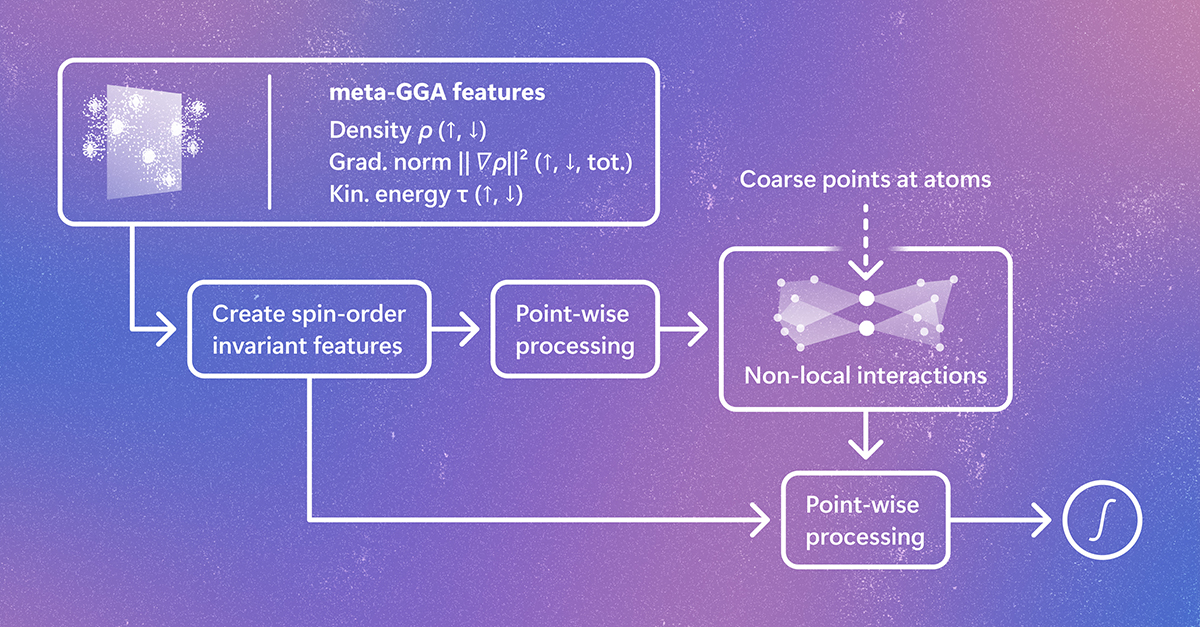
Skala 1.1, the updated deep-learning exchange-correlation functional from Microsoft Research, provides greater accuracy, expanded accessibility across the computational chemistry ecosystem, and a living benchmark to track computational performance. The post Broadening access to Skala creates a faster path to predictive DFT appeared first on Microsoft Research.
We use cookies to run the site and, with your consent, for analytics and to show ads.
See our Cookie Policy.