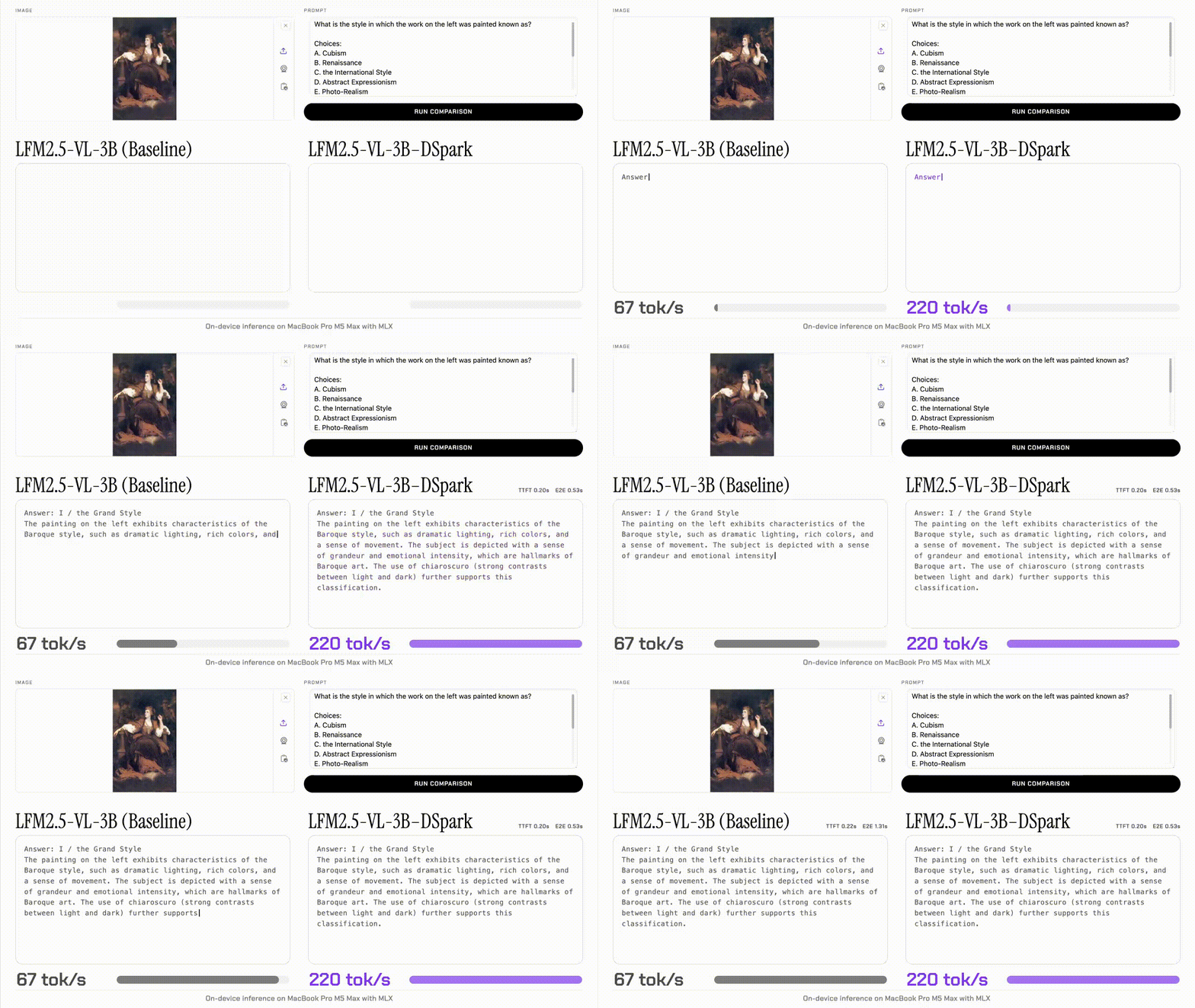
The model family shows gains in held-out scientific-code repair and across selected general-purpose benchmarks in code, reasoning, and knowledge, providing evidence of positive transfer from scientific experience to broader capabilities.
Abstract
Scientific code repositories encode decades of human knowledge in executable models, methods, and tools. Yet fragmented toolchains, implicit domain conventions, and specialized correctness criteria make this knowledge difficult to convert into reliable learning experience-a challenge we call the scientific experience bottleneck. We introduce ScienceIDE, infrastructure for turning the world's scientific code into programmable environments for scientific agents. Guided by expert-defined scientific cases and acceptance criteria, agents transform repositories into executable environments that support task generation, execution, and scientific verification. These environments provide a shared foundation for supervised fine-tuning, reinforcement learning, and evaluation. Using verified interaction trajectories, we train PhAI-IDE-72B, PhAI-IDE-9B, and PhAI-IDE-4B. The model family shows gains in held-out scientific-code repair and across selected general-purpose benchmarks in code, reasoning, and knowledge, providing evidence of positive transfer from scientific experience to broader capabilities. ScienceIDE lays the foundation for an integrated workspace for agent learning and scientific practice, making humanity's scientific software a shared substrate for developing scientific intelligence. Code: https://github.com/aitofound/ScienceIDE

A paired ablation that removes explicit scientific guidance while preserving the repository and executable engineering context shows that scientific knowledge is not uniformly beneficial: well-grounded information can constrain repair and improve average performance and token efficiency, whereas poorly aligned guidance...
Zhi-Peng Xu, Jia-Hao Lu, Yi-Ning Zheng et al.· 3 citations
Embodied agents offer a promising route to automating scientific experimentation, yet their progress is constrained by the lack of reliable and systematic evaluation environments. Existing simulation-based laboratory benchmarks rely heavily on manual task engineering, making it challenging to systematically compile div...
Mao-Kai Qin, Chuan Qin, Qi Zhang et al.· 0 citations
TDD-Agent is introduced, which operationalizes the test-driven development paradigm for code generation and improves not only code correctness but also the effectiveness of the generated tests, yielding higher pass rates, coverage, and mutation scores, suggesting that tests can serve as evolving reasoning artifacts rat...
Hong Yu, Ke-Fan Li, Jia-Kun Li et al.· 2 citations
Vero is introduced, the first benchmark to evaluate joint implementation and proof synthesis at the repository level and an audit mechanism where agents are allowed to formally prove unsatisfiability of provided specification or incorrectness of reference code, which surfaces and corrects latent code and specification...
Zhe Ye, Hantao Lou, Yuechun Sun et al.· 0 citations
AlgoEvo is introduced, a unified agentic architecture that transforms automated algorithm discovery into an interactive, knowledge-accumulating process, demonstrating strong intra-task accumulation, cross-task transfer, and the ability to reproduce or exceed the strongest existing methods through flexible skill activat...
Jun-Hao Qiu, Qing-Long Hu, Ji Cheng et al.· 0 citations
PRAXIS is a framework that enables agents to systematically extract, represent, and reuse tacit knowledge for domain code generation and outperforms state-of-the-art agents equipped with powerful agentic search capabilities, as well as experience-based and skill-based methods.
Xue Jiang, Tianyue H. Zhang, Ling-Wei Wu et al.· 0 citations
Related blog posts
MIT News · Artificial Intelligence· news.mit.eduSep 24, 2026
A new method, called CW-Net, translates the reasoning process of an autonomous vehicle’s AI system into understandable concepts that explain its behavior.
We use cookies to run the site and, with your consent, for analytics and to show ads.
See our Cookie Policy.