TetrisCNN is introduced, a convolutional architecture with parallel branches of differently shaped filters, reminiscent of Tetris blocks, that learns sparse, interpretable latent representations directly in terms of spin correlators, and opens the way to integrating interpretable neural networks with quantum simulators to uncover and understand new phases of matter.

Abstract
Detecting phases of matter in general relies on identifying the correct order parameter - a task that remains notoriously difficult for unknown transitions and traditionally is guided by physical intuition and educated guess. Neural networks have recently offered an alternative route by locating phase transitions in known models without any a priori physical knowledge. Yet these approaches remain black boxes and only identify phases without elucidating their properties. Moreover, they often struggle when confronted with realistic, noisy experimental data, which constitute the ultimate testbed for automated methods in physics. Here, we bridge these perspectives by introducing TetrisCNN, a convolutional architecture with parallel branches of differently shaped filters, reminiscent of Tetris blocks, that learns sparse, interpretable latent representations directly in terms of spin correlators. Applied to experimental snapshots of two-dimensional Ising and XY quantum simulators measured in multiple bases, the network not only detects phase transitions and crossovers but also expresses its latent representation and decision boundaries as symbolic formulas built from experimentally measurable spin correlators. This framework opens the way to integrating interpretable neural networks with quantum simulators to uncover and understand new phases of matter.
AI for Science aims not only to predict complex physical systems from data, but also to extract mathematical structure and physically testable representations from learned models. Here, a train--prune--readout--rewrite workflow is developed that separates physical-domain grounding from three increasingly stringent anal...
Si-Ran Zhang, Shu-Ming Cheng, Xiang Li et al.· 0 citations
Deep learning models are powerful but opaque. As quantum machine learning matures, the field faces a defining choice: build quantum models that are equally opaque, or exploit the mathematical structure of quantum mechanics to make them inherently interpretable. We show that the latter is possible. By tracking quantum m...
The results indicate that a converged moment-matching loss is not a reliable measure of generalization, and that train-classical, deploy-quantum workflows will need approaches that target generalization directly, leaving open whether better training objectives suffice or whether the model architectures themselves must...
S. Raj, Natansh Mathur, A. Perdomo-Ortiz· 0 citations
KANs offer a promising, efficient, and interpretable machine-learning approach for finite-measurement steering detection of arbitrary two-qubit states, and further feature compression can still retain competitive detection performance.
It is shown that a transition-probability-only learning interface can possess exact continuous blind directions in certain quantum-state families, and multistate relational observables are established as measurable, trainable, and physically consequential signals for quantum representation learning beyond pairwise fide...
Quantum systems are rarely isolated from their surroundings. These hidden environments can retain information and return it later, producing correlated errors in quantum computers and complicating the interpretation of experiments. On a quantum processor, for example, one job can therefore leave an environmental trace...
Aaron Sander, J. F. Kam, S. Gauthameshwar et al.· 0 citations
Related blog posts
MIT News · Artificial Intelligence· news.mit.eduOct 2, 2026
A weeklong summer workshop brought higher education faculty to campus to explore how AI and machine learning materials can be adapted for their classrooms.
MIT News · Artificial Intelligence· news.mit.eduAug 27, 2026
A new machine-learning framework aims to improve the success rate of computational protein design while moving away from results that reproduce sequences found in nature.
Microsoft Research Blog· microsoft.comAug 20, 2026
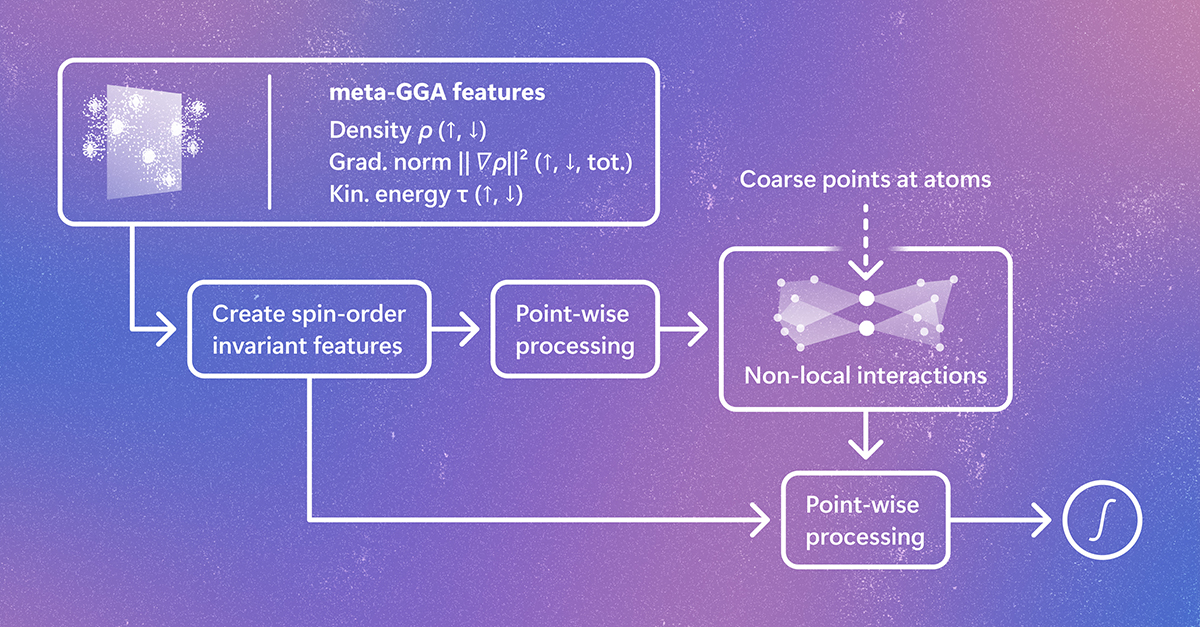
Skala 1.1, the updated deep-learning exchange-correlation functional from Microsoft Research, provides greater accuracy, expanded accessibility across the computational chemistry ecosystem, and a living benchmark to track computational performance. The post Broadening access to Skala creates a faster path to predictive DFT appeared first on Microsoft Research.
We use cookies to run the site and, with your consent, for analytics and to show ads.
See our Cookie Policy.