Structural causal models for time series recover contemporaneous and lagged effects, but most methods require complete observation windows and become misspecified when samples are missing. We introduce ITSY, the first continuous-optimization method for causal discovery from irregular time series under a linear model. ITSY reformulates the structural equation so that prediction uses the nearest available history rather than the possibly missing current slice, and jointly imputes missing values while learning both graphs. A weighted reconstruction objective corrects the noise transformation induced by this reformulation. Across synthetic regimes varying missingness, scale, graph density, and noise, and on a real world benchmark, ITSY consistently improves graph recovery over representative SCM-based baselines, demonstrating the effectiveness of the proposed method. The results establish a focused solution for irregular linear first-order dynamics and clarify the assumptions required for nonlinear or higher-order extensions.
Causal discovery from nonstationary subsample time series is a fundamental yet challenging problem in many scientific domains. In such data, observations are often recorded at a coarse time scale (subsampling). At the same time, the underlying data-generating mechanisms may change over time (nonstationarity), making st...
Wei Chen, Qian Huang, Fu-Hong Wang et al.· Neural Networks· 0 citations
Finding which variables cause which others in multivariate time series, and at what lags, is central to science and policy, yet existing methods force a choice between flexible confounder adjustment, data-driven lag selection, and inference that controls the false discovery rate (FDR). ORACLE-VARX does all three in one...
Hong-Qiong Tan, Isaac-Neil Zanoria, James Chen et al.· 0 citations
In observational time series, statistical inference for dynamic causal effects of a one-time intervention across horizons is complicated by high-dimensional observed pre-treatment information, unmeasured confounding, and serial dependence. To address these challenges, we develop a semiparametric framework for inference...
Shi-Bo Yu, Yan Chen, Jin-Hong Du et al.· 1 citation
Causal representation learning for time-series data aims to identify latent states and their causal relations from observations. In this setting, an important challenge is to model both lagged causal relations across observation intervals and faster causal effects that appear as instantaneous relations within an interv...
Tatsuya Yamada, H. Morioka, Yoshinobu Kawahara· 0 citations
A regime-adaptive deconfounding layer that first estimates the confounding regime from data using a Mar\v{c}enko--Pastur spectral router, then applies a deconfounding strategy matched to that regime, which attenuates factor-dominated variation and recovers contemporaneous structure from the resulting innovations.
The Regime-Enhanced Intelligent Granger Network is proposed, a novel causal discovery framework specifically engineered for nonstationary time series and achieves an Optimal F1 score of 0.529, substantially outperforming PCMCI+ and PC in structural edge recovery.
Quang-Vinh Dang, M. Dinh, Dat Le et al.· Journal of Data Science and...· 0 citations
Related blog posts
Microsoft Research Blog· microsoft.comNov 16, 2026
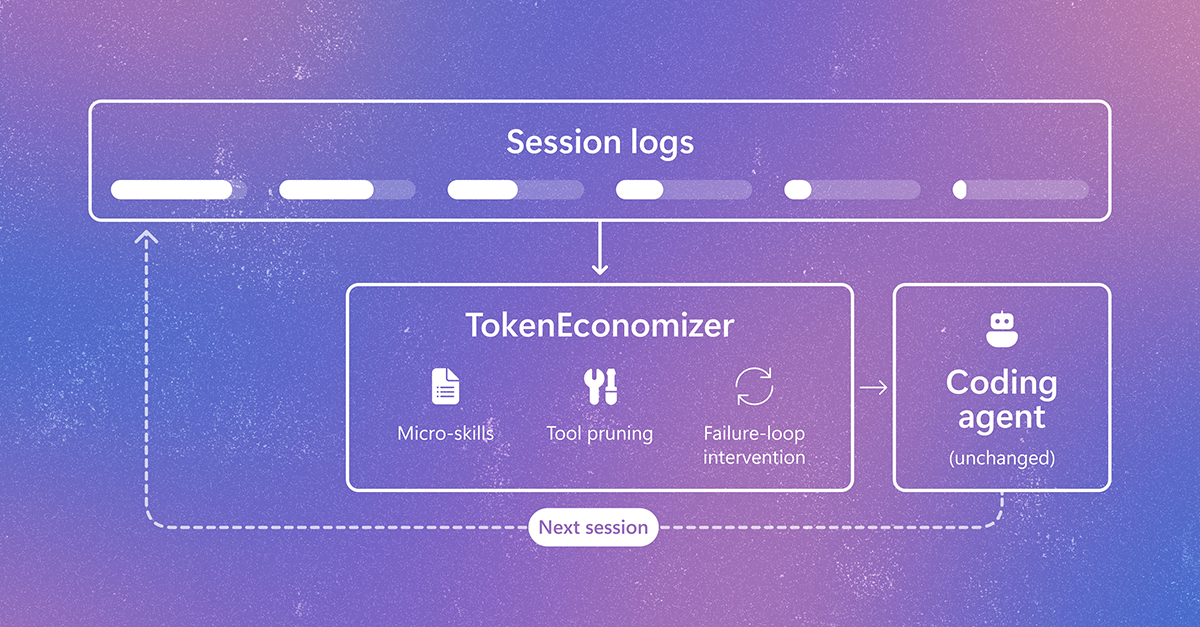
AI coding agents are increasingly help developers fix bugs and build features largely on their own, but every interaction with their models consumes tokens. In each session, an agent sends instructions, tool descriptions, and session history to its model. Most efforts to reduce this cost focus on individual tasks. Yet developers return to the same […] The post TokenEconomizer: Learning from Experience to Make AI Coding Agents More Efficient appeared first on Microsoft Research.
MIT News · Artificial Intelligence· news.mit.eduNov 13, 2026