Skip to content

Physics-Informed Classical and Quantum Neural Networks for One-Dimensional Schrodinger Eigenvalue Problems

Aug 2026 · 0 citations · 60 references
Physics Computer Science

Abstract

The Schrodinger equation in one spatial dimension admits a small set of exactly solvable potentials that serve as natural proving grounds for any new eigenvalue solver. We formulate Physics-Informed Neural Networks (PINNs) and Physics-Informed Quantum Neural Networks (PIQNNs) for the time-independent Schrodinger equation and apply them to three of these benchmarks: the harmonic oscillator, the infinite square well, and the finite square well. In each case a composite loss encodes the differential-equation residual, the normalization condition, the boundary behavior, and the orthogonality between eigenstates, so that the trial wave function is driven toward a genuine eigenfunction without supervised data. The eigenvalues and wave functions returned by both methods are compared against the exact spectra and against three classical references: the matrix Numerov method, the finite difference method, and the shooting method. For the smooth oscillator the two neural solvers reproduce the lowest four eigenvalues to parts per million, while for the square wells they recover the analytic levels with comparable fidelity even where the potential is discontinuous. The quantum circuit, built as a layered angle-embedding ansatz with strongly entangling blocks, converges more reliably than its classical counterpart on the higher excited states, where the loss landscape of the classical network becomes harder to navigate.

View source

Similar papers

Open access Sep 2026

A Numerical Approach to Bound-State Eigenvalues of the One-Dimensional Finite Square Quantum Well

The one-dimensional finite quantum well is one of the fundamental problems in quantum mechanics, illustrating the formation of bound states, the penetration of the wave function into classically forbidden regions, and the quantization of energy. Unlike the infinite potential well, the finite quantum well requires the s...

Mohammad Muhsen Hewadmal, Khudaidad Wasiq, S. A. S. Mosamem · 0 citations
Preprint Sep 2026

Exact computation of quantum wave functions for nonlinear potentials

Recent work shows that the Schroedinger equation can be solved exactly based only on classical least action rspa.2025.0413. The computation is based on first solving a Hamilton-Jacobi equation for the action, computing the classical propagated density along all stationary action paths, and finally constructing the exac...

Winfried Loghmiller, J. Slotine · 1 citation
Review Open access 2026

Quantum Pendulum via Physics-Informed Neural Networks: A Topological Approach to Quantum Dynamics

This work bridges the gap between modern Scientific Machine Learning and canonical quantum mechanics, serving as a tutorial on embedding topological constraints into neural solvers.

José Carlos Ferreira Bastos, Glendo de Freitas Guimarães, Maximilian Esper · 0 citations
Open access Sep 2026

Learning quantum eigenspaces under geometric symmetry breaking with Rayleigh-Ritz physics-informed neural networks

We develop a Rayleigh–Ritz physics-informed neural formulation for quantum eigenproblems on geometry-parametrized domains, in which the neural representation and its validation diagnostic track the spectral object selected by the physics rather than the eigenvalue index alone. Tested on the one-dimensional well, the...

Leonardo dos Santos Vitoria, Mikael de Alcantara Santos, Gregório Cândido dos Santos Valadares de Almeida et al. · 0 citations
Preprint Aug 2026

Classical Mechanics Exactly Yields the Full Bound-State Spectrum of the Two-Dimensional Coulomb Problem

High-lying Rydberg excitons in two-dimensional semiconductors universally exhibit a characteristic odd-integer energy scaling distinct from three-dimensional systems. While this hallmark of two-dimensional Coulomb interaction is well known from quantum mechanical solutions, its deeper classical geometric origin remains...

Gang Zheng, Wen-Qi Xue, Meng-Li Wang et al. · 0 citations

Related blog posts

MIT News · Artificial Intelligence Aug 27, 2026

Looking beyond natural sequences

A new machine-learning framework aims to improve the success rate of computational protein design while moving away from results that reproduce sequences found in nature.

Microsoft Research Blog Aug 20, 2026

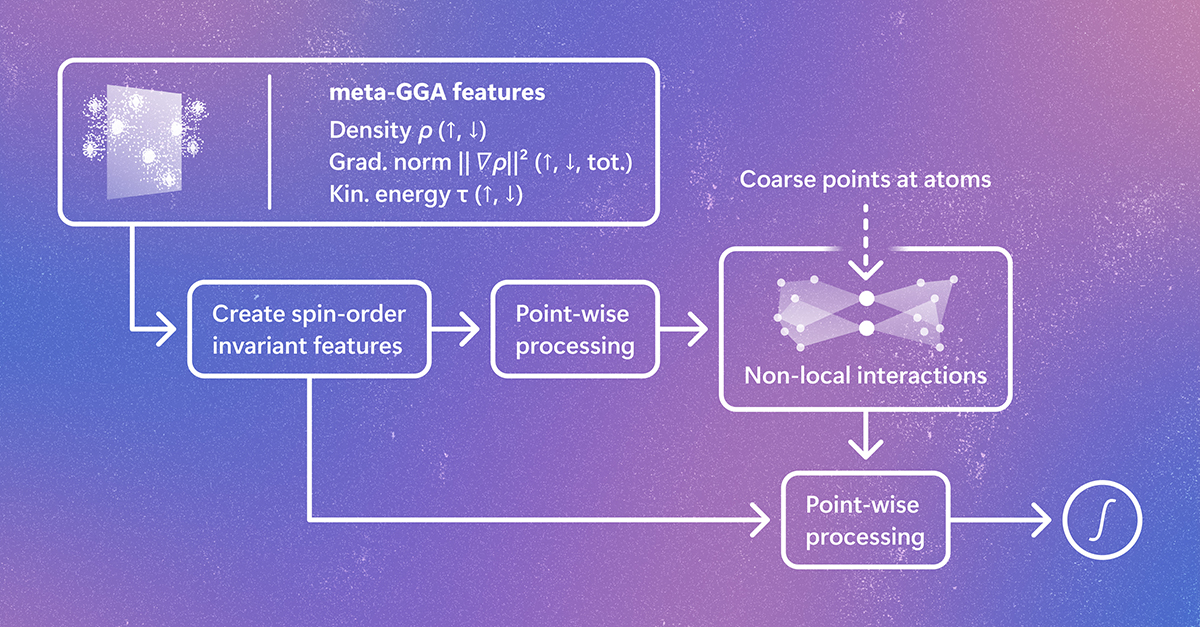
Broadening access to Skala creates a faster path to predictive DFT 

Skala 1.1, the updated deep-learning exchange-correlation functional from Microsoft Research, provides greater accuracy, expanded accessibility across the computational chemistry ecosystem, and a living benchmark to track computational performance. The post Broadening access to Skala creates a faster path to predictive DFT  appeared first on Microsoft Research.

We use cookies to run the site and, with your consent, for analytics and to show ads. See our Cookie Policy.