Skip to content

Rethinking Diffusion Segmentation: When Does It Rely on Its Noisy State, and Does Diffusion Matter?

Sep 2026 · 0 citations · 35 references
Computer Science

TL;DR

These results identify supervision path as a determinant of state reliance in the audited methods and show that diffusion-specific computation often provides no deterministic endpoint advantage, including in methods that rely on the audited state properties.

Abstract

Diffusion models are increasingly adapted from generation to conditional prediction, where a conditioning signal is combined with an evolving noisy representation of the target. In fully supervised segmentation, however, the conditioning image can already support direct target prediction, so endpoint performance alone establishes neither reliance on the added diffusion state nor a deterministic advantage over image-only prediction. For state reliance, we disrupt target-derived state content or correct image-state pairing during retraining of twelve published methods across three datasets, with ten matched seeds per setting. All 40 original-method comparisons whose evaluated-mask routes remained downstream of noised-quantity reconstruction exhibited state reliance, whereas all 30 comparisons with a segmentation-supervised bypass preserved reference performance. Rerouting five originally bypass-capable methods by forcing segmentation supervision through noise-to-mask reconstruction converted all 30 corresponding comparisons from preserved performance to state reliance. For deterministic utility, matched image-only counterparts achieved similar or better performance in 28 of 35 settings overall, including 16 of 20 whose native methods relied on both audited state properties. These results identify supervision path as a determinant of state reliance in the audited methods. Separately, matched image-only counterparts show that diffusion-specific computation often provides no deterministic endpoint advantage, including in methods that rely on the audited state properties. More generally, when conditioning already supports strong target prediction, diffusion-specific claims require additional evidence that the added state is used and that diffusion-specific computation improves the claimed capability beyond a matched condition-only counterpart.

View source

Similar papers

Preprint Sep 2026

UnfoldCRF: Structured Mask Refinement with Image-Conditioned Latent Regions

UnfoldCRF treats refinement as inference in a conditional random field over pixel labels and latent region variables, and zeroing individual messages shows where the corrections come from: the pairwise messages mostly fix boundaries, the region messages mostly fix non-boundary errors.

Chun-Ming He, Rihan Zhang, Lei Xu et al. · 0 citations
Preprint Sep 2026

Diffuse2Seg: Diffusion Models Can Segment Anything Without Supervision

Diffuse2Seg is introduced, which repurposes generative diffusion models for automatic mask generation by propagating a grid of point prompts through their self-attention representations in an edge-preserving manner, and shows that a model trained on Diffuse2Seg labels provides a strong initialization for semi-supervise...

Christoph Hümmer, Joachim Sicking, Fabian Hüger et al. · 0 citations
#diffusion models Review Open access Oct 2026

Functional Roles of Diffusion Models in Medical Image Segmentation: A Focused Narrative Review

Diffusion-based medical image segmentation has expanded quickly, but the term now covers methods that solve different problems. Existing reviews often organize the field by architecture or application, which can blur the distinction between a model that generates a mask, one that supplies a prior, one that repairs an e...

Chen-Yang Li · 0 citations
#artificial intelligence Preprint Oct 2026

Correction Training for Diffusion Models

The method substantially improves upon previously reported FID scores for unguided generation and, notably, unconditional generation, where producing high-quality samples without guidance has been particularly challenging.

Donghoon Ahn, Run-Qian Wang, Alexei A. Efros et al. · 0 citations
Preprint Aug 2026

CARD: Calibration via Agreement in Reverse Diffusion for Out-of-Domain MRI Segmentation

Across cardiac, prostate and brain MRI shifts, CARD lowers calibration error in 45 of 49 comparisons against the strongest baseline in each setting, and maps the temporal aggregate of this disagreement to a temperature field applied per pixel across all classes, so that confidence changes while the segmentation does no...

Jiateng Dai, Wei Guo, Qing-Biao Li et al. · 0 citations
Preprint Sep 2026

SelfLift: Accelerating Few-Step Diffusion via Self-Recovering Resolution Transition

SelfLift is introduced, a self-recovering progressive-resolution framework that derives both transition-repair signals and trajectory-aligned supervision from the generative model itself and reduces end-to-end latency across FLUX, establishing a stronger speed-quality frontier for few-step diffusion.

Ting-Yan Wen, Chen-Qian Yan, Xu-Rui Peng et al. · 0 citations

Related blog posts

Microsoft Research Blog Aug 11, 2026

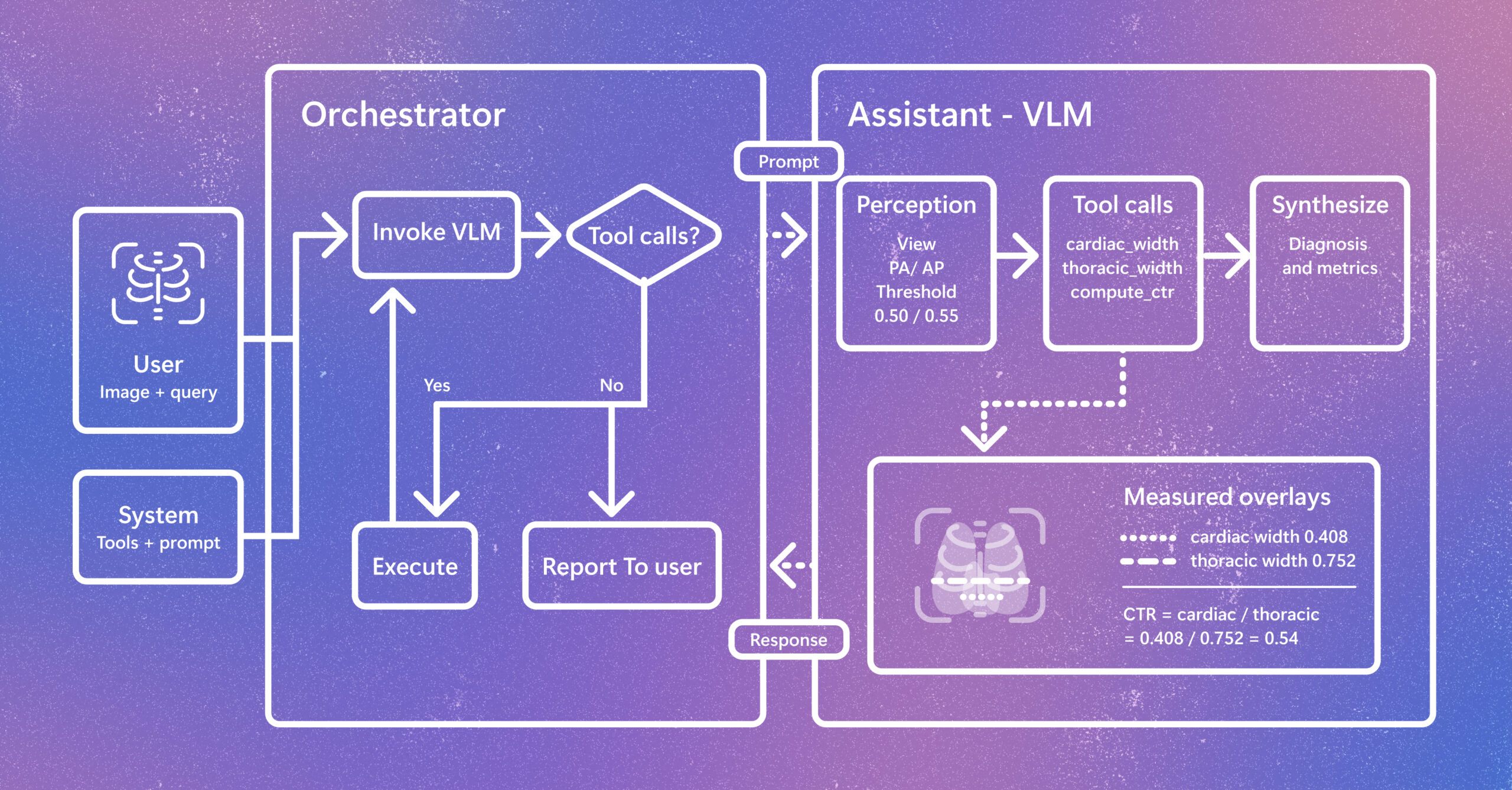
Introducing CARE-X: Towards Clinically Useful Radiology VLMs with Auxiliary Supervision, Reward-Aligned Learning, and Tool-Augmented Measurement

Radiology AI is evolving beyond report generation. CARE-X explores a unified approach that combines flexible reasoning, calibrated predictions, and measurement-based tools for chest X-ray interpretation. The post Introducing CARE-X: Towards Clinically Useful Radiology VLMs with Auxiliary Supervision, Reward-Aligned Learning, and Tool-Augmented Measurement appeared first on Microsoft Research.

MIT News · Artificial Intelligence Oct 23, 2026

Q&A: How AI came to model the “messy” human mind

Assistant Professor Benjamin Lindquist studies how engineers deliberately injected randomness into early AI, giving rise to deep-learning models that sometimes hallucinate.

We use cookies to run the site and, with your consent, for analytics and to show ads. See our Cookie Policy.