Interestingly, greater familiarity within the owner-co-owner dyad was associated with both higher disclosure acceptability and lower co-owner misalignment, whereas the exploratory four-item empathy measure was not.
Abstract
AI assistants increasingly mediate interpersonal communication on behalf of their primary user, but they risk violating the privacy expectations of third-party information owners. Resolving these tensions requires understanding how humans anticipate interpersonal privacy boundaries. Therefore, we conducted a dyadic study (N=76) and a matched evaluation of AI models across 18 information types and 3 recipient relationships. We found that data owners'privacy judgments are highly contextual and relationship dependent. While familiar data co-owners show meaningful alignment with owners'expectations, they significantly overestimate the need for permission. Interestingly, greater familiarity within the owner-co-owner dyad was associated with both higher disclosure acceptability and lower co-owner misalignment, whereas our exploratory four-item empathy measure was not. In contrast, AI models significantly underperform human co-owners in anticipating the data acceptability, even when provided with within-dyad examples. These findings underscore a core HCI design challenge to develop privacy-aware AI that respects multi-stakeholder information boundaries.

This publication proposes a definition and a classification of agile software development approaches and analyses ten software development methods that can be characterized as being "agile" against the defined criterion.
P. Abrahamsson, O. Salo, Jussi Ronkainen et al.· arXiv.org· 727 citations· ⚡54
The study shows that agile practices improve both informal and formal communication, but indicates that, in larger development situations involving multiple external stakeholders, a mismatch of adequate communication mechanisms can sometimes even hinder the communication.
M. Pikkarainen, Jukka Haikara, O. Salo et al.· Empirical Software Engineeri...· 401 citations· ⚡48
The results indicate that software engineering work practices are chosen opportunistically, adapted and configured to provide value under the constrains imposed by the startup context.
Nicolò Paternoster, Carmine Giardino, M. Unterkalmsteiner et al.· Information and Software Tec...· 394 citations· ⚡54
The perception of the impact of agile methods is predominantly positive, and several challenge areas were discovered, but based on this study, agile methods are here to stay.
M. Laanti, O. Salo, P. Abrahamsson· Information and Software Tec...· 260 citations· ⚡20
Related blog posts
MIT News · Artificial Intelligence· news.mit.eduNov 18, 2026
By studying the computational foundations of language learning, Associate Professor Jacob Andreas builds intelligent systems that can communicate effectively with humans.
Microsoft Research Blog· microsoft.comNov 16, 2026
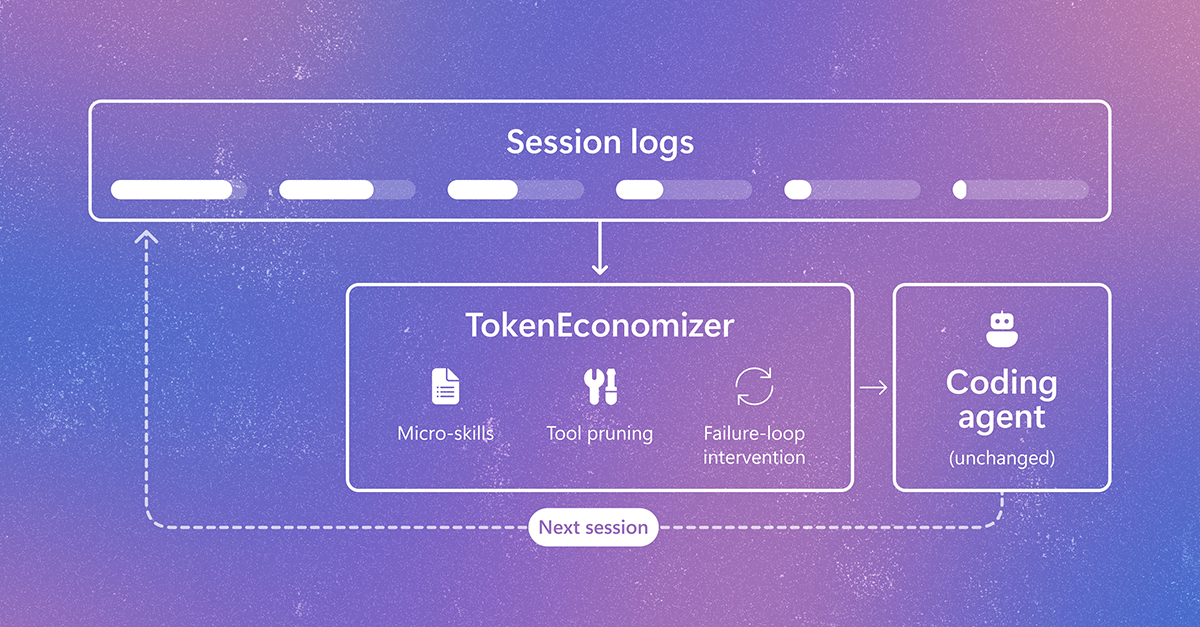
AI coding agents are increasingly help developers fix bugs and build features largely on their own, but every interaction with their models consumes tokens. In each session, an agent sends instructions, tool descriptions, and session history to its model. Most efforts to reduce this cost focus on individual tasks. Yet developers return to the same […] The post TokenEconomizer: Learning from Experience to Make AI Coding Agents More Efficient appeared first on Microsoft Research.
We use cookies to run the site and, with your consent, for analytics and to show ads.
See our Cookie Policy.