This work introduces DRIFT (Denoising Redirection via Input perturbation of the Flow-matching Trajectory), a test-time universal adversarial patch placed on the robot's gripper that attacks the denoising velocity field of an off-the-shelf policy.
Abstract
Flow-matching vision-language-action (VLA) models such as pi0 generate robot actions by integrating a learned denoising velocity field, and have been reported to resist adversarial perturbations that readily fool autoregressive VLAs. We show that this robustness is largely illusory: it stems from prior attacks ignoring the multi-step denoising ODE. We introduce DRIFT (Denoising Redirection via Input perturbation of the Flow-matching Trajectory), a test-time universal adversarial patch placed on the robot's gripper that attacks the denoising velocity field of an off-the-shelf policy. Our central finding is counterintuitive: attacking only the first denoising step is both stronger and cheaper than attacking a wider window of steps, which we explain through a gradient conflict unique to input-space optimization and which is exactly opposite to the training-time backdoor regime. On pi0 and pi0.5 across four LIBERO suites, DRIFT breaks essentially all originally-solvable tasks with a small single patch, far exceeding action- and embedding-space attack baselines.

This work proposes BMAT (Bilevel-Minimax Adversarial Transfer), an integrated bottom-up solver that combines a Soft Weight Modulator and an Implicit Gradient Approximator to enable ternary coupling among initialization, surrogate adaptation, and perturbation optimization.
AdvNav is proposed, a behavior-guided black-box adversarial attack framework that disturbs an agent's first-person views during navigation, which demonstrates the effectiveness and generality of AdvNav, reveals critical perception vulnerabilities and offers insights for the design of future resilient VLN models.
Chenyang Li, Kaige Li, Zeyu Jiang et al.· 0 citations
This work proposes MeanFlow-Transfer, which maps heterogeneous source outputs into a shared velocity representation, uses it to initialize an MF generator from the source weights, and optimizes an MF objective on the target domain, and introduces Continuous Adversarial MeanFlow, a post-training stage that extends conti...
Yara Bahram, Zahra Dehghani, M. Desbos et al.· 0 citations
Large Vision--Language Models (VLMs) unlearning tends to eliminate the influence of ``to-be-forgotten'' content in the training corpora, algorithmically by suppressing the likelihood of faithfully generating responses on forget-target inputs. The injection of adversarial inputs can manipulate the unlearned VLM's genera...
Yi-Min Liu, Peng Jiang, Ya-Jie Wang· Proceedings of the Thirty-Fi...· 0 citations
This work studies the opposite of an imperceptible perturbation to fool a model: a large, clearly visible perturbation that causes the model to keep its original, correct prediction, even though a human would no longer recognize the image.
This survey examines a recent class of adversarial efficiency degradation attacks that target these mechanisms to increase computation without necessarily degrading accuracy, and unify and compare two representative attacks across three popular token-pruning frameworks.
Anadi Goyal, Nandish Chattopadhyay, Anupam Chattopadhyay et al.· 0 citations
Exploring how generative AI could make machine vision more accessible to businesses. The post GenEye in a Box: Making Machine Vision Something You Can Just Ask For appeared first on GPT-Lab.
Microsoft Research Blog· microsoft.comAug 11, 2026
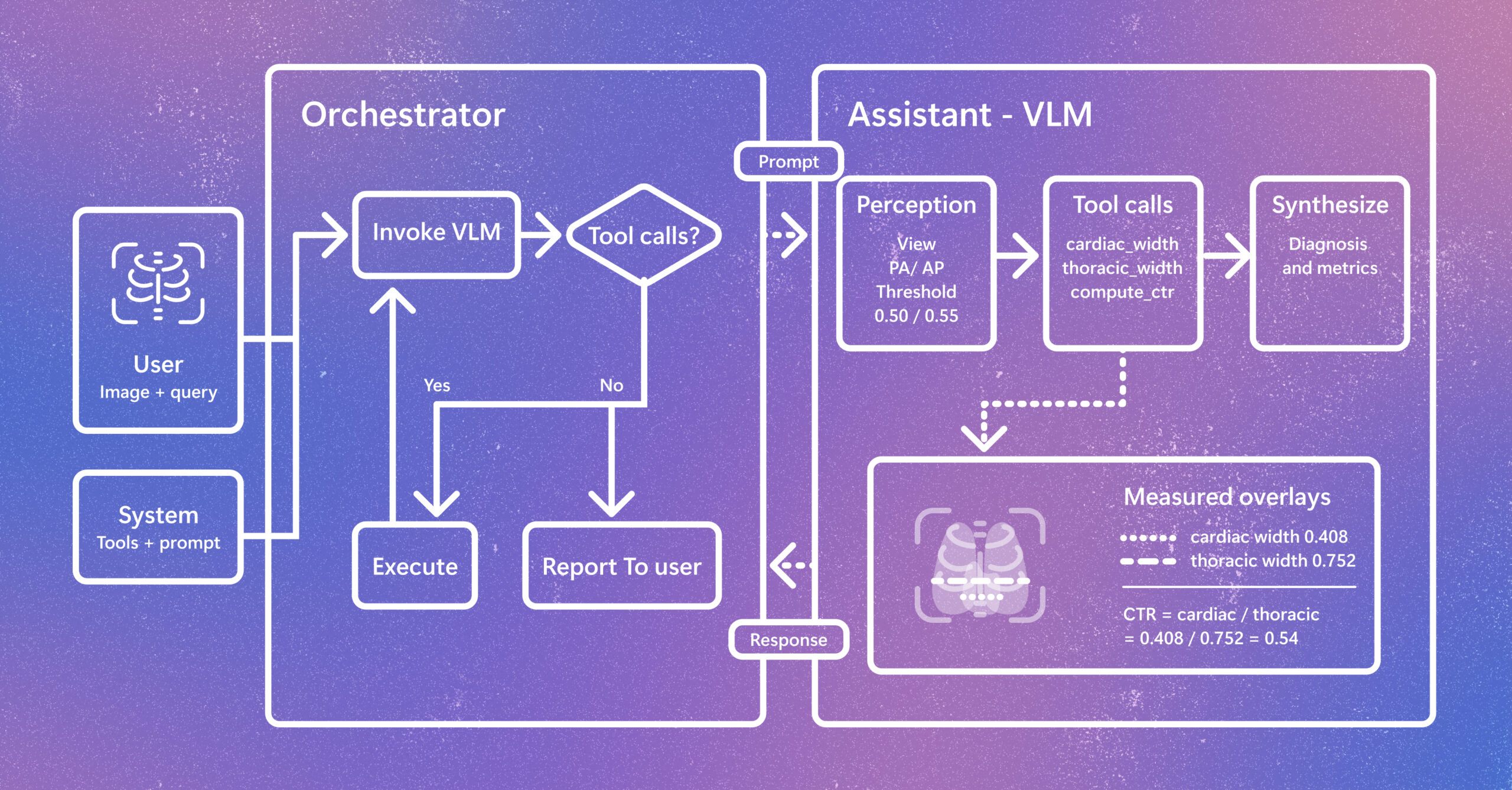
Radiology AI is evolving beyond report generation. CARE-X explores a unified approach that combines flexible reasoning, calibrated predictions, and measurement-based tools for chest X-ray interpretation. The post Introducing CARE-X: Towards Clinically Useful Radiology VLMs with Auxiliary Supervision, Reward-Aligned Learning, and Tool-Augmented Measurement appeared first on Microsoft Research.