Skip to content

QSV: Quat-Sphere-Vision for Coupled Quaternion Attention on Spherical Lattices

Sep 2026 · 0 citations · 44 references
Computer Science

TL;DR

Quat-Sphere-Vision (QSV), a sparse spherical vision model that replaces this projection triple with a single learned unit quaternion per token, is studied, showing the two roles to be asymmetric.

Abstract

In standard attention, three separately learned projections decide how strongly a token attends to each neighbor ($W_Q$, $W_K$) and how the attended features are transformed before aggregation ($W_V$). We study Quat-Sphere-Vision (QSV), a sparse spherical vision model that replaces this projection triple with a single learned unit quaternion per token: the relative quaternion $r_{ij} = q_i^{*} \otimes q_j$ supplies both the attention logit $\operatorname{Re}(r_{ij})$ and a sandwich-product feature transport $x \mapsto r_{ij} \otimes x \otimes r_{ij}^{*}$, with messages passed over sparse kNN graphs on concentric Fibonacci spheres. Ablations that change only the targeted component show the two roles to be asymmetric. Removing the transport reduces test accuracy by about four percentage points on CIFAR-10 and CIFAR-100 (single runs per CIFAR-100 variant), while replacing the learned attention weights with uniform averaging leaves it essentially unchanged. Parameter-matched controls then remove the geometry itself: standard attention on the same graph exceeds QSV (mean $87.3\%$ vs. $85.9\%$), and the same model on a flat 2D lattice reaches $91.1\%$, within $2.1$ points of a ResNet-20 trained under the same pipeline (single run). In the coupled kernel, nearly all of the learned pairwise computation resides in the transport channel.

View source

Similar papers

Preprint Sep 2026

Gauge-Equivariant Attention for Rotation-Stable $360^\circ$ Scene Understanding

Gauge-equivariant relative position encoding (GE-RPE) is proposed, a parameter-free Reynolds average of the bias over a finite cyclic subgroup of gauge rotations of gauge rotations that is a usable visual-computing primitive across panoramic relighting, immersive video, and cross-dataset transfer.

Tian-Jian Zhou, Yi-Shan Li, Jie Jiang et al. · 0 citations
#machine learning Preprint Sep 2026

Attention Manifolds: Steering or Blocking Language Models by Editing Learned B-Spline Surfaces

In standard transformer attention, a source token sends the same value vector to every receiver. The query determines \emph{how much} to attend but not \emph{what} to extract. This work introduces \textbf{attention manifolds}: learned 2D B-spline surfaces $S_d(q_d, k_d)$ that modulate each value dimension based on the...

N. Mysore · 0 citations
Preprint Sep 2026

Directions That Don't Drift: Stiefel Manifold Routing for Transformer Attention

Four propositions prove steepest descent in the embedded metric, gradient-scale independence, well-conditioning, well-conditioning, and exact $\mathrm{O}(d)$-equivariance; two five-seed grokking studies confirm the constrained arm does not grok better than the baseline and the weight-decay exemption has no grokking con...

Rubén Darío Guerrero · 0 citations
#machine learning Preprint Sep 2026

Task-Induced Riemannian Metrics for Vision Transformer Feature Spaces

The Spectral Pullback Network (SPN) is developed, which learns a low-rank version of the metric from randomized power iteration, and is distill into a $310$K-parameter importance head that predicts token importance directly from the features.

Andrew Bond, Ege Erdem Ozlu, Tuna Çimen et al. · 0 citations
#machine learning Preprint Sep 2026

Soft-Argmax for the Projective Plane via the Veronese Embedding

The Veronese soft-argmax is validated in a Hough transform-based network across all resolvable lines, confirming uniform and seam-free recovery and the squared chordal distance between lines in projective space is derived, enabling a geometrically precise training objective.

Benjamin El-Zein, Dominik Eckert, Paul Zech et al. · 0 citations

Related blog posts

Microsoft Research Blog Aug 11, 2026

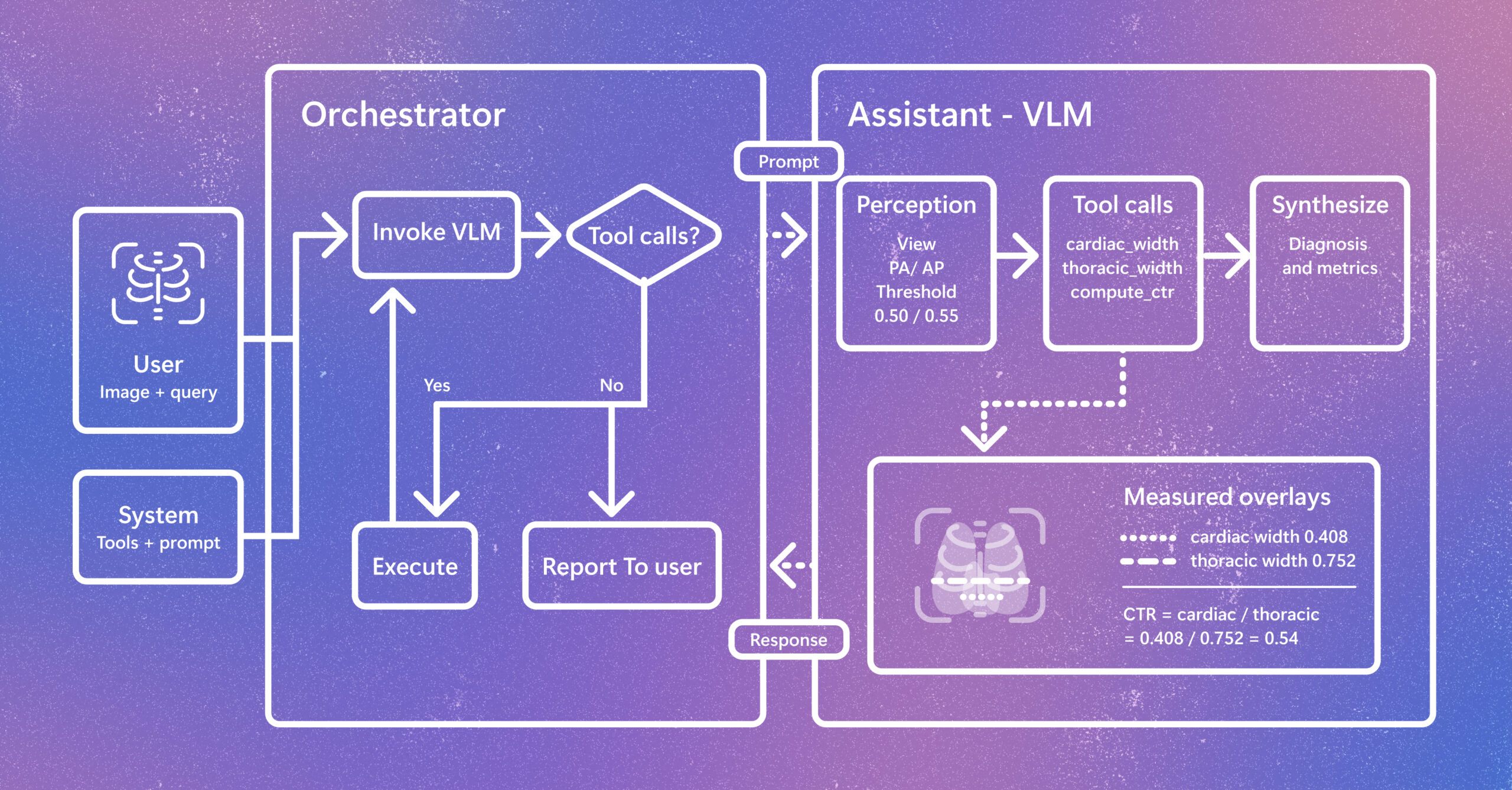
Introducing CARE-X: Towards Clinically Useful Radiology VLMs with Auxiliary Supervision, Reward-Aligned Learning, and Tool-Augmented Measurement

Radiology AI is evolving beyond report generation. CARE-X explores a unified approach that combines flexible reasoning, calibrated predictions, and measurement-based tools for chest X-ray interpretation. The post Introducing CARE-X: Towards Clinically Useful Radiology VLMs with Auxiliary Supervision, Reward-Aligned Learning, and Tool-Augmented Measurement appeared first on Microsoft Research.

We use cookies to run the site and, with your consent, for analytics and to show ads. See our Cookie Policy.