Skip to content

Differentiable RNA Secondary Structure Extraction for Deep Learning

Sep 2026 · 0 citations · 34 references
Computer Science

TL;DR

The SDSM model showed the strongest overall performance: it outperformed the BCE baseline under all four extraction algorithms and produced pre-extraction outputs closest to the ground truth, suggesting that SDSM normalization is a tractable alternative to traditional structure extraction.

Abstract

Many deep learning approaches to RNA secondary structure prediction have recently been proposed. They typically output a weight matrix $W$ where $W_{ij}$ is an arbitrary weight for base $i$ pairing with base $j$. Converting this matrix to a predicted secondary structure or base-pairing probability matrix typically involves ad hoc and problematic downstream algorithms. Despite the importance of this conversion step, which we refer to as structure extraction, it has received relatively little attention in the literature. In this work, we analyze how the congruence between training and extraction methods affects prediction performance. To do this, we compare four extraction algorithms: a Nussinov-like dynamic programming method, maximum-weight graph matching and the greedy extraction algorithms used by SPOT-RNA and RiNALMo. These are evaluated on outputs from the pretrained RiNALMo model and three toy models trained in this paper: a differentiable Nussinov-like model, a binary cross-entropy (BCE) baseline, and a model that incorporates a novel symmetric doubly stochastic matrix (SDSM) normalization algorithm during training which allows it to output base-pairing probability matrices directly, without a separate extraction step. This SDSM normalization algorithm is differentiable and can be added inline to any deep learning model during training and evaluation. We find that the performance of each extraction method depends strongly on how the corresponding model was trained. Considering the toy models themselves, the SDSM model showed the strongest overall performance: it outperformed the BCE baseline under all four extraction algorithms and produced pre-extraction outputs closest to the ground truth. These results suggest that SDSM normalization is a tractable alternative to traditional structure extraction.


View source

Similar papers

Review 2027

Tutorial on Machine Learning Methods for RNA-RNA Interaction Prediction.

This tutorial and literature survey provide a comprehensive overview of machine learning methodologies applied to RRI prediction, focusing on classical models such as Naive Bayes and Bayesian networks, alongside cutting-edge deep learning techniques exemplified by Bidirectional Encoder Representations from Transformers...

S. Parthiban, Swetha Varadarajan · 0 citations
Review 2027

Tutorial: End-to-End Deep Learning Pipeline for RNA-RNA Interaction Prediction.

This chapter provides an end-to-end guide for constructing deep learning pipelines for RNA-RNA interaction (RRI) prediction, starting from raw RNA sequences, and covers dataset curation, negative sampling, feature engineering, model selection, training, evaluation, and interpretability using explainable AI techniques.

S. Harithanush, P. Chokalingam, Swetha Varadarajan · 0 citations
Open access Oct 2026

RiboDFM: Robust RNA sequence design using backbone-conditioned discrete flow matching

Designing RNA sequences that fold into predefined 3D structures is central to RNA engineering, yet it remains challenging due to the scarcity of experimentally determined structures and the complex sequence-structure relationships. Here, we present RiboDFM, a backbone-conditioned discrete flow-matching framework for RN...

Xiao-Cheng Liu, Xiao-Yu An, Zhen-Ling Peng et al. · 0 citations

Related blog posts

MIT News · Artificial Intelligence Nov 17, 2026

Learning the language of machine learning

By studying the computational foundations of language learning, Associate Professor Jacob Andreas builds intelligent systems that can communicate effectively with humans.

Microsoft Research Blog Nov 16, 2026

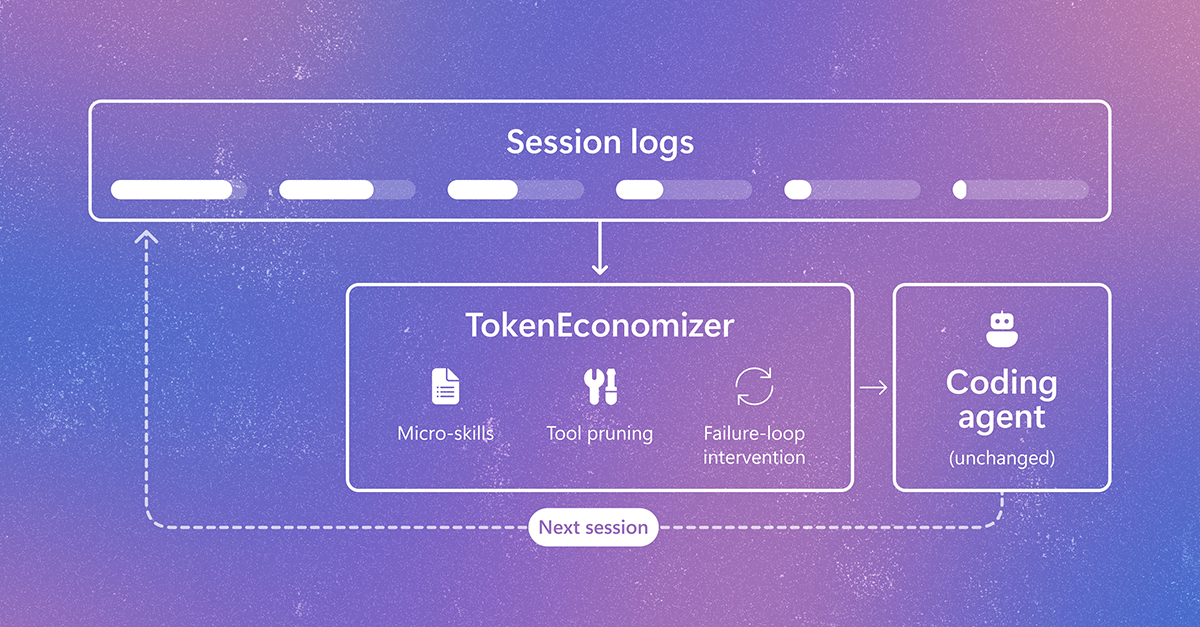
TokenEconomizer: Learning from Experience to Make AI Coding Agents More Efficient

AI coding agents are increasingly help developers fix bugs and build features largely on their own, but every interaction with their models consumes tokens. In each session, an agent sends instructions, tool descriptions, and session history to its model. Most efforts to reduce this cost focus on individual tasks. Yet developers return to the same […] The post TokenEconomizer: Learning from Experience to Make AI Coding Agents More Efficient appeared first on Microsoft Research.

We use cookies to run the site and, with your consent, for analytics and to show ads. See our Cookie Policy.