We study geometric moment contraction (GMC) of the constant-parameter stochastic Nesterov recursion \[ Y_k=\Theta_k+\beta(\Theta_k-\Theta_{k-1}),\qquad \Theta_{k+1}=Y_k-\gamma G(Y_k,X_{k+1}). \] Under mean strong monotonicity and stochastic $L^p$ Lipschitz continuity, an explicit Perron comparison proves synchronous $L^p$ contraction when $\beta\gamma L_p<(1-\beta)(1-q_{\gamma,p})$. This direct criterion includes infinite-variance gradients for $1<p<2$, but its small-step regime requires $\beta<\mu/(\mu+L_p)$. A complementary power-Lyapunov argument establishes a positive, generally much smaller, step-size interval for every fixed $\beta<1$ and every $p>1$, using only a finite $p$th gradient moment. At $p=2$, a simpler explicit certificate gives \[ 0<\gamma<\frac{2\mu(1-\beta)^2}{L_2^2(1-\beta+2\beta^2)}. \] Its quadratic high-momentum scaling is a limitation of the chosen metric, not a sharp stability boundary. We quantify this loss, provide a general mean-only quadratic $S$-procedure, and exploit endpoint Lyapunov inequalities under stronger samplewise sector information. Verified endpoint certificates can be orders of magnitude less conservative than the explicit metric.
We analyze a one-evaluation-per-iteration method for $\mathrm{VI}(C,B)$ with monotone $L$-Lipschitz $B$: $x_{k+1}=P_C(x_k-\lambda B(u_k))$, $u_k=x_k+\theta_k(x_k-x_{k-1})+\beta_k(x_k-u_{k-1})$, $\theta_k+\beta_k=1$. For constant step and summable filter ($\sum_k\beta_k<\infty$) we prove weak convergence via a Lyapunov...
We study the periodic fractional stochastic Burgers equation $(\partial_t+\Lambda^\gamma)u=\partial_x(u^2)+|\partial_x|^{1-\alpha}\xi$, where $1<\gamma\leq 2$ and $\xi$ is space-time white noise. Under the condition $\alpha>\max{(7-4\gamma)/2,(15-8\gamma)/6}$, we establish pathwise $L^1$, energy, and Besov estimates fo...
We study the classical Moreau--Yosida unadjusted Langevin algorithm (MYULA) for $\pi(\,\mathrm{d} x)\propto e^{-f(x)-g(x)}\,\mathrm{d} x$, where $f\in C^2(\mathbb{R}^d)$ is $m$-strongly convex with $L_f$-Lipschitz gradient and $g:\mathbb{R}^d\to\mathbb{R}$ is convex and globally $G$-Lipschitz. For the Moreau-smoothed t...
Let $\alpha$ be irrational and let $q_j$ be the denominators of its continued-fraction convergents. We study the function \[ h(x)=\sum_{j\geq1}\frac{\cos(2\pi q_jx)}{q_j} \] and the skew product \[f(x,y)=(x+\alpha,y+h(x))\quad\mathrm{mod}\quad\mathbb{Z}^2.\] The function $h$ is H\"older continuous of every exponent bel...
We establish near-linear accuracy bounds for the classical Moreau--Yosida unadjusted Langevin algorithm (MYULA). The target is $\pi\propto e^{-f-g}$, where $f\in C^2(\mathbb{R}^d)$ is $m$-strongly convex with Lipschitz gradient and $g$ is convex and globally Lipschitz. Under an explicit parameter-dependent step-size co...
We study the Euler-Maruyama approximation of the degenerate stochastic differential equation $dX_t = |X_t|^\alpha\,dW_t$, $0<\alpha<1/2$, $X_0 = 0$, for which uniqueness in law fails. The Euler scheme started exactly from zero is trapped by the absorbing solution, whereas a nonzero initialization $x_h \to 0$ can select...
Akihiro Tanaka· 0 citations
Related blog posts
MIT News · Artificial Intelligence· news.mit.eduNov 6, 2026
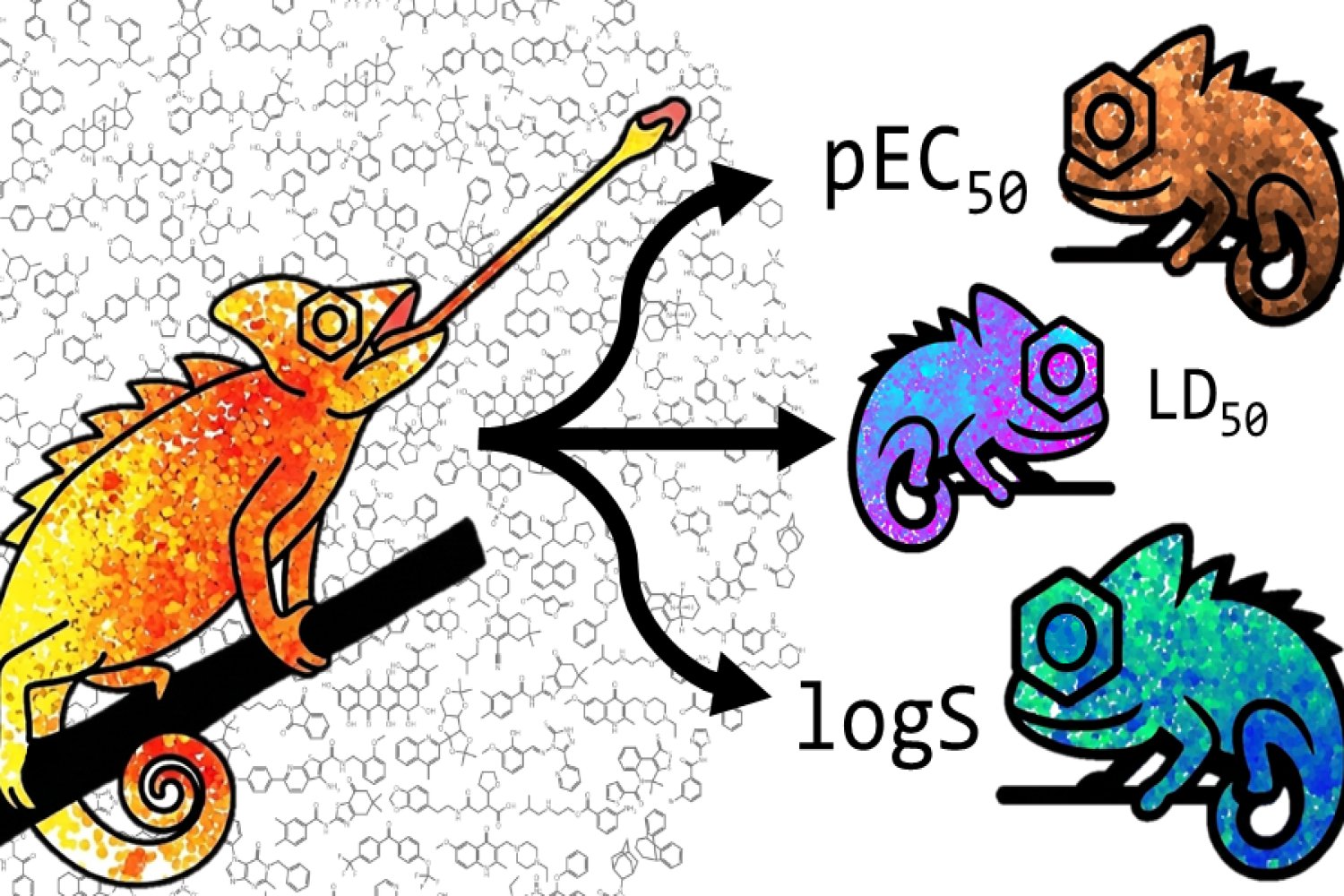
A machine-learning approach called CheMeleon provides a practical way to develop new drugs or other molecules with much less detailed, expensive experimentation.
Learn how Google DeepMind and GovTech Singapore uses lightweight on-device Gemma models to intercept conversational scams in private chats with zero cloud data egress.