We give a gap-free $(\epsilon,\delta)$-differentially private algorithm for the principal component analysis (PCA) problem with Gaussian data. The algorithm is based on a private variant of the power iteration method, and it is computationally efficient.
We construct a smooth, strictly convex ring that admit a unique solution of Gaussian $p$-Capacity problem whose super-level sets are nonconvex. This result provide a negative answer.
We study the maximum sum rate of uniquely decodable code pairs. A weighted refinement of a complement-gluing construction yields an explicit code of length 672 and sum rate exceeding $1.318639029203$. An iterated projection argument, combined with a conditional entropy estimate and a justified continuous limit, gives a...
Under the assumption that the irreducible unitary representation $\pi$ is infinite dimensional, this paper improves the Helgason-Johnson bound in 1969 for $Sp(p, q)$.
In this short note we give a Khintchine-type inequality involving non-independentrandom variables. The basic setting is inspired by Breuer-Major theorem and the proof is based on a hypercontractivity argument.
By studying the computational foundations of language learning, Associate Professor Jacob Andreas builds intelligent systems that can communicate effectively with humans.
Microsoft Research Blog· microsoft.comNov 16, 2026
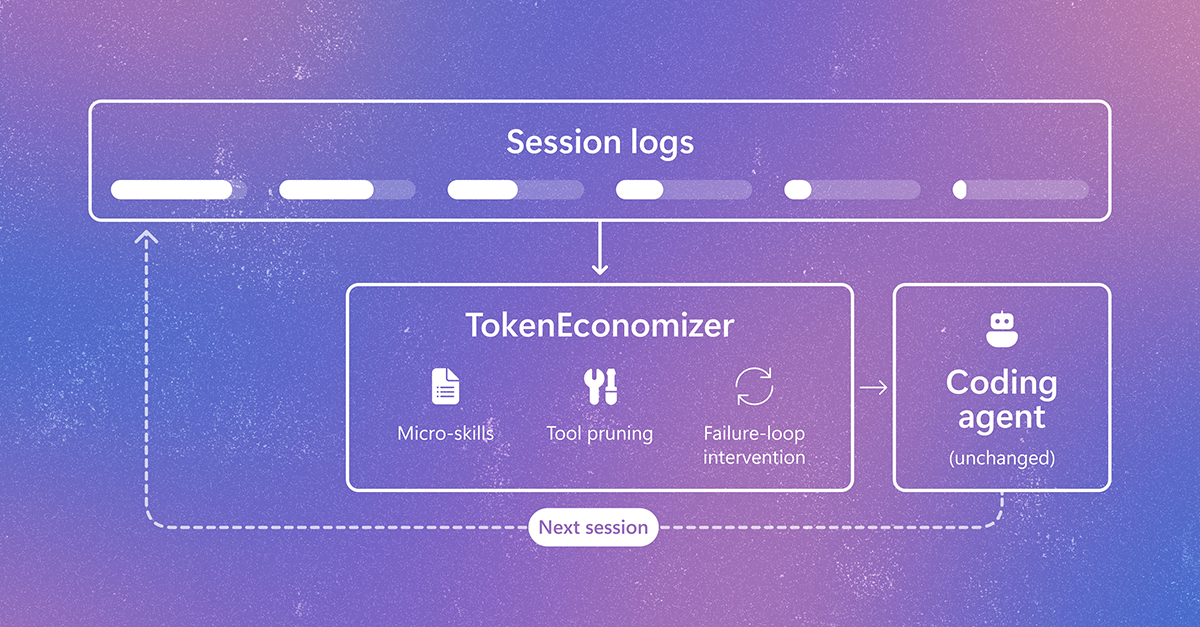
AI coding agents are increasingly help developers fix bugs and build features largely on their own, but every interaction with their models consumes tokens. In each session, an agent sends instructions, tool descriptions, and session history to its model. Most efforts to reduce this cost focus on individual tasks. Yet developers return to the same […] The post TokenEconomizer: Learning from Experience to Make AI Coding Agents More Efficient appeared first on Microsoft Research.
MIT News · Artificial Intelligence· news.mit.eduNov 13, 2026