This work develops a residual-based dynamic algorithm that selectively propagates local errors via push operations, maintaining an approximation to the evolving fixed point without full recomputation, and proves that the method achieves amortized $O(1/\epsilon)$ update time per graph change under a degree-normalized error guarantee.
Abstract
Graph Neural Networks (GNNs) are widely used for representation learning on graphs, but most methods assume static topologies, making them inefficient on evolving networks where edges change over time. Existing dynamic approaches either model graph evolution through temporal GNN architectures without focusing on efficient dynamic maintenance, or are restricted to linear propagation models based on Personalized PageRank. In this work, we study how to efficiently maintain node representations for non-linear GNN propagation under edge insertions and deletions. The propagation has no learned parameters, and only a classifier applied afterward is trained. For a broad class of standard activation functions, we develop a residual-based dynamic algorithm that selectively propagates local errors via push operations, maintaining an approximation to the evolving fixed point without full recomputation. We prove that our method achieves amortized $O(1/\epsilon)$ update time per graph change under a degree-normalized error guarantee. Our approach uses a potential-based analysis in a degree-scaled norm and, in contrast to prior work on the linear case, requires no randomness assumptions on either the update sequence or the input vector. For the linear special case, we additionally provide an exact dynamic algorithm via low-rank matrix inverse updates. Experiments on benchmark datasets show that incorporating non-linearity improves accuracy while preserving efficient update performance, yielding a scalable and theoretically grounded method for maintaining this propagation on dynamic graphs.
Experiments on five dynamic graph benchmarks show that CacheDyG adopts substantially fewer trainable parameters and lower runtime to obtain more competitive predictive performance than baselines, demonstrating that cache-based decoupling provides an effective principle for scalable dynamic graph learning.
Topology-Aware Dynamic Reweighting (TAR+), a model-agnostic framework for node classification under strict graph distribution shifts and related robustness stressors, is proposed, supporting the broad applicability of topology-aware reweighting across heterogeneous graph learning conditions.
Jia-Xing Li, Jia-Shuo Liu, Wei-Huang Zheng et al.· IEEE Transactions on Pattern...· 0 citations
This work-in-progress paper proposes graph edit paths as a controlled tool for probing how GNN predictions respond to structural and attribute-level edits, and develops heuristics for generating edit paths and evaluates standard GNNs along these paths, quantifying their sensitivity to different types of edits.
This work introduces PathLapPE, a novel spectral positional encoding (PE) derived from the path Laplacian on directed graphs that provides node- and edge-level features that encode directional higher-order structure and can be incorporated into standard graph learning architectures.
Lydia Mezrag, Semih Cantürk, Michael Perlmutter et al.· 0 citations
Real-world interaction networks are inherently dynamic: edges form and dissolve as node behavior shifts over time. Most snapshot-based contrastive methods encode temporal dependencies implicitly in encoder weights, without an explicit model of how node representations evolve, making them brittle under distribution shif...
Information propagation over graph-structured data depends critically on the quality of node representations learned by graph neural networks (GNNs). However, how different GNN architectures organize embedding spaces and how these representations influence downstream propagation behavior remain insufficiently under...
By studying the computational foundations of language learning, Associate Professor Jacob Andreas builds intelligent systems that can communicate effectively with humans.
Microsoft Research Blog· microsoft.comNov 16, 2026
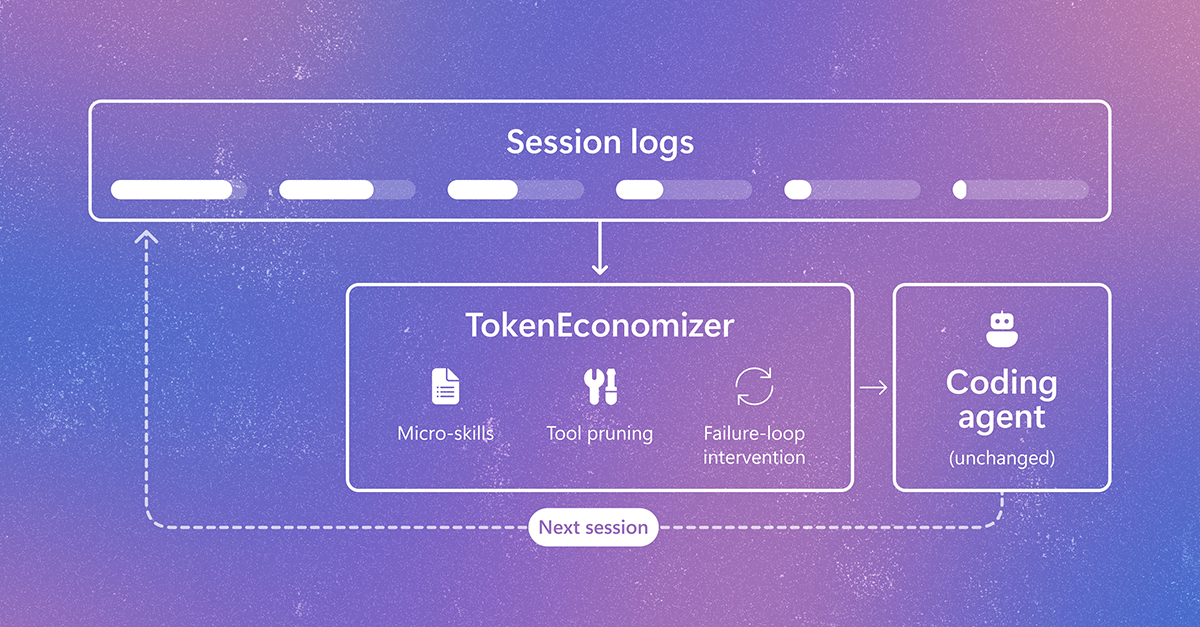
AI coding agents are increasingly help developers fix bugs and build features largely on their own, but every interaction with their models consumes tokens. In each session, an agent sends instructions, tool descriptions, and session history to its model. Most efforts to reduce this cost focus on individual tasks. Yet developers return to the same […] The post TokenEconomizer: Learning from Experience to Make AI Coding Agents More Efficient appeared first on Microsoft Research.
MIT News · Artificial Intelligence· news.mit.eduNov 13, 2026