Skip to content

Beyond Site Agreement: Re-estimation for Brain Network Generalization

Sep 2026 · 0 citations · 60 references
Computer Science

TL;DR

Brain Network Re-estimation-Informed OOD Learning (BRIO) is proposed, a framework that uses within-scan FC re-estimation to guide cross-site alignment and consistently outperforms competitive baselines.

Abstract

Cross-site out-of-distribution (OOD) generalization in resting-state functional magnetic resonance imaging (rs-fMRI) often relies on learning task-discriminative representations from full-scan functional connectivity (FC) graphs and promoting invariance across source sites. However, FC graphs are estimated from finite, temporally correlated blood-oxygen-level-dependent (BOLD) sequences. Cross-site agreement therefore does not necessarily imply that predictive evidence remains supported under FC re-estimation within the same scan. In this paper, we propose Brain Network Re-estimation-Informed OOD Learning (BRIO), a framework that uses within-scan FC re-estimation to guide cross-site alignment. BRIO maps fullscan graphs and their re-estimates into consistently indexed connectome factors, enabling comparisons of their predictive contributions. It assesses re-estimation support from changes in these contributions relative to within-class subject variability and class separation. For each source-site pair and class, this task-calibrated support from both sites is combined with predictive relevance to form pairwise qualifications, which determine relative factor weights and overall alignment strength. Leave-one-site-out experiments on four real-world datasets (ABIDE, REST-metaMDD, SRPBS, and ABCD) show that BRIO consistently outperforms competitive baselines, with relative improvements of up to 3.8% in accuracy. These gains also persist under an alternative brain parcellation on ABIDE.

View source

Similar papers

#machine learning Preprint Aug 2026

Benchmarking External Generalization of SPD Matrix Learning for Resting-State fMRI Connectome Prediction

A reproducible age-prediction benchmark across six rs-fMRI datasets is introduced and provides common inputs, model settings, data splits, and analysis scripts so that future SPD matrix learning methods can be evaluated under the same external-validation protocol.

Ce Ju, A. Collas, Florent Bouchard et al. · 0 citations
Aug 2026

An explicit functional-map framework for structure–function correspondence in brain connectivity

The proposed framework provides an interpretable basis for testing population-level, network-level, and subject-sensitive SC-FC relationships and for constructing reference-conditioned individual deviation measures without treating prediction accuracy as direct evidence of biological constraint.

Zhengyuan Lyu, Zhi-Wei Song, Si-Yue Fu et al. · 0 citations
Jul 2026

A Neuroinformatics Framework for Evaluating Functional Connectivity Metrics in Small-Sample Resting-State fMRI: An Age-Stratified Autism Study

A neuroinformatics framework for systematic evaluation of multiple FC measures under small-sample rs-fMRI conditions and explicitly addresses data leakage and overfitting through strict cross-validation and training-only feature selection is proposed.

Hossein Haghighat · 0 citations
#machine learning Preprint Sep 2026

Beyond Feature Reliability: Repeat-Informed Multifractal Curve Regression for Brain-Age Prediction

Brain-age prediction from resting-state fMRI provides a quantitative framework for characterizing age-related changes in spontaneous brain dynamics and for identifying functional signatures. Existing studies have linked fractal and multifractal scaling to age and examined the reliability of individual features. However...

Yu Chang, An-Zhe Cheng, Jia-Hao Chen et al. · 0 citations
Open access Aug 2026

Precision Confidence Mapping: An approach to determining individualized network topography with limited data

Individualized resting-state functional magnetic resonance imaging (rs-fMRI) is increasingly used to guide neuromodulation target selection. However, clinical scans are often short and noisy, and standard pipelines for functional network identification do not provide information about confidence of network assignment....

Julian S. B. Ramirez, R. Hermosillo, Julia Moser et al. · 0 citations
Preprint Aug 2026

M2LG-DG: A Multi-modal Local-Global Domain Generalization Framework for Cross-site Major Depressive Disorder Classification

Classification models based on resting-state functional magnetic resonance imaging (rs-fMRI) often show lower performance at imaging sites not included during model development, which can limit their use in clinical settings. Domain generalization (DG) addresses this issue by learning representations from source sites...

Muhammad Asif Hasan, Yan-Ming Zhu, Xuefei Yin et al. · 0 citations

Related blog posts

Microsoft Research Blog Nov 16, 2026

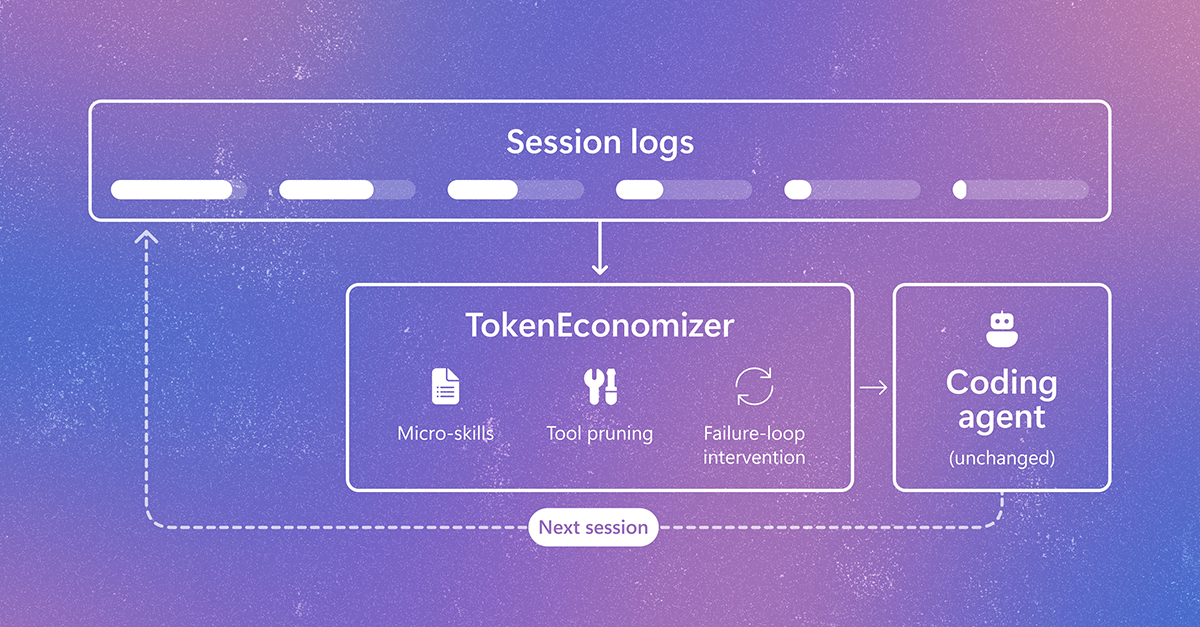
TokenEconomizer: Learning from Experience to Make AI Coding Agents More Efficient

AI coding agents are increasingly help developers fix bugs and build features largely on their own, but every interaction with their models consumes tokens. In each session, an agent sends instructions, tool descriptions, and session history to its model. Most efforts to reduce this cost focus on individual tasks. Yet developers return to the same […] The post TokenEconomizer: Learning from Experience to Make AI Coding Agents More Efficient appeared first on Microsoft Research.

We use cookies to run the site and, with your consent, for analytics and to show ads. See our Cookie Policy.