Skip to content

GenMem: Generative Symbolic Memory for Self-Evolving Harness

Sep 2026 · arXiv.org · Vol abs/2609.34633 · 0 citations · 56 references
Computer Science

TL;DR

GenMem is presented, which reformulates memory management as generative symbolic addressing, a multi-level discrete token tuple drawn from a Cartesian-product address space that factorizes a million-scale sparse memory space using fewer than one hundred discrete symbols.

Abstract

Long-term memory supports the self-evolution of LLM agents by retaining experience and skills across tasks and enabling their retrieval, reuse, and revision in subsequent long-horizon decision-making. Yet existing memory management approaches remain limited to discriminative retrieval and to address the sparse, hierarchical, and highly redundant structure of reusable experience: only a small, task-dependent subset of trajectories and memories warrants retention, retrieval, or revision. Learning these operations is further complicated by sparse, delayed, and indirect task-level feedback, with weak supervision across the memory lifecycle. Moreover, continual memory evolution introduces an architectural tension as addressing invariance: stored experience is perpetually revised, yet the addressing interface consumed by learned retrieval policies must remain stable. To address, we present GenMem, which reformulates memory management as generative symbolic addressing. Its core mechanism is the Symbolic Identifier (SID), a multi-level discrete token tuple drawn from a Cartesian-product address space that factorizes a million-scale sparse memory space using fewer than one hundred discrete symbols. Instead of generating ever-changing raw content, the memory agent learns to generate SIDs, while memory evolution rewrites the payload at a fixed address without shifting the address itself. Architecturally, GenMem couples a MemRetriever and a MemEvolver within a multi-agent harness, trained via GRPO with dense process and outcome rewards with two-channels optimization. Under offline memory evolution, experiments spanning ALFWorld, WebShop, multi-hop QA, medical reasoning, and deep research evaluate GenMem against strong memory-augmented baselines...

View source

Similar papers

RPMem: Learning Long-Term Recurrent Parametric Memory Across Sessions for LLM Agents

RPMem is introduced, a two-stage architecture that compiles each session into a model-independent latent memory through forward computation and selectively integrates it with retained memory via a task-trained recurrent gate, establishing RPMem as a lifecycle-independent parametric memory framework that maintains evolv...

Fan-Yu Zhao, Rui-Ke Cao, Liang Dong et al. · 1 citation · ⚡1
Preprint Aug 2026

MindMemOS: A Portable and Self-Evolving Memory Operating Layer for AI Agents

MindMemOS is presented, a portable and self-evolving memory operating layer that organizes open-world information using a unified entity property timestructure that supports scenario-adaptive memory modeling, higher-order pattern discovery, autonomous memory refinement, and continuous skill evolution.

Kaichao Liang, Yu-Qi Cui, Hao Kong et al. · 0 citations

MemBodied: Recurrent Associative Memory for Vision-Language-Action Models

Findings support MemBodied as a practical alternative to expanding the policy context for history-dependent manipulation, a fixed-size episodic memory with two complementary components: an associative state that records interactions across policy calls and an episode anchor that preserves a compact representation of th...

Tej Deep Pala, N. Majumder, Bryce Goh et al. · 1 citation

ARM: Attention with Routed-Memory for Learnable Sparse Control

Attention with Routed Memory is proposed a novel KV caching structure that introduces a fully differentiable, fixed-size memory system organized as a hierarchical router that achieves superior performance and efficiency compared to fixed KV-caching approaches, while remaining efficient and scalable in terms of both mem...

Qiu-Hao Zeng, Jerry M. Huang, Peng Lu et al. · 0 citations
#artificial intelligence Preprint Sep 2026

DRAM: Delta-rule Recurrent Associative Memory for Robot Manipulation Policies

Robotic manipulation is inherently history-dependent, yet most pretrained robotic policies condition on only the current observation or a short temporal window. Equipping such policies with long-term memory remains challenging: existing approaches either feed the backbone multi-frame observation windows, which substant...

Xin-Yu Zhao, Yixiang Shan, Tao Yang et al. · 0 citations

Related blog posts

Microsoft Research Blog Nov 16, 2026

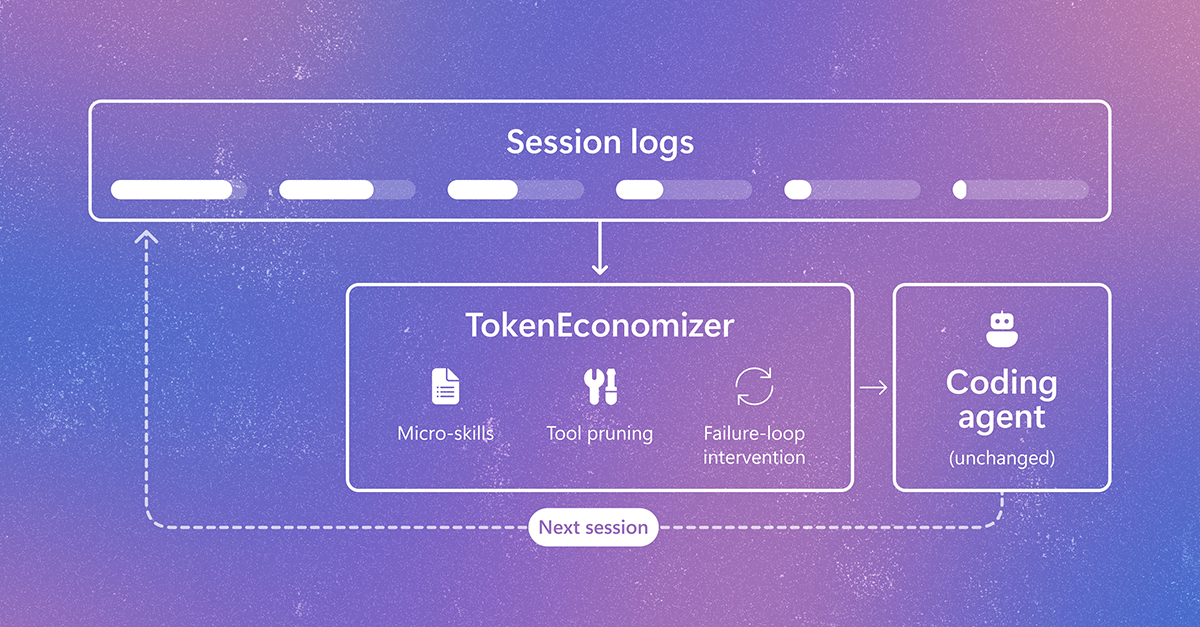
TokenEconomizer: Learning from Experience to Make AI Coding Agents More Efficient

AI coding agents are increasingly help developers fix bugs and build features largely on their own, but every interaction with their models consumes tokens. In each session, an agent sends instructions, tool descriptions, and session history to its model. Most efforts to reduce this cost focus on individual tasks. Yet developers return to the same […] The post TokenEconomizer: Learning from Experience to Make AI Coding Agents More Efficient appeared first on Microsoft Research.

We use cookies to run the site and, with your consent, for analytics and to show ads. See our Cookie Policy.