Skip to content

ReCo: When to Relocate Sensor Kits under Deployment Constraints -- A NILM Case Study

Sep 2026 · 0 citations · 20 references
Computer Science

TL;DR

A constraint-based relocation framework is proposed and instantiate it for NILM as ReCo (Relocation by Coverage gain), which outperforms fixed-dwell and count-based schedules and a threshold rule using the same metric in every setting.

Abstract

Many sensing tasks obtain training labels only by deploying instruments in the field. With a limited number of sensor kits, a collection deadline, and measurement downtime at every move, the collector must repeatedly decide whether to stay at the current site or relocate. We study this decision in non-intrusive load monitoring (NILM), which estimates the power drawn by individual appliances from a home's main meter and is trained on data from homes temporarily fitted with appliance-level sub-meters. In NILM, appliance usage varies with the appliance, season and climate, and the value of new data depends on how diverse the combinations of target operation and background load are. To address this, we propose a constraint-based relocation framework and instantiate it for NILM as ReCo (Relocation by Coverage gain). ReCo counts new operating regimes in a joint target-background feature space, forecasts each home's future gain from the data collected so far, and each night weighs the gain of staying against the gain of moving elsewhere after the downtime. In replayed deployments on the Plegma dataset under two kit counts and two downtime costs, ReCo outperforms fixed-dwell and count-based schedules and a threshold rule using the same metric in every setting. Its advantage is not explained by collecting more days alone and reflects allocating the days to more valuable homes and periods.


View source

Similar papers

#machine learning Review Sep 2026

Accountable and uncertainty-aware evaluation of sensor-based AI under distribution shift: devices, subjects, and nearly three years underground

A staged, accountable evaluation protocol that treats the evaluation of a deployed model as a measurement with declared reference levels and a quantified uncertainty and demonstrates the protocol on infrastructure-free geomagnetic localisation with smartphone-based recurrent classifiers in two real underground mines.

Benny Platte, Rico Thomanek, Christian Roschke et al. · 0 citations
Open access 2026

Lite-NILMFormer: A Lightweight Nonintrusive Load Monitoring Method for Smart Metering Applications

Nonintrusive load monitoring (NILM) extracts appliance-level energy consumption from aggregate power measurements and is essential for smart metering systems. However, Transformer-based methods such as NILMFormer suffer from high computational complexity and distribution shifts across households, limiting edge deployme...

Lie-Quan Liang, Zhen-Yu Hao, Q. Pang et al. · 0 citations
#machine learning Preprint Sep 2026

Ask for Any Appliance: A Prompt-Programmable Foundation Model for Non-Intrusive Load Monitoring

Non-intrusive load monitoring (NILM) estimates appliance-level consumption from a whole-home meter, but appliance-specific models and fixed output inventories make coverage costly to extend. We present FM4NILM (Foundation Model for NILM), a single prompt-programmable model that estimates a requested appliance's power t...

Xu-Dong Wang, Jia-Cheng Cui, Jun-Yu Xue et al. · 0 citations
Sep 2026

CPTA technology for enhanced non-intrusive load monitoring in AI-based smart homes

The feedback processes to reduce the estimation discrepancy in NILM are discussed and a closed-loop learning approach is proposed that may significantly improve the accuracy of NILM, and it is applicable for practical applications.

Li-Ping Chen, Zhao-Yu Wen, Cen Li et al. · 0 citations
#machine learning Preprint Oct 2026

FLoRa: Flight-Assisted Data Collection from Duty Cycling LoRa Nodes under Energy Constraints

Data collection using Unmanned Aerial Vehicles (UAVs) is challenging when LoRa IoT Devices (IoTDs) duty-cycle to conserve battery. Under energy constraints, a UAV must decide which IoTDs to visit, in what order, where to hover, and how many times to probe each node, while time-based data freshness decays. Tractably sol...

Naresh Babu Kakarla, V. Mahendran · 0 citations
Open access Oct 2026

PPO-ReLA: Residual Link Adaptation for UAV LoRa Backhaul Under Power-Line Interference

A UAV inspecting a live 750 kV corridor needs a LoRa uplink in which towers repeatedly cross the line of sight. The LoRaWAN adaptive data rate (ADR) infers each decision from recently decoded frames, so a sustained obstruction starves its evidence window and its spreading-factor choice drifts toward cheap transmissions...

Long-Qiang Luo, Duo Wang, Ming Chen et al. · 0 citations

Related blog posts

MIT News · Artificial Intelligence Nov 17, 2026

Learning the language of machine learning

By studying the computational foundations of language learning, Associate Professor Jacob Andreas builds intelligent systems that can communicate effectively with humans.

Microsoft Research Blog Nov 16, 2026

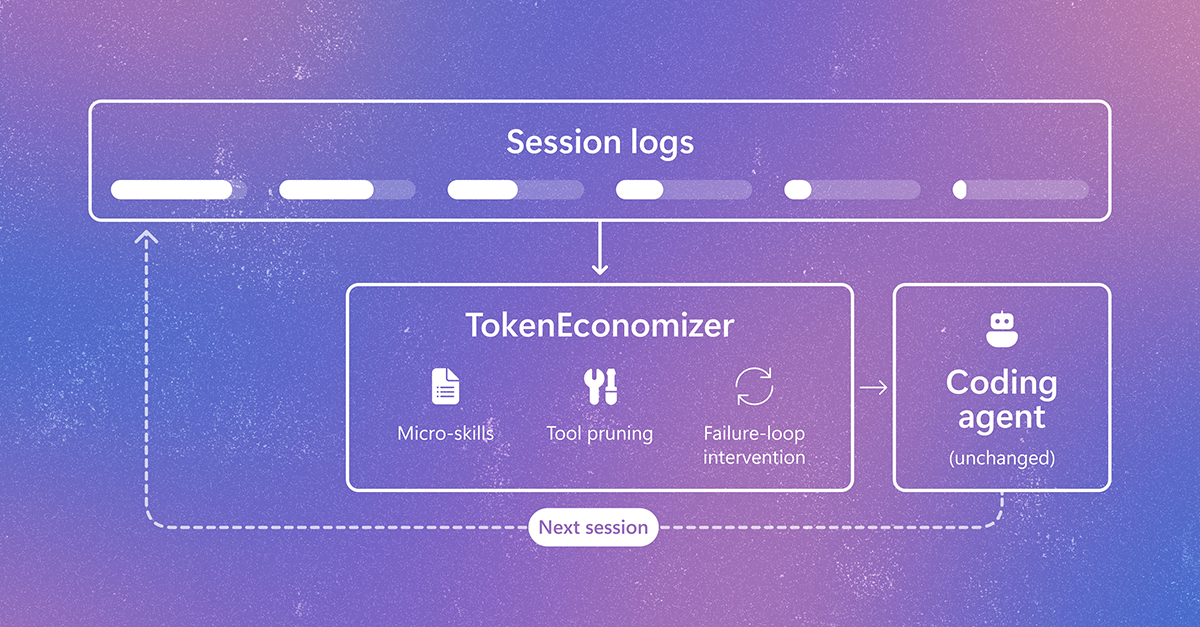
TokenEconomizer: Learning from Experience to Make AI Coding Agents More Efficient

AI coding agents are increasingly help developers fix bugs and build features largely on their own, but every interaction with their models consumes tokens. In each session, an agent sends instructions, tool descriptions, and session history to its model. Most efforts to reduce this cost focus on individual tasks. Yet developers return to the same […] The post TokenEconomizer: Learning from Experience to Make AI Coding Agents More Efficient appeared first on Microsoft Research.

We use cookies to run the site and, with your consent, for analytics and to show ads. See our Cookie Policy.