Latent visual reasoning (LVR) enables multimodal large language models (MLLMs) to perform intermediate computation in continuous latent tokens rather than expressing every reasoning step in words. However, unlike textual CoT, latent reasoning is not directly observable, making it difficult to supervise what latent tokens learn. In this work, we first conduct a thorough analysis of latent-token behavior and identify a latent evidence-credit gap: latent tokens respond only weakly to image perturbations that alter the correct answer. We hypothesize that this issue stems from the lack of explicit supervision during GRPO training. These findings suggest that a final-answer reward provides too little guidance on what visual evidence to preserve or how credit should be assigned across latent tokens. To bridge this gap, we propose ReaLVR, which brings visual-evidence supervision to the model's own free-running latent trajectories. ReaLVR contrasts correct and model-generated wrong answers to determine where stronger supervision is needed, and relevant and mismatched visual evidence to specify what to preserve. Across three model families, ReaLVR consistently outperforms evaluated LVR baselines, achieving the highest five-task average of 63.7% on Qwen2.5-VL-7B. Crucially, we are the first to scale visual reasoning in latent space, showing that our framework continues to deliver robust improvements at frontier model scales up to 235B. Further analyses show more question-sensitive latent-token positions, stronger alignment with relevant visual regions, and greater fixed-context dependence on the most attended latent tokens.
This publication proposes a definition and a classification of agile software development approaches and analyses ten software development methods that can be characterized as being "agile" against the defined criterion.
P. Abrahamsson, O. Salo, Jussi Ronkainen et al.· arXiv.org· 727 citations· ⚡54
The study shows that agile practices improve both informal and formal communication, but indicates that, in larger development situations involving multiple external stakeholders, a mismatch of adequate communication mechanisms can sometimes even hinder the communication.
M. Pikkarainen, Jukka Haikara, O. Salo et al.· Empirical Software Engineeri...· 401 citations· ⚡48
The results indicate that software engineering work practices are chosen opportunistically, adapted and configured to provide value under the constrains imposed by the startup context.
Nicolò Paternoster, Carmine Giardino, M. Unterkalmsteiner et al.· Information and Software Tec...· 394 citations· ⚡54
The possibility of inferring high-dimensional data inference in a model that consists of a prior and an auxiliary differentiable constraint given some additional information is considered, thereby allowing a range of potential applications in adapting models to new domains and tasks.
Alexandros Graikos, Esmeralda S. Whitammer, N. Jojic et al.· Neural Information Processin...· 316 citations· ⚡15
A new machine-learning framework aims to improve the success rate of computational protein design while moving away from results that reproduce sequences found in nature.
Microsoft Research Blog· microsoft.comAug 11, 2026
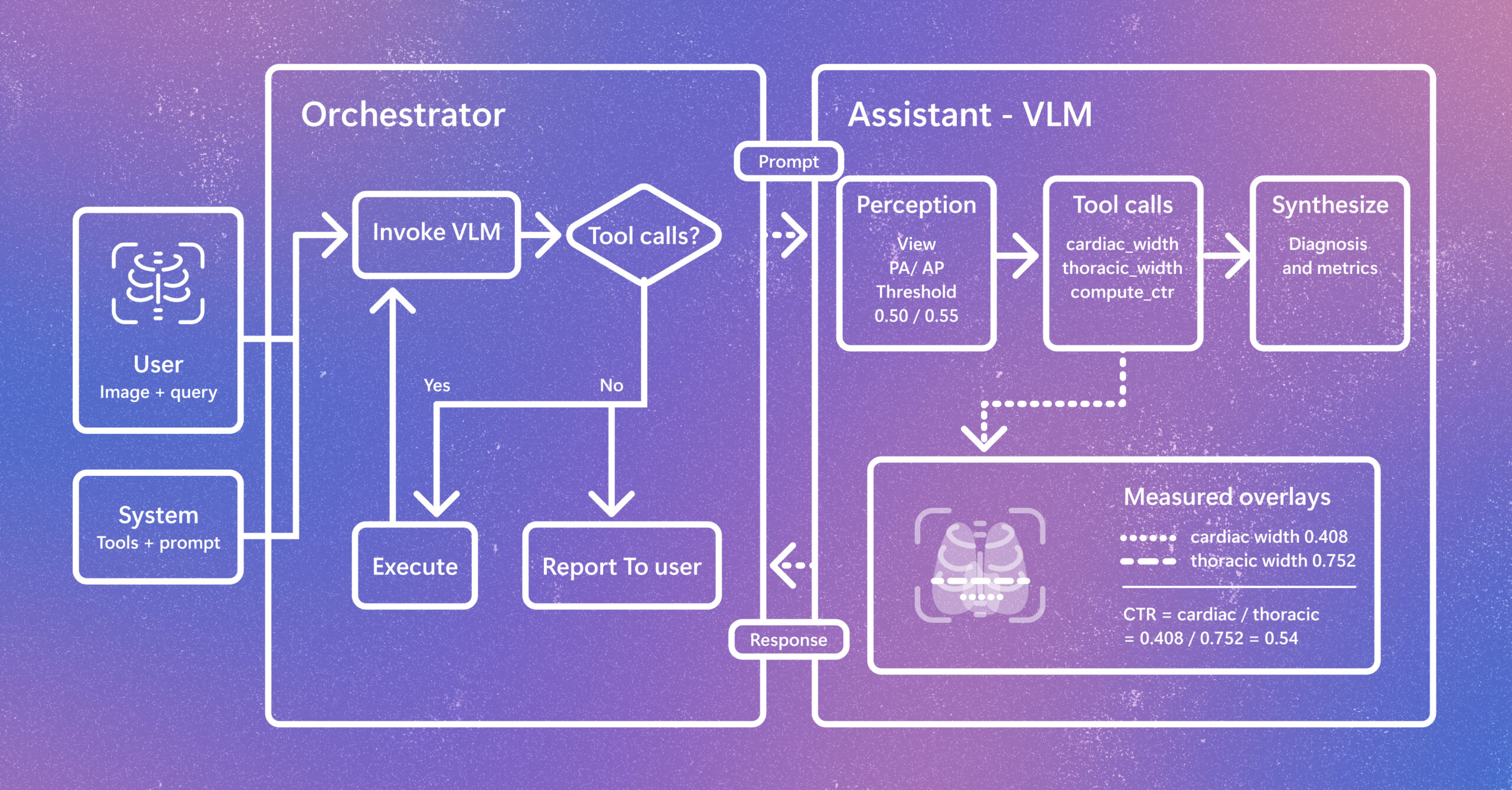
Radiology AI is evolving beyond report generation. CARE-X explores a unified approach that combines flexible reasoning, calibrated predictions, and measurement-based tools for chest X-ray interpretation. The post Introducing CARE-X: Towards Clinically Useful Radiology VLMs with Auxiliary Supervision, Reward-Aligned Learning, and Tool-Augmented Measurement appeared first on Microsoft Research.