It is suggested that linking a model's internal features to its errors and their effects on performance may help select training images that improve performance, thereby allowing the model's current state to guide which images are labeled next.

Abstract
With limited annotation budgets, choosing which images to label determines how much a model improves. Data-selection methods that use features from a separately trained model, or scene descriptions written by vision-language models, have been successful, but those signals do not directly capture changes in the model being improved. The target model's own internal features reflect what it has learned so far and change with retraining, making them a natural cue for choosing the next training data. However, feature rarity alone does not reveal the errors that matter for performance. Here we link internal features to prediction errors and their expected impact on performance and select images for labeling and retraining without using labels for candidate images. We evaluated the method with an object detector on two datasets and two pairs of random seeds. Adding internal features improved the identification of prediction errors in 15 of 16 conditions. When performance was averaged over successive labeling rounds, the method outperformed selection based only on feature rarity in all four evaluation settings and ranked among the top two of six methods. With other conditions held fixed, performance after retraining was again higher than with rarity-based selection, even though the latter collected more errors. With longer retraining, the proposed method ranked first among six methods. These results suggest that linking a model's internal features to its errors and their effects on performance may help select training images that improve performance, thereby allowing the model's current state to guide which images are labeled next.
Vision-language models (VLMs) are usually chosen from leaderboards, which give one ranking for every application. On questions about objects that a scene suggests but does not contain, however, the model with the lowest error on the POPE hallucination benchmark is not the one with the lowest error on such questions. Fo...
Reliable scene understanding requires deciding which predictions to trust, retain, or inspect. In semantic segmentation, component failure predictors support these decisions, but their predictive performance does not fully describe the value of the resulting selection. We develop a decision-centered evaluation framewor...
Min-Hui Kang, Yi-Yao Zhang, Pei-Zhe Long et al.· 0 citations
Evaluating generative image models remains challenging, as commonly used metrics depend on fixed pretrained feature extractors optimized for different tasks that do not always align with human realism perception across datasets and model families. To address this limitation, we investigate a human-inspired evaluation f...
E. Ristori, L. Bindini, Marco Lippi et al.· 0 citations
This work studies an activation alignment, a map from a source model's layerwise activations to a target's, and factors this map into a layer map, whose output is an explicit target-by-source matrix that can be extracted and inspected, and a layer-shared feature map between hidden spaces.
А. Ю. Судаков, Guy Bar-Shalom, Fabrizio Frasca et al.· 0 citations
While data collection for model training is relatively easy, curating high-quality datasets from large collections is inherently challenging. Coreset estimation methods address this problem by identifying the best data subsets to train models on. However, existing approaches often require proxy model training, extensiv...
Julia Hindel, Benjamin Ramtoula, Kyuhwan Yeon et al.· 0 citations
Visual in-context learning (ICL) enables vision-language models (VLMs) to adapt at test time via demonstration examples, but its effectiveness depends critically on the examples selected. Recent counterfactual selection methods improve ICL by constructing demonstrations that expose how individual attribute changes affe...
Exploring how generative AI could make machine vision more accessible to businesses. The post GenEye in a Box: Making Machine Vision Something You Can Just Ask For appeared first on GPT-Lab.
Microsoft Research Blog· microsoft.comAug 11, 2026
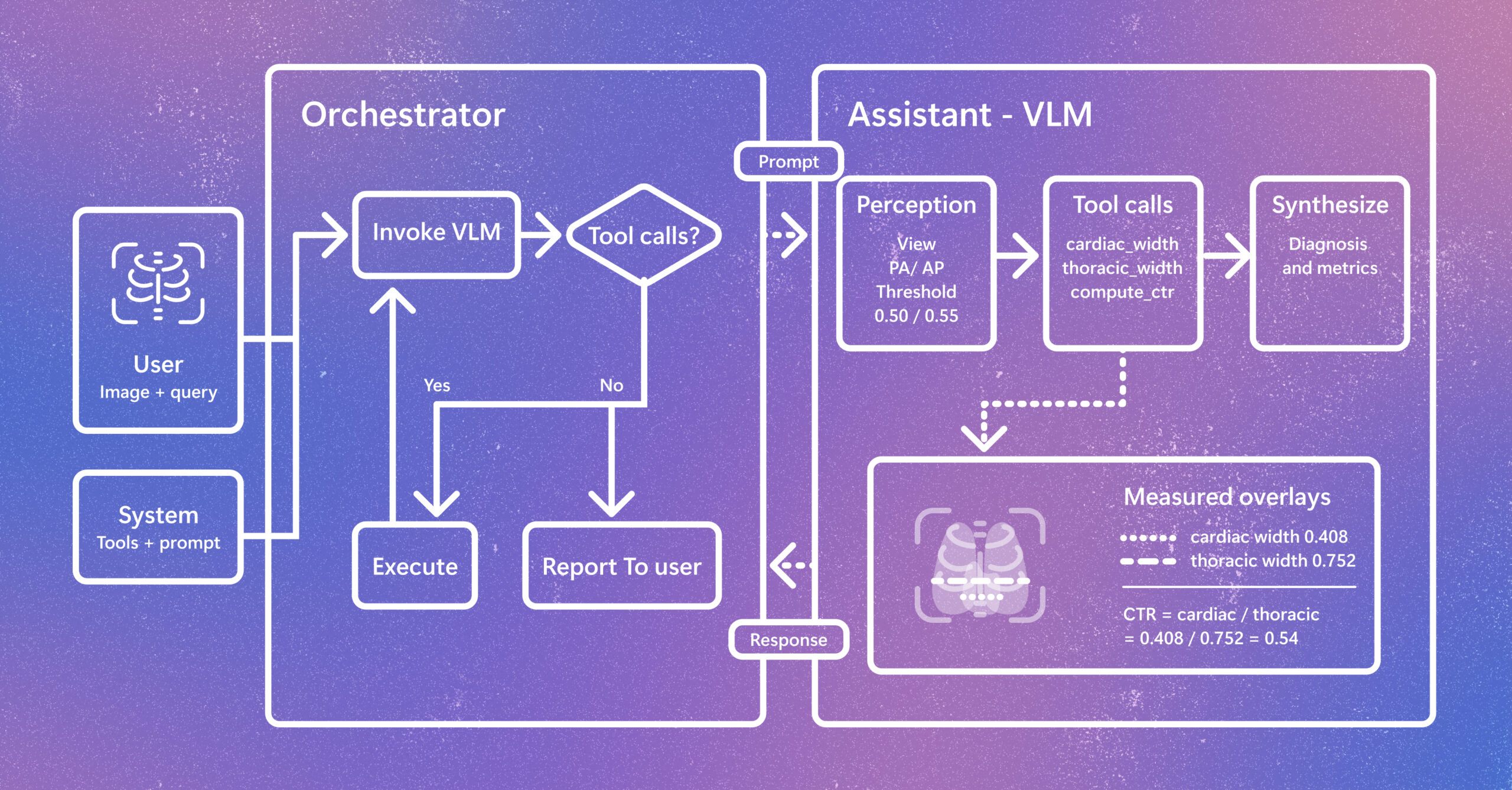
Radiology AI is evolving beyond report generation. CARE-X explores a unified approach that combines flexible reasoning, calibrated predictions, and measurement-based tools for chest X-ray interpretation. The post Introducing CARE-X: Towards Clinically Useful Radiology VLMs with Auxiliary Supervision, Reward-Aligned Learning, and Tool-Augmented Measurement appeared first on Microsoft Research.
Assistant Professor Benjamin Lindquist studies how engineers deliberately injected randomness into early AI, giving rise to deep-learning models that sometimes hallucinate.
We use cookies to run the site and, with your consent, for analytics and to show ads.
See our Cookie Policy.