Answering questions about long videos often requires connecting events involving the same objects across hours or days. Chronological descriptions and text-derived entities can leave physical identity unresolved: different objects may share a description, while observations of the same object remain disconnected across events. Retrieving relevant events therefore does not necessarily recover the"biography"of the particular entity a question concerns. To address this, we introduce Grounded Entity Biographies (GEB), a long-video memory framework that groups visually grounded observations of the same physical instance across clips into retrievable biographies while preserving the context of each moment. During question answering, the biography is retrieved alongside episodic evidence, allowing the model to follow an entity through events using identity links established during memory construction. Evaluations across four benchmarks, including day-long and week-long recordings, demonstrate improvements over prior memory frameworks in both multiple-choice and open-ended question answering. On EgoLifeQA, GEB achieves 72.0% accuracy, 4.4 percentage points above the best published result. Ablations show that grounded identity association and biography reading both contribute to the gains, which additional descriptions alone do not fully recover.

This publication proposes a definition and a classification of agile software development approaches and analyses ten software development methods that can be characterized as being "agile" against the defined criterion.
P. Abrahamsson, O. Salo, Jussi Ronkainen et al.· arXiv.org· 727 citations· ⚡54
The study shows that agile practices improve both informal and formal communication, but indicates that, in larger development situations involving multiple external stakeholders, a mismatch of adequate communication mechanisms can sometimes even hinder the communication.
M. Pikkarainen, Jukka Haikara, O. Salo et al.· Empirical Software Engineeri...· 401 citations· ⚡48
The results indicate that software engineering work practices are chosen opportunistically, adapted and configured to provide value under the constrains imposed by the startup context.
Nicolò Paternoster, Carmine Giardino, M. Unterkalmsteiner et al.· Information and Software Tec...· 394 citations· ⚡54
The possibility of inferring high-dimensional data inference in a model that consists of a prior and an auxiliary differentiable constraint given some additional information is considered, thereby allowing a range of potential applications in adapting models to new domains and tasks.
Alexandros Graikos, Esmeralda S. Whitammer, N. Jojic et al.· Neural Information Processin...· 316 citations· ⚡15
It is proved that any global minimizer of the trajectory balance objective can define a policy that samples exactly from the target distribution, and empirically demonstrate the benefits of the trajectories balance objective for GFlowNet convergence, diversity of generated samples, and robustness to long action sequenc...
Esmeralda S. Whitammer, Moksh Jain, Emmanuel Bengio et al.· Neural Information Processin...· 302 citations· ⚡60
Exploring how generative AI could make machine vision more accessible to businesses. The post GenEye in a Box: Making Machine Vision Something You Can Just Ask For appeared first on GPT-Lab.
MIT News · Artificial Intelligence· news.mit.eduSep 29, 2026
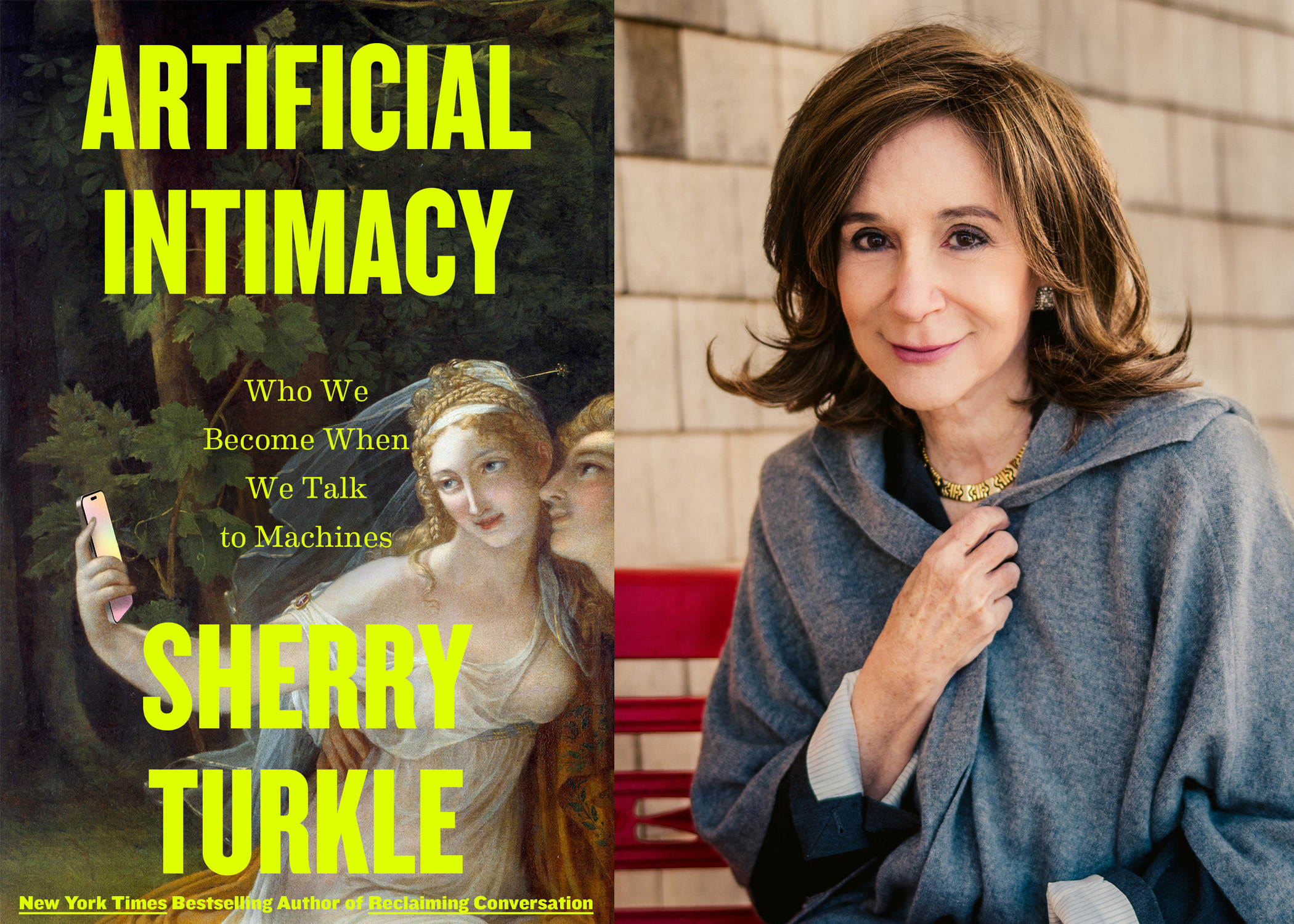
Professor Sherry Turkle’s new book, “Artificial Intimacy,” offers a withering critique of chatbots and the antisocial dynamics she believes they encourage.
We use cookies to run the site and, with your consent, for analytics and to show ads.
See our Cookie Policy.