Together, these results support architecture-prior alignment: preserving an addressable feature axis provides an inductive bias for task-adaptive relevance inference for task-adaptive relevance inference.
Abstract
Tabular foundation models (TFMs) are increasingly popular because they deliver strong predictions on new datasets through in-context learning, without task-specific training or extensive tuning. Yet released TFMs differ simultaneously in their pretraining priors, architectures, and objectives, obscuring their respective inductive biases. We therefore examine one concrete capability: irrelevant-feature suppression. Across synthetic tasks and real-world datasets, adding null features causes substantially greater predictive degradation in the row-token model TabDPT, whereas the cell-token alternating-axis model TabPFN v2 and other TFMs remain comparatively stable. This gap motivates us to ask whether architecture contributes to irrelevant-feature suppression. Because released TFMs remain confounded by other design choices, we train streamlined row-token and alternating-axis transformers under identical sparse-to-dense linear priors. Exact Bayes analysis shows that sparse prediction requires context-dependent feature gating, whereas the dense endpoint requires only uniform feature weighting. Consistent with this distinction, the alternating-axis model is substantially closer to the Bayesian optimal predictor on sparse tasks, while the architecture gap becomes negligible on dense tasks; almost all of the sparse gap arises from linear coefficient-estimation error. Finally, in both the controlled model and frozen TabPFN v2, we examine the effect of interventions on the feature-attention outputs on the linear coefficients, finding evidence of task-dependent selective routing of computation through feature-indexed pathways. Together, these results support architecture-prior alignment: preserving an addressable feature axis provides an inductive bias for task-adaptive relevance inference. Code is available at https://github.com/Tianqi-Zhao/ArchitecturePriorTFMs.

OrionMoE-Small-v1.0 is introduced, a compact tabular foundation model that combines distribution-aware representations with dataset-conditioned sparse mixture-of-experts computation that enables adaptive allocation of computation across heterogeneous tabular problems while retaining a shared computational pathway acros...
Mohamed Bouadi, Nassim Bouarour, Aditya Tanna et al.· 0 citations
In-context-learning Tabular Foundation Models (TFMs) are uniquely suited to scenarios with limited resources or privacy constraints, as they solve new tasks without additional training. However, their architecture consists of multiple transformer blocks, resulting in high computational and memory footprints. Meanwhile,...
PACE (Plug-and-Play Contextual Embedding) inserts a frozen tabular foundation model (TFM) column encoder before an existing feature-scoring rule, expanding each feature into a higher-dimensional contextual representation, positioning pretrained column geometry as a reusable upstream primitive for tabular learning.
Tabular foundation models (TFMs) achieve strong predictive performance by conditioning on labeled demonstrations provided in context, without any parameter update. Yet how individual demonstrations shape a given prediction remains poorly understood. This gap matters in practice: the context is often assembled from what...
Yacine Benihaddadene, Milan Bhan, Eliot Dugelay et al.· 0 citations
Tabular foundation models (TFMs) based on prior-data fitted networks typically use sampled hard query labels, leaving avoidable sampling variability in pretraining. A key observation is that intermediate generator states can reveal label uncertainty beyond a sampled outcome. We propose Generator-state-Informed Supervis...
Zhang-Yang Peng, Jing-Ze Shi, Tong-Yi Zhang et al.· 0 citations
Transformer-based tabular foundation models (TFMs) achieve state-of-the-art performance on small to medium-sized tabular prediction tasks while processing diverse inputs through a shared stack of layers. Recent layerwise analyses identify strong predictive performance in early TFM representations and substantial overla...
Wen-Wen Gong, Hao-Tian Gu, Zhen Yang et al.· 0 citations
Related blog posts
MIT News · Artificial Intelligence· news.mit.eduNov 17, 2026
By studying the computational foundations of language learning, Associate Professor Jacob Andreas builds intelligent systems that can communicate effectively with humans.
Microsoft Research Blog· microsoft.comNov 16, 2026
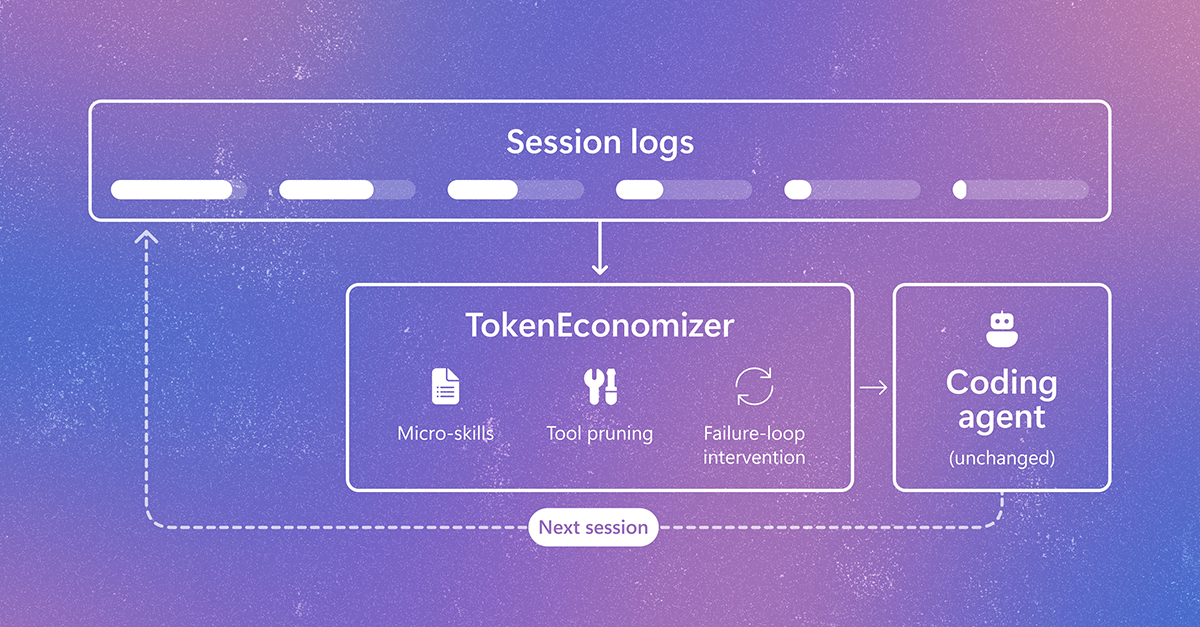
AI coding agents are increasingly help developers fix bugs and build features largely on their own, but every interaction with their models consumes tokens. In each session, an agent sends instructions, tool descriptions, and session history to its model. Most efforts to reduce this cost focus on individual tasks. Yet developers return to the same […] The post TokenEconomizer: Learning from Experience to Make AI Coding Agents More Efficient appeared first on Microsoft Research.
MIT News · Artificial Intelligence· news.mit.eduNov 13, 2026