Recent advances in large language models have made automatic game generation increasingly feasible, yet reliably improving generated games beyond a playable version remains challenging. Naive iterative refinement can easily overfit a small set of test cases, producing fragile games with unresolved bugs, missing behaviors, and poor generalization to broader player interactions. We introduce RSIGame, an autonomous agentic game development framework with recursive self-improvement. RSIGame organizes development into complementary local and global loops. Concretely, a local explore-diagnose-improve loop broadly explores the executable game, diagnoses and prioritizes discovered issues, and performs evidence-grounded revision, where an evolving checklist continually accumulates new testing and improvement guidance. A global loop tracks overall quality, preserves the best checkpoint, and detects saturation or regression over long-horizon development. Beyond test-time improvement, RSIGame further internalizes successful development experience into the generator through training. Across 140 GameCraft-Bench tasks, two game engines, and five generators, RSIGame consistently improves game quality under matched development budgets. Notably, experience internalization enables Qwen3.8-27B to reach 61.38 on Godot and 58.53 on Phaser, exceeding GPT-5.5 one-shot scores while reducing Qwen's generation tokens by 11 times.
It is found that Llama 3 delivers comparable quality to leading language models such as GPT-4 on a plethora of tasks, and performs competitively with the state-of-the-art on image, video, and speech recognition tasks.
This paper investigates developing real-world perception for active agents, proposes Gibson Environment for this purpose, and showcases a set of perceptual tasks learned therein.
F. Xia, Amir Zamir, Zhi-Yang He et al.· 2018 IEEE/CVF Conference on...· 1,069 citations· ⚡112
This publication proposes a definition and a classification of agile software development approaches and analyses ten software development methods that can be characterized as being "agile" against the defined criterion.
P. Abrahamsson, O. Salo, Jussi Ronkainen et al.· arXiv.org· 727 citations· ⚡54
Supporting data, adapters, predictions and code for the article *Low-Cost LoRA Fine-Tuning of Small Language Models for Multi-Step Arithmetic Reasoning* by Jake O'Grady, Asena Isik Gürhan, Chee Fong Ting and Effirul Ramlan (University of Galway). We generated 20,000 GSM8K-derived arithmetic problems with step-by-step s...
O'Grady, Jake, Gürhan, Asena Isik, Chee, Fong Ting et al.· Zenodo (CERN European Organi...· 465 citations
The results indicate that software engineering work practices are chosen opportunistically, adapted and configured to provide value under the constrains imposed by the startup context.
Nicolò Paternoster, Carmine Giardino, M. Unterkalmsteiner et al.· Information and Software Tec...· 394 citations· ⚡54
The possibility of inferring high-dimensional data inference in a model that consists of a prior and an auxiliary differentiable constraint given some additional information is considered, thereby allowing a range of potential applications in adapting models to new domains and tasks.
Alexandros Graikos, Esmeralda S. Whitammer, N. Jojic et al.· Neural Information Processin...· 316 citations· ⚡15
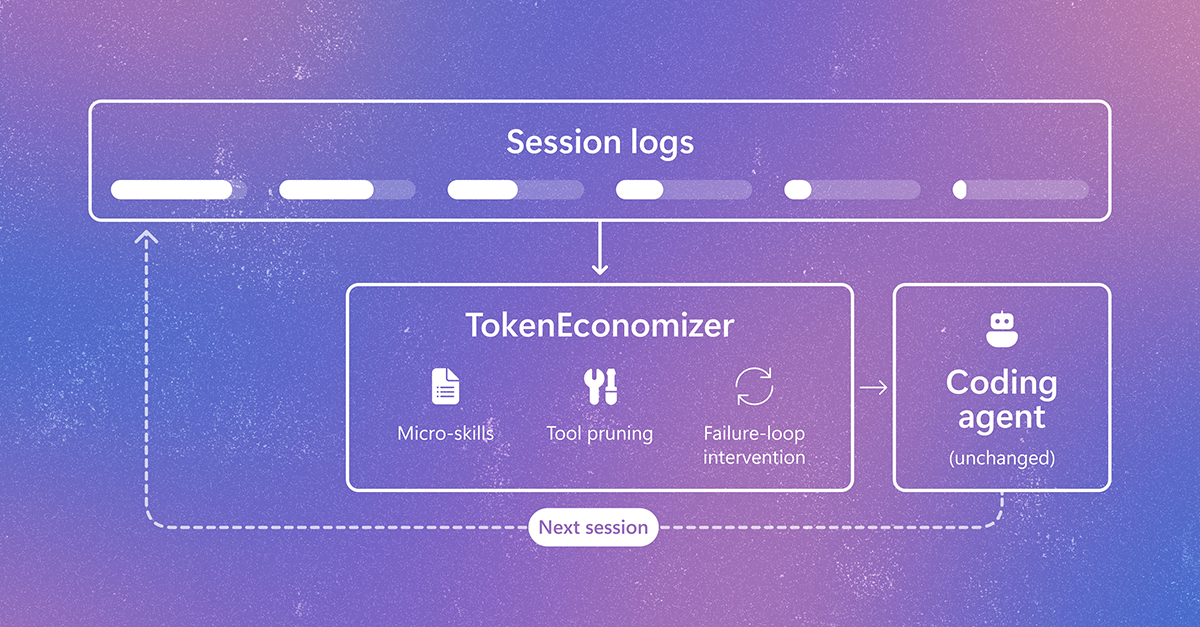
AI coding agents are increasingly help developers fix bugs and build features largely on their own, but every interaction with their models consumes tokens. In each session, an agent sends instructions, tool descriptions, and session history to its model. Most efforts to reduce this cost focus on individual tasks. Yet developers return to the same […] The post TokenEconomizer: Learning from Experience to Make AI Coding Agents More Efficient appeared first on Microsoft Research.
We use cookies to run the site and, with your consent, for analytics and to show ads.
See our Cookie Policy.