Skip to content

UBTree: Parallel Tree Drafting via Unigram and Bigram Models for Speculative Decoding

Sep 2026 · 0 citations · 47 references
Computer Science

Abstract

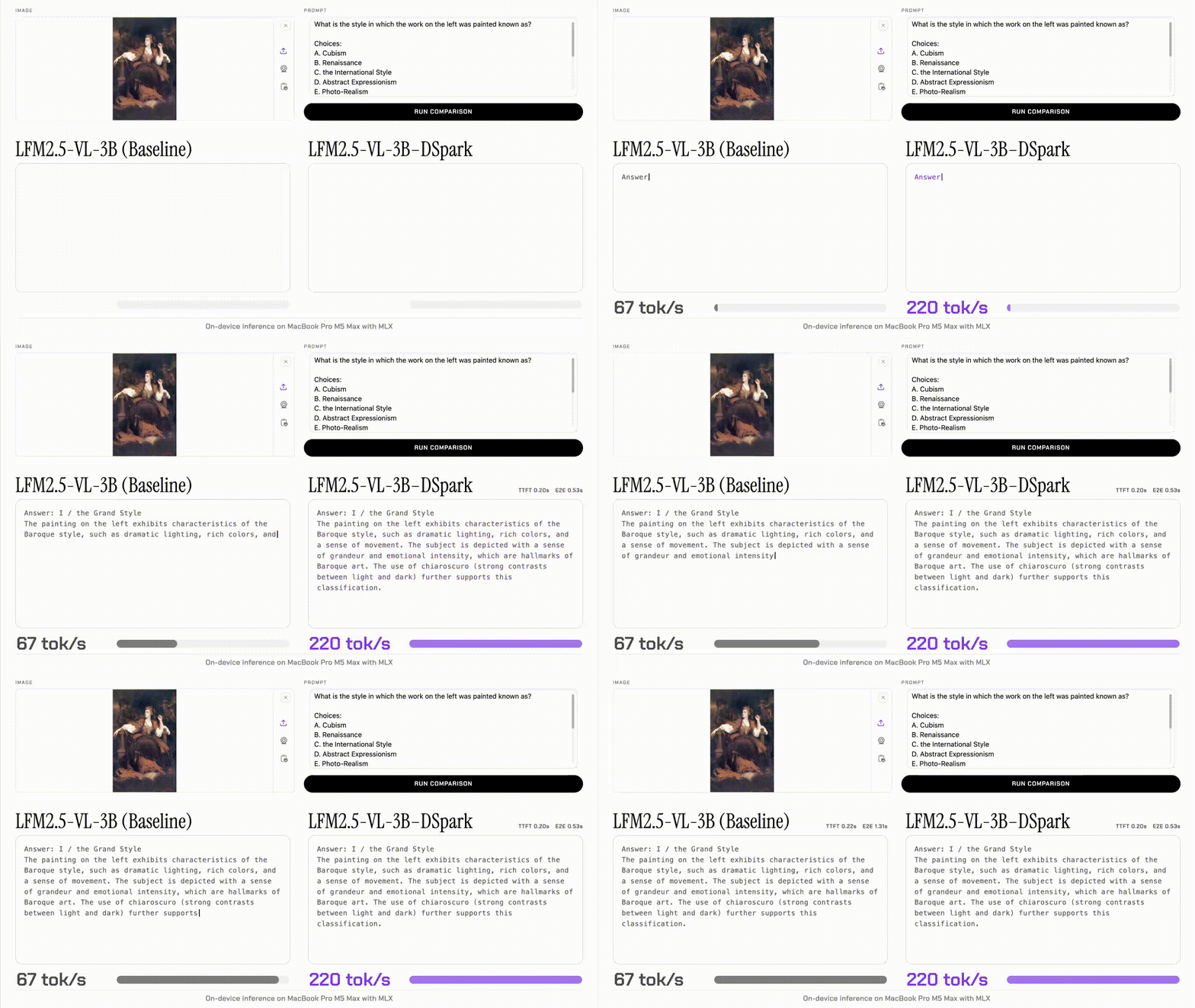
Speculative decoding accelerates language model inference by verifying multiple draft tokens in a single target-model pass. Recent parallel drafters have achieved breakthrough performance in frontier production models, but their effectiveness deteriorates as the entropy of target distributions increases due to insufficient draft diversity. To overcome this bottleneck without sacrificing parallelism, we introduce UBTree, a parallel drafter that couples a Unigram proposer with a Bigram selector to construct drafting Trees. The unigram proposer is trained with the standard cross-entropy objective to generate candidate tokens independently for each position, while a lightweight bigram selector predicts transition scores between adjacent candidate pairs. Unlike the proposer, the selector is trained with a renormalized KL objective on high-temperature data. This tree-native training broadens the supervision beyond the greedy path, encouraging plausible alternative branches that improve the chance of accepting additional tokens during tree verification. Across seven standardized benchmarks with Qwen3-4B and Qwen3-8B, UBTree achieves an average speedup of $5.84$--$6.94\times$ over autoregressive decoding and outperforms DARTree in all 28 comparisons. Production-scale evaluation further demonstrates UBTree's advantage over frontier baselines such as DSpark.

View source

Similar papers

#computer vision Review Sep 2017

Agile Software Development Methods: Review and Analysis

This publication proposes a definition and a classification of agile software development approaches and analyses ten software development methods that can be characterized as being "agile" against the defined criterion.

P. Abrahamsson, O. Salo, Jussi Ronkainen et al. · 727 citations · ⚡54
#computer vision Open access Jul 2017

What happens when software developers are (un)happy

Consequences of happiness and unhappiness that are beneficial and detrimental for developers' mental well-being, the software development process, and the produced artifacts are found.

D. Graziotin, Fabian Fagerholm, Xiaofeng Wang et al. · 236 citations · ⚡13
#computer vision Open access Oct 2004

Mobile-D: an agile approach for mobile application development

The Mobile-D approach is briefly outlined here and the experiences gained from four case studies are discussed, which helped develop an agile development approach for mobile application development.

P. Abrahamsson, Antti Hanhineva, H. Hulkko et al. · 225 citations · ⚡18
#computer vision Open access Mar 2014

Happy software developers solve problems better: psychological measurements in empirical software engineering

A study with 42 participants investigates the relationship between the affective states, creativity, and analytical problem-solving skills of software developers and offers support for the claim that happy developers are indeed better problem solvers in terms of their analytical abilities.

D. Graziotin, Xiaofeng Wang, P. Abrahamsson · 216 citations · ⚡13
#artificial intelligence Open access May 2023

Evaluating the Performance of Large Language Models on GAOKAO Benchmark

GAOKAO-Bench is introduced, an intuitive benchmark that employs questions from the Chinese GAOKAO examination as test samples, including both subjective and objective questions that contribute a robust evaluation benchmark for future large language models and offers valuable insights into the advantages and limitations...

Xiaotian Zhang, Chun-yan Li, Yi Zong et al. · 216 citations · ⚡17
#machine learning Review Open access Jun 2014

Why Early-Stage Software Startups Fail: A Behavioral Framework

This state-of-practice investigation was performed using a literature review followed by a multiple-case study approach and presents how inconsistency between managerial strategies and execution can lead to failure by means of a behavioral framework.

Carmine Giardino, Xiaofeng Wang, P. Abrahamsson · 175 citations · ⚡19

Related blog posts

MIT News · Artificial Intelligence Sep 24, 2026

Estimating suicide risk from text

A new language-processing tool could help identify the highest-risk individuals from natural language, enabling swifter interventions.

We use cookies to run the site and, with your consent, for analytics and to show ads. See our Cookie Policy.