Skip to content

SkillSpec: Consensus-Gated Agent Skill Evolution via Representation Specialization

Sep 2026 · 1 citation · 28 references
Computer Science

TL;DR

SkillSpec, a two-phase framework comprising consensus-gated evolution and representation specialization, is introduced, demonstrating that reliable skill evolution and representation specialization address complementary objectives: deciding what knowledge to retain and how to structure it for inference.

Abstract

Natural-language skills are textual procedural memories through which large language model (LLM) agents retain reusable task knowledge without updating model weights. Existing methods typically treat skills as either static artifacts or monolithic documents optimized using aggregate validation scores as feedback. However, representing a skill as a monolithic document restricts optimization to its textual content, without explicitly modeling the structure through which procedural knowledge is retrieved and executed. We identify a key distinction between learning what knowledge to retain and determining how to organize it: textual updates should first be validated through execution evidence, after which the retained knowledge should be structured according to its procedural dependencies and retrieval requirements. To this end, we introduce SkillSpec, a two-phase framework comprising consensus-gated evolution and representation specialization. In the consensus-gated phase, complementary editing intents generate complete candidate skills. An update is committed only when paired evaluations reach consensus, requiring sufficient overall improvement and non-negative aggregate paired gain in every repeated evaluation. In the specialization phase, signals of process and redundancy sensitivity derived from the full optimization trajectory, including accepted and rejected candidates, guide the selection of a flat, graph, or hybrid representation.Across six benchmarks and three target language models, SkillSpec improves average success rate over SkillOpt by 6.89%, averaged across the three models. These results demonstrate that reliable skill evolution and representation specialization address complementary objectives: deciding what knowledge to retain and how to structure it for inference.
View source

Similar papers

Preprint Oct 2026

MultiEvoSkill: Structure-Aware Multi-Agent Skill Evolution for Generalizable Skill Artifacts

Skill documents are becoming the default adaptation surface for frozen large language model (LLM) agents, but current skill generators face two key limitations. First, humans and different LLMs differ in how they organize procedural knowledge and approach task solving. Skills authored from a human or single-model persp...

Kounianhua Du, Jian-Xing Liu, R. Shan et al. · 0 citations

Rep2Skill: Representation-Guided Skill Self-Evolution for LLM Agents

Textual skills enable large language model (LLM) based agents to accumulate reusable procedural knowledge without updating model parameters. Yet existing skill evolution remains largely confined to the text space: an optimizer must diagnose success and failure patterns, and revise skills solely from long execution traj...

Kai-Xin Zhang, Chang-Ming Li, Ying-Dong Shi et al. · 0 citations

SkillFocus: Evolving Agent Skills via Capability Decomposition

Across four benchmarks spanning heterogeneous tasks, SkillFocus achieves the best held-out accuracy on all four, outperforming the strongest competing result by 5.7 points on average while using 24\% fewer evolution tokens on average than the closest iterative baseline.

Ning Wang, Z. Gong, Bing-Dong Li et al. · 0 citations
#natural language process... Preprint Oct 2026

Hierarchical Skill Evolution for Coding Agent

HSE progressively distills procedural knowledge from coding trajectories through hierarchical evidence aggregation, which evolves the skill library from target-benchmark trajectories without verifier feedback, relying solely on the learned evaluator for candidate assessment and achieving additional gains through benchm...

Jun Gao, Yun Peng, Chang-Hai Zhou et al. · 0 citations
Preprint Oct 2026

D-Skill: Distilling Teacher Knowledge through Agent Skills

D-Skill is introduced, a framework that treats the teacher as a black box and distills its behavioral advantage into an interpretable natural-language skill by analyzing paired rollouts and identifying behavioral divergences and agreements.

Shuo Yuan, Da-Cheng Li, Joseph Gonzalez · 0 citations
#artificial intelligence Preprint Oct 2026

AtomSearch: Evidence-Grounded Tree Search for Agent Skill Optimization

AtomSearch is introduced, which keeps revision actions local while using subsequent skill states to guide search, and shows how local rule edits can support the exploration of useful revision paths and yield compact skills, with additional offline evaluations used to explore alternative states.

Jiang-Shuai-Chen-Rui-,-Zhang-Rong-,-Wang-Gui-Fang- Tong, Sen Deng, Ming-Pei Peng et al. · 0 citations

Related blog posts

MIT News · Artificial Intelligence Nov 17, 2026

Learning the language of machine learning

By studying the computational foundations of language learning, Associate Professor Jacob Andreas builds intelligent systems that can communicate effectively with humans.

Microsoft Research Blog Nov 16, 2026

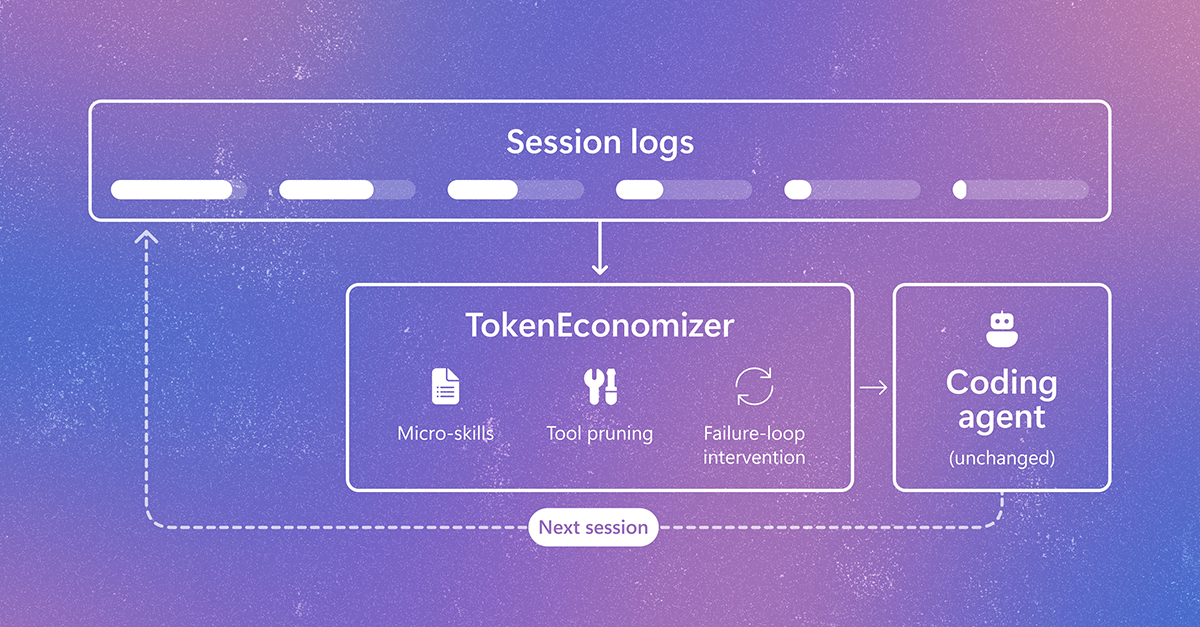
TokenEconomizer: Learning from Experience to Make AI Coding Agents More Efficient

AI coding agents are increasingly help developers fix bugs and build features largely on their own, but every interaction with their models consumes tokens. In each session, an agent sends instructions, tool descriptions, and session history to its model. Most efforts to reduce this cost focus on individual tasks. Yet developers return to the same […] The post TokenEconomizer: Learning from Experience to Make AI Coding Agents More Efficient appeared first on Microsoft Research.

We use cookies to run the site and, with your consent, for analytics and to show ads. See our Cookie Policy.